
L3Harris at Eurosatory 2026: night vision and distributed counter-drone priorities
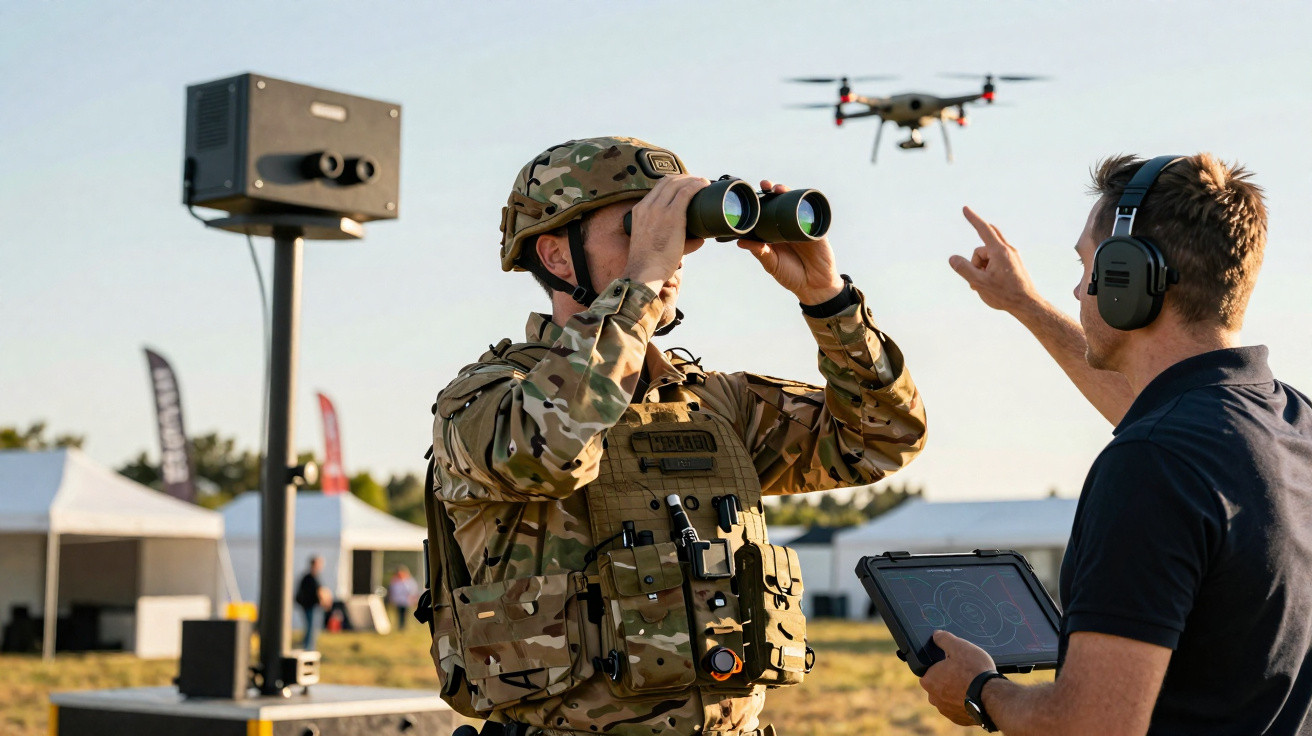
At Eurosatory 2026, L3Harris arrived with a line-up that mirrors what today’s battlefield is demanding: night vision that can be scaled and afforded in volume, alongside low-cost, distributed C-UAS options. Recognised worldwide for tactical communications and imaging, the firm used the Paris defence and security show to unveil NOVA, a new night-vision binocular, and Wraith Shield-a software enhancement that turns Falcon IV family radios into elements of a portable, intelligent counter-drone network.
Zona Militar interview: NOVA NVG and Wraith Shield C-UAS
Zona Militar spoke with Kevin Steubing, Vice President of Sales and International Business, and Brenna Baker, President of Integrated Vision Solutions at L3Harris Technologies. They outlined the latest on the NOVA NVG, the Wraith Shield C-UAS function, and what the company expects to achieve at Eurosatory 2026.
NOVA: Night vision binoculars for the entire force
NOVA is L3Harris’ newest night-vision goggle, developed as a commercial offshoot of the company’s work on the U.S. Army’s BiNOD (Binocular Night Observation Device) programme. Work started in 2021 with a straightforward aim: move away from ageing monocular solutions towards a cost-effective binocular system that can be issued at scale. In April 2026, the U.S. Army selected NOVA for the programme, awarding L3Harris a contract valued at up to US$465 million across seven years to manufacture the device.
The NOVA architecture centres on an integrated tube design intended to make upkeep simpler and to lengthen overall service life. It uses high-gain, unfilmed Gen 3 image intensifier tubes, with anti-bloom functionality included on the lower-gain versions. The casing is built to the IP68 immersion standard, and the unit is designed to power down automatically when folded into either the monocular or binocular configuration.
By using a binocular layout, NOVA improves depth perception, helping troops move more confidently and efficiently in complex terrain. It also incorporates an integrated illuminator to support threat detection in extremely low-light environments, while keeping weight down-an important factor for personnel expected to operate in the field for long periods.
To reduce the burden on supply chains and technicians, the system was also engineered with logistics and sustainment in mind, offering a set-up that can be adjusted to match operational requirements during servicing. L3Harris has also streamlined several design elements so that maintenance can be performed with less reliance on highly specialised staff.
In L3Harris’ positioning, NOVA sits alongside the company’s premium offerings-the GPNG, ENVG-B, and BNVD-which are typically allocated to special operations forces and units focused on direct-action tasks. With NOVA now in the catalogue, the company is aiming at the rest of the force structure: conventional soldiers, border patrol personnel, and tactical law-enforcement teams who often do not currently have access to high-end night-vision capability.
After supplying more than 20,000 ENVG-B systems to the U.S. Army, and with initial NOVA deliveries planned for the fourth quarter of 2026, L3Harris is continuing to reinforce and broaden its role as a major provider of night-vision systems to Western armed forces.
Wraith Shield: Tactical C-UAS protection
Wraith Shield is driven by a simple but disruptive idea: use software to convert the Falcon IV family of tactical radios-over 100,000 units fielded with the U.S. military, NATO, Five Eyes nations, and partner forces-into components of a portable counter-UAS capability, with no need to add extra hardware. The feature is enabled via a software update to the Wraith waveform, created in 2022 and 2023 with substantial contributions from Ukraine.
The capability works in partnership with DataShapes AI. Its GlobalEdge platform turns radio-frequency (RF) information collected by the radios into real-time, actionable intelligence at the tactical edge, without depending on cloud services or centralised processing. In practice, the radios already scan the spectrum to find other friendly radios using the Wraith waveform and then build a local ad hoc network. Wraith Shield extends this by detecting the signals opponents use to command drones, distributing that data across the local network, and synchronising the radios so they emit white noise on the same frequency-thereby interrupting the drone’s control link.
At present, Wraith Shield can synchronise concurrent jamming from up to 40 Falcon radios, which is sufficient for an infantry platoon. L3Harris intends to increase this to 100 radios through a future software update. The first radio to receive the capability is the compact RF-9820S (AN/PRC-171), while an embedded version for the RF-9820S-ER is scheduled for later in 2026. The upgrade will also be offered for other Wraith-compatible sets, including the AN/PRC-158C, AN/PRC-163, and AN/PRC-167. Wraith Shield is intended to fit into layered air-defence structures: it targets small drones using commercial control links, while larger solutions such as L3Harris’ own VAMPIRE and Drone Guardian are aimed at countering bigger and more advanced airborne threats.





Comments
No comments yet. Be the first to comment!
Leave a Comment