
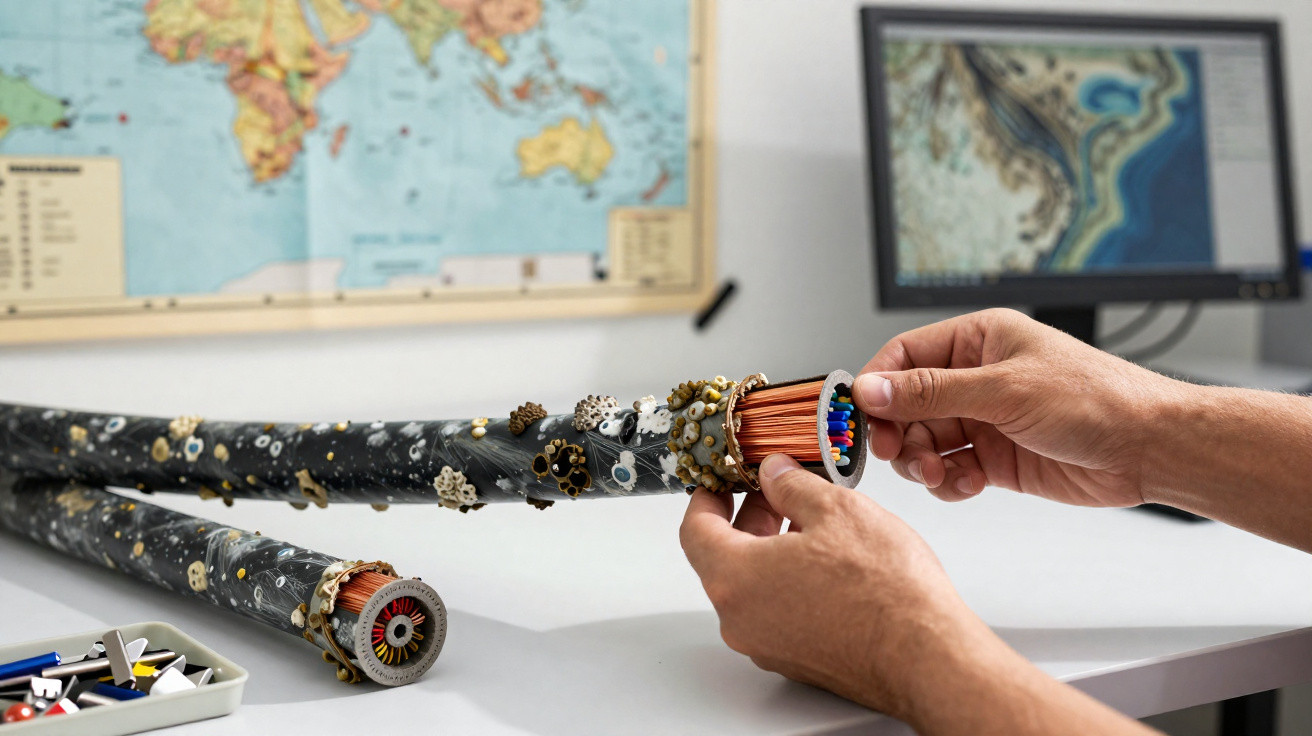
A specialist vessel is now lifting the first transatlantic fibre-optic cable ever laid from the seabed. The famed TAT‑8 linked Europe and the United States from the late 1980s and helped usher in an era of fast data exchange. Its story is ending, but not in a museum: instead, it is being turned into recycled feedstock for the digital infrastructure of tomorrow.
How a fibre-optic cable reshaped the Atlantic
In December 1988, telecoms companies from the United States, the United Kingdom and France embarked on what was, at the time, a high-risk undertaking: installing a new subsea cable between North America and Europe that no longer relied on copper, but on pulses of light carried through glass fibres. It was called TAT‑8, Transatlantic No. 8.
Where earlier systems had pushed electrical signals through metal, the new link sent rapid flashes of light through hair-thin strands of glass. Compared with the copper cables that came before it, this approach delivered many times the capacity. In 1988, it felt closer to science fiction than everyday engineering.
"For the first time, a cable designed specifically for fibre optics connected the continents - an invisible backbone for the later internet revolution."
Although the data rate looks tiny by today’s standards, it was extraordinary in 1988. In under 18 months, the connection was already running at full capacity. The operators took an unmistakable message from that experience: fibre optics would become the foundational technology of global communications.
That lesson shaped the subsea networks that followed. Today, thousands of fibre-optic cables span the oceans and carry most international data traffic - from video calls and streaming to banking transactions and cloud services.
Why the cable went dark after 20 years
Inside TAT‑8, the technology aged quickly. Newer cables could handle far more data, ran more efficiently and were easier to maintain. Eventually, repairing the old route no longer made economic sense.
In 2002, the operators switched it off. Since then, most of the cable has sat largely unused on the seabed - a mostly forgotten relic from the internet’s early years.
Its return to the surface now comes down to two drivers: valuable raw materials and rising expectations for digital infrastructure.
Precision work at several thousand metres depth
Recovering a retired subsea cable is nothing like a simple “hook it and haul it up” job. Many stretches lie several thousand metres down, sometimes across difficult seabed terrain.
The recovery vessel progresses methodically, section by section:
- locating the cable position using sonar and legacy charts
- lowering specialised hooks or grab tools to the seabed
- lifting the cable and winching it slowly on to the deck
- winding it by hand, metre by metre, on to large drums
- roughly separating materials on board and preparing them for recycling
Because the fibres inside are delicate, technicians wind the line carefully to avoid creating additional breaks. Heavy swell, crosswinds and shifting currents make each lift more challenging.
"The ship has to adjust its route constantly - storms and an early cyclone season repeatedly force the crew to divert."
Operations like this often run for weeks and cost millions. Even so, demand is growing, because vast lengths of old cable systems lie unused on seabeds around the world.
A raw-materials trove underwater: copper, steel and plastic
Even though fibre optics are the core: a subsea cable is far more than glass alone. Multiple protective layers, insulation and reinforcement sit around it - and many of those materials can be recycled.
| Component | Function | Reuse |
|---|---|---|
| Copper | Power supply, signal path | Feedstock for the electrical industry |
| Steel | Mechanical protection, tensile strength | Scrap steel for new components |
| Polyethylene sheath | Water and corrosion protection | Plastic recycling for new products |
| Glass fibres | Data transmission | usually not directly recycled, more often disposed of |
Copper, in particular, is in the spotlight. The International Energy Agency has been warning for some time about possible bottlenecks, as electric mobility, the energy transition and digitalisation all push demand higher. Every tonne recovered from old cables reduces pressure on mining.
Steel and plastics can also be reprocessed. The outer jacket becomes recycled polymers, while steel armouring turns back into industrial metal. For operators, the sums can add up: they reclaim raw materials and free up space for modern links.
Why fibre-optic cables remain essential despite satellites
When people think about global internet access, many picture satellite constellations first. Yet the vast majority of data moving between continents still travels through subsea cables. Estimates put the share at well over 90 percent.
The reasons are threefold:
- extremely high capacity per cable route
- low latency, meaning short ping times
- strong reliability for sustained, high-volume traffic
Satellites complement this infrastructure rather than replacing it. They excel in remote areas and for mobile use, but for bulk data such as streaming or cloud backups, they do not yet match fibre-optic performance.
"Without the nearly invisible cables on the ocean floor, global data traffic would collapse within seconds."
As old lines are removed and new systems are built, a second wave of subsea expansion is under way. New cables offer many times the bandwidth, use more energy-efficient repeaters and follow optimised routes to move data faster.
What happens to old cables in the sea
TAT‑8 is only a symbol of a much larger issue. Estimates suggest around two million kilometres of decommissioned subsea cable exist worldwide. A large share still lies on the ocean floor.
For each retired system, the same question arises: leave it in place, or recover it? The decision depends on several factors:
- the value of the raw materials inside
- accessible water depth and location
- the environmental impact of recovery
- how much space is needed for new routes
In deep, remote zones, many of these cables cause little disturbance and are simply left where they are. In heavily used sea areas - for example near coasts with dense shipping - decommissioning projects are becoming more common. New routes are not meant to be forced through a tangle of old lines.
What non-specialists should know about subsea cables
For most users, this all feels distant - an invisible system somewhere out in the ocean. A few points help put the scale into perspective:
- A modern transatlantic cable can carry tens of terabits per second.
- Even a single fibre within a bundled cable can provide more capacity than many older systems combined.
- Shipping companies and cable operators coordinate routes closely with fisheries, offshore wind farms and maritime traffic.
Faults are often caused by anchors, trawl nets or natural events such as landslides on continental slopes. When that happens, specialist vessels must lift the affected segment, repair it or replace it - similar in principle to the work now being done on TAT‑8, only far more time-critical.
What risks and opportunities the new recycling wave brings
Salvaging old cables also carries risks. Any intervention on the seabed stirs up sediment, can disrupt habitats and may temporarily burden local ecosystems. Specialist firms therefore plan operations in detail to minimise the area they disturb.
At the same time, a new sector is taking shape: companies are specialising in tracking down old lines that have long since disappeared from official charts. They assess the residual value of the materials and offer operators full packages covering removal, transport and recycling.
Governments and regulators, meanwhile, face a policy question: how strictly should the removal of legacy systems be required? On one hand, recycling profits and cleaner seabeds are attractive; on the other, such projects are expensive and demand technical expertise.
For users, the outcome is mostly indirect: more bandwidth and steadier connections delivered by newer, higher-performance cables. As a pioneer like TAT‑8 is lifted from the Atlantic piece by piece, the next chapter of the world’s data highways is quietly taking shape beneath the surface.




Comments
No comments yet. Be the first to comment!
Leave a Comment