
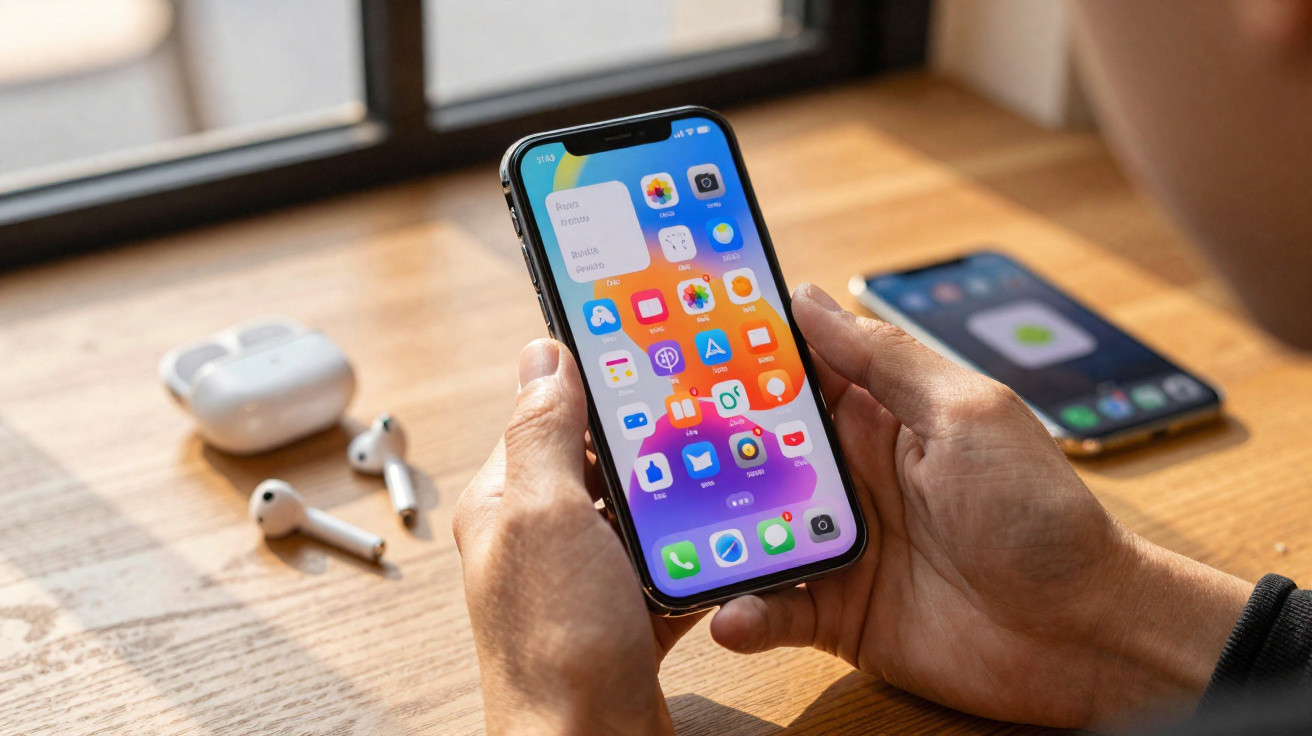
We tried the Oppo Reno 16 Pro: a smartphone that looks a lot like the iPhone 17, yet adds a dash of originality and runs on Android - enough, perhaps, to tempt iOS devotees.
After the X9 range, Oppo is now refreshing its Reno line-up. For the moment, the series includes two handsets: the Reno 16 and the Reno 16 Pro, which is the model tested here. The target audience is clearly stated: younger users first, but also influencers - and, above all, iPhone fans.
Despite its strong resemblance to the iPhone 17, the Reno 16 Pro differs in plenty of ways, starting with the fact it’s an Android phone. It also tries to look thoroughly up to date on paper, notably thanks to a 6000 mAh silicon–carbon battery (7000 mAh in China) paired with 80 W fast charging.
So does it have what it takes to win over Apple’s latest loyalists?
Price and availability of the Oppo Reno16 Pro
The Oppo Reno 16 Pro goes on sale from 3 July 2026, starting at €899. That launch price is temporary, rising to €1,099 from 31 July. Only two finishes are planned: Pop White and Starlight Black.
A small, cute design
If you’ve had enough of phones creeping towards 7-inch displays, the Reno 16 Pro 5G could be your kind of device. With a 6.32-inch screen, it stays fairly compact by today’s standards: 151.21 × 72.42 × 8.36 mm. That makes it only slightly larger than an iPhone 17, and roughly 10 g heavier (188 g on the spec sheet, 190 g on our scales with a SIM inserted).
The real differentiator is on the back, where Oppo has introduced what it calls HoloVerse 3D. It’s a multi-layer coating set with millions of micro-lenses designed to catch and reflect light. As that light returns to your eye, it animates a planet motif on the top layer, creating a holographic-style effect.
It’s genuinely distinctive - but you’ll only see it properly with a clear case, or by going without a case entirely. That feels a bit risky given the deep scratch that appeared on our review unit after only a few days. Oppo also doesn’t mention any Gorilla Glass-type protection to limit scuffs and gouges, although the handset is IP69K certified for water and dust resistance.
Aside from that small snag with the rear finish, the Reno 16 Pro’s build quality holds up well against its rivals. The edges sit comfortably in the hand, the camera bump is integrated into the same piece as the rear glass, the silver trim around the lenses adds a touch of elegance, and the buttons are easy to tell apart and simple to reach. There’s also a new control, the Snap Key - akin to the iPhone’s Action button - which we’ll come back to.
A lovely OLED display
On the front, the screen is framed by slim, evenly sized bezels, which helps the phone look particularly neat. On paper, the AMOLED panel is also well specced: 2640 × 1216 pixels (460 PPI), a variable refresh rate that can switch between 60, 90, 120 and 144 Hz, 10-bit colour, and peak brightness up to 3600 nits.
In real-world use, those numbers need a little context. By default, resolution is set to 2344 × 1080 pixels (which, truthfully, is perfectly adequate), while typical brightness tops out at 600 nits. For comparison, the iPhone 17 is rated at 800. That said, you’re unlikely to notice in day-to-day conditions because HBM brightness - the level that matters for outdoor use - reaches 1800 nits, versus 1600 on Apple’s handset. In other words, it sits towards the upper end of the segment, with good legibility even outside.
As usual, you also get eye-comfort options to cut blue light, plus several colour profiles of varying accuracy so you can fine-tune tone and saturation to taste.
Android with an iOS flavour
Apple influences aren’t limited to the Reno 16 Pro’s hardware styling. The software experience is heavily reminiscent of iOS too, though it’s built on Android 16 - which, for instance, means you still benefit from a full app drawer. Some will call it the best of both worlds and a smoother route between platforms; others will see it as imitation lacking originality. Either way, the interface is very smooth, feels modern, and comes with extensive personalisation options alongside a few extra features.
One of those is the Snap Key: a physical button you can map to one of eight shortcuts. In practice, a long press can be assigned to things like switching on the torch, taking a screenshot, adjusting ring volume, or launching the camera. We’d have liked the option to assign actions based on different press patterns and durations, but only the “Save to Mind Space” shortcut offers multiple actions. In my case, I set it to the torch - handy, though not something I use constantly.
LLMs also play a major role within ColorOS. You’ll find Gemini, Google’s AI assistant, including screen-reading functions, as well as Oppo AI. Oppo AI bundles three tools: an AI writer to edit text, AI translation, and a recorder with transcription and translation. Lastly, Mind Pilot is a chatbot that lets you converse with Gemini, Perplexity and GPT, although the exact models aren’t specified.
The most striking upcoming addition is audio sharing: the ability to connect two pairs of headphones to the phone at the same time, each with independent volume control - useful, for example, if you want to watch a series together on a train journey. We couldn’t test it, however, as it won’t be available until July 2026.
As is often the case on Android, the handset arrives with a fair number of pre-installed apps. Some are genuinely useful tools, but there are also duplicates many could do without (the web browser, for instance), plus around a dozen partner apps (Amazon Music, AliExpress, Netflix…).
On longevity, Oppo promises five years of major OS updates and six years of security patches. That’s slightly behind the very best (Apple, Samsung and Google), but still above average.
Gaming: it delivers
One of the iPhone’s key strengths is its chipset, which sits near the top of the class. Navigation feels effortless, and raw performance is excellent. To compete, Oppo needed serious horsepower, and it’s gone with the MediaTek Dimensity 8550 Super, paired with 12 GB of LPDDR5X RAM.
Whether exploring the open world of Genshin Impact or jumping into frantic online matches in Fortnite, the Oppo Reno 16 Pro can max out the graphics and keep frame rates both high and stable. We did notice the frame warming up quickly, although testing took place in 40 °C weather, which doesn’t exactly help with heat dissipation.
Photo and video
Compared with its predecessor, the Oppo Reno 16 Pro 5G drops the idea of a variable zoom in favour of a more conventional trio of fixed lenses. The setup includes a 200 MP main camera (f/1.8 with optical stabilisation), a 3.5× 50 MP telephoto (f/2.8 with OIS), and a 50 MP ultra-wide (f/2.0).
Factoring in digital zoom across the available focal lengths, the Reno 16 Pro offers a range equivalent to 16 mm through to 170 mm. It’s not as flexible as a Galaxy S26 Ultra, but it’s still very comfortable for framing what you want - and even at the longest digital zoom, quality remains respectable.
Overall results are solid without being truly jaw-dropping. Take the figurine photo in my sample set: autofocus locks on to the area around the crotch, while the helmet ends up slightly soft. The same thing happens on a shot of my cat, where the adorable nose is a touch less crisp than its fluffy little chest. In other images, dynamic range is pushed quite hard, leaving very dark areas. It does add character, but if you plan on post-processing, you lose information, which makes editing trickier.
In low-light scenes, the Oppo Reno 16 Pro tends to overdo illumination and colour. The outcome is detailed and punchy - bright, vivid and contrasty - but it can look far from true to life. It’s a particular style, and it’s well executed in its own way, yet it won’t suit everyone.
Up front, Oppo doesn’t hold back either. The selfie camera uses the same 50 MP sensor as the telephoto, paired with an 18 mm f/2.0 lens. The camera app also offers three different zoom levels, including an ultra-wide option for group selfies. Versatility isn’t its only advantage: quality is excellent, with notably sharp detail.
For video, recording goes up to 4K60. We did spot some issues with moiré effects and a shift in colour rendering when changing focal length. On the plus side, there’s a handy option to film simultaneously with the front camera and one rear camera for vlog-style clips.
Excellent battery life
Brands within BBK Electronics (the group Oppo belongs to) have broadly embraced silicon–carbon batteries. This technology can significantly increase capacity without making the battery physically larger. That’s how the Reno 16 Pro fits a 6000 mAh cell into a compact body - more than one and a half times the iPhone 17’s 3692 mAh.
Combine that with a SoC that manages power efficiently, especially on standby, and you end up with genuinely standout endurance. A camping weekend with no plug socket nearby shouldn’t be a concern for the Reno 16 Pro. In fact, with light use you could even edge towards three days without charging, which is a meaningful day-to-day convenience.
And if you do forget to top it up, it’s not a disaster. Thanks to 80 W charging (charger not included), you can quickly put back the missing charge and get on with your day.
Our verdict
Even though it takes a lot of inspiration from the iPhone 17, the Reno 16 Pro still retains its own character and distinct strengths. Battery life is undoubtedly its biggest asset, but it performs well across the board.
iOS users won’t feel completely lost, Android regulars will feel at home, and younger buyers will appreciate features designed with them in mind. Overall, it’s a strong success for its intended audience. The main drawback is the real-world pricing: it’s competitive at €900, but at €1,100 you can find better. It’s therefore worth buying on pre-order or during promotional periods.
Oppo Reno16 Pro
Price: €1,099
Overall score: 8.2
Design
7.5/10
Screen
8.0/10
Performance
8.5/10
Battery
10.0/10
Value for money
7.0/10
What we like
- Great battery life and fast charging
- Strong performance
- Lovely screen
- Good camera versatility
What we like less
- A bit too expensive outside promotions
- Photos can look unnatural
- Too many pre-installed apps





Comments
No comments yet. Be the first to comment!
Leave a Comment