
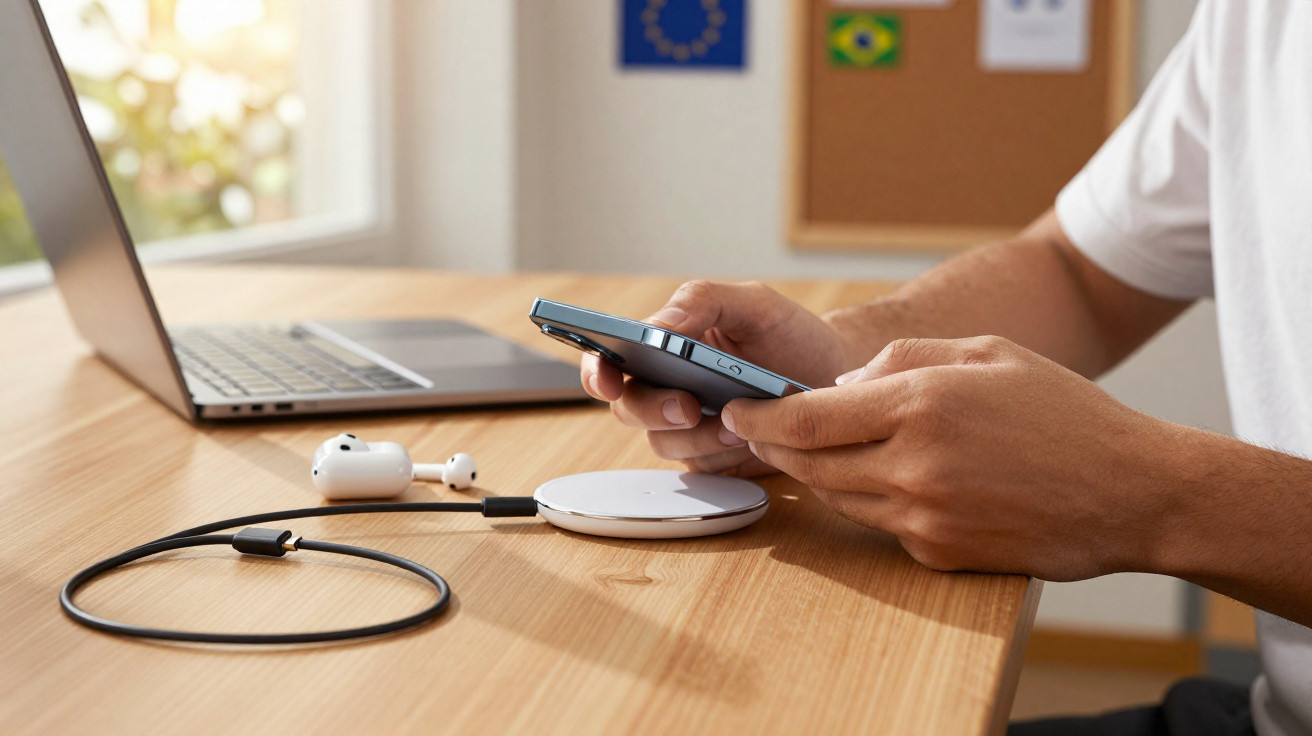
A modest tweak in Brussels is starting to echo in everyone’s pockets: the EU has just tightened the rules around how our gadgets charge, and the fallout could be far larger than the USB‑C badges on fresh packaging. By insisting on a shared wired connector and-more importantly-urging the industry to harmonise wireless charging, Europe has quietly made fully portless phones far more plausible. No flap. No opening. No pocket fluff. No lead. Just glass, metal, magnets and air.
In real life it already looks familiar. One lead fits the power bank but not the handset. Another tops up painfully slowly. A third is clearly meant for a laptop. Then, a couple of seats away, someone taps a magnetic puck onto the back of their phone, it clicks into place, and they keep scrolling like it’s routine.
It’s like seeing tomorrow turn up without fanfare.
And then the penny drops: the EU has just made that “tomorrow” much more likely. A brief rule with an outsized knock-on effect. Interesting, isn’t it?
USB-C was never the endgame - it’s the bridge
Here’s the irony. The EU’s “common charger” law effectively standardised the wired side around USB‑C, but it also gave the market a shove towards interoperable wireless charging. That second clause is the understated upheaval. If chargers speak the same “over-the-air” language, manufacturers can drop the cable altogether without marooning people in a chaotic, brand-specific accessory labyrinth.
In that light, USB‑C looks less like the finish line and more like a stepping stone towards a world where the port simply disappears. It’s odd and exhilarating-and slightly unsettling.
We’ve had previews already. Meizu’s “Zero” concept was bold enough to propose a phone with no openings whatsoever back in 2019. Apple’s MagSafe pulled magnets into the mainstream, and Qi2-the Wireless Power Consortium’s new magnetic profile-is now standardising that snap-on charging behaviour across brands. Industry reporting already puts the number of Qi-compatible devices in circulation at well over a billion, and it continues to climb by double digits year after year.
Walk into an airport shop and you’ll find pucks and pads sitting alongside cables. On desks, wireless “coasters” have become almost as common as pens. Most of us have witnessed it: a friend drops their phone onto a pad mid-conversation and never breaks stride. It becomes normal remarkably fast.
So why would manufacturers pursue portless designs? For a start, toughness. Remove the cut-out and you eliminate a frequent point of failure, improve dust and water resistance, and enable frames that can be slimmer without sacrificing rigidity. It also makes sealing easier when using recycled materials and can cut e-waste linked to corroded connectors. Commercially, a portless approach also helps limit counterfeit accessories and keeps the experience more controlled and predictable.
The downsides still matter. A wire remains quicker for moving large video files, for emergency recovery, and for professional workflows. This is where the EU’s position becomes pivotal: if a device doesn’t offer wired charging, the USB‑C requirement doesn’t apply; and if wireless is pushed towards interoperability, consumers still retain real choice. Different route, same goal-reliable, universal charging.
Living portless now: small habits that make it effortless
Begin by building a tiny “mesh” of chargers. Keep a Qi2- or MagSafe-compatible puck wherever you naturally pause: your desk, your bedside table, that kitchen spot you always lean on. Pair it with a slim magnetic power bank for commuting, and use a car mount that both holds and charges. For data, set up wireless ADB or Finder over Wi‑Fi on your laptop, switch on automatic cloud backups, and rely on Wi‑Fi transfer for photos.
That’s all it takes-no theatrics, just fewer snags.
Heat is wireless charging’s quiet adversary. Choose pucks with active cooling or decent airflow, and avoid burying them under books or wedging them behind routers. If your phone allows it, set charging to cap at 80% by default; then add quick top-ups during short breaks rather than “cooking” it overnight. And still keep one small USB‑C cable in your bag-not for your future portless phone, but for friends’ devices, earbuds and cameras.
Be realistic: almost nobody sticks to that perfectly every single day. Aim for “most days” and you’ll still notice the benefit.
Travelling changes the calculus too. A fold-flat 3‑in‑1 pad can replace a nest of chargers, and a universal plug adaptor keeps life simple across borders. Leave one puck in your suitcase so it doesn’t get stranded on the bedside table during the last-minute room sweep. If you shoot video, trial a wireless studio workflow before a big trip-rather than improvising once you’re already on it.
“Cutting the port isn’t about aesthetics. It’s about removing the weakest mechanical part of the phone,” a hardware engineer told me at a trade show.
- Choose Qi2-certified kit for improved alignment and better speeds.
- Turn on encrypted wireless backups on a schedule, not only when you remember.
- Build a recovery plan: a second device, passkeys and a cloud vault.
- Keep a compact USB‑C hub in your bag-you’ll still need it for everything else.
What a portless future really changes
Yes, the design looks cleaner-but the bigger shift is cultural. Work moves from “plug in and wait” to “sync and forget”. Public areas evolve into charging surfaces rather than just wall sockets. Audio defaults to wireless, cars feel more seamless, and phone cases start behaving like smart mounts and snap-on batteries. The boundary between “accessory” and “module” blurs: fewer cables, more clever attachments.
There is a serious catch worth arguing about. When a phone fails catastrophically, a wired connection is often the safety line. In a portless world, rescue tooling has to mature: quicker local Wi‑Fi restore, peer-to-peer transfers between devices, and NFC-based boot helpers in repair shops. Expect regulators to ask for that playbook just as forcefully as they pushed for USB‑C.
Right-to-repair campaigners will also press for simpler battery replacements and clearer longevity commitments to offset what’s lost when the jig and cable vanish. Sustainability doesn’t mean fewer features; it means better systems. The EU’s request to harmonise wireless charging looks minor on paper, yet it could trigger the biggest design shake-up since the headphone jack disappeared. And yes, the memes will be loud.
Once things settle, the debate won’t be “USB‑C or Lightning?” It will be “cable or no cable?” And after a month without digging lint out of a charging port, you’ll know your answer.
The truly striking part is this: the EU didn’t have to explicitly say “go portless” to push the market in that direction. Make wired charging universal, steer wireless towards a shared standard, and you get freedom with fewer headaches. Brands can build tighter and tougher devices; cities can install smarter tables; travellers can pack lighter. There’s a human rhythm here as well: we charge the way we live-little bursts between moments, not tethered to a wall like it’s 2013.
We all know that small spike of panic when a cable gets left at home. A portless future won’t eliminate panic, but it relocates the answers: into the air, into magnets, into software that covers you. On good days, you won’t register it. On bad days, you’ll feel it sharply. That’s why this shift deserves discussion over coffee, not only in specification sheets.
The EU has opened the door. What happens next depends on designers, tinkerers and the routines we genuinely keep. If you’ve tried a week of living without wires, you’ll know it’s less about gadgets and more about cadence-tiny habits that become automatic. Share what worked for you; someone reading this at a chaotic gate will appreciate it.
| Key point | Detail | Benefit for the reader |
|---|---|---|
| Wireless harmonisation | EU pressure converges on Qi2-style interoperable charging | Buy one puck, charge any modern phone |
| Portless compliance | With no wired port, the USB‑C rule doesn’t apply to the device | Design can be sleeker, tougher and simpler |
| New habits | Build a wireless-first routine for power and data | Less cable stress, more reliable day-to-day |
FAQ:
- When could phones go portless in Europe? Some niche models could appear within a year, with mainstream adoption following as Qi2 chargers and magnetic accessories become ubiquitous.
- Is the EU banning ports or USB‑C? No. The law requires USB‑C for devices that offer wired charging. It also nudges the market towards interoperable wireless, which enables portless designs.
- How do you recover a crashed phone without a port? Through local encrypted Wi‑Fi restore, peer-to-peer device transfers, or service tools at repair shops. Expect vendors to make these paths clearer and faster.
- Will wireless ever match wired speeds? For charging, Qi2 narrows the gap for daily use. For data, Wi‑Fi 6/7 and UWB workflows already move photos and edits quickly enough for many creators.
- Do my old chargers and cables become useless? No. USB‑C remains essential for laptops, tablets, cameras and accessories. Phones will still work with existing Qi pads; Qi2 just adds better alignment and stability.



Comments
No comments yet. Be the first to comment!
Leave a Comment