
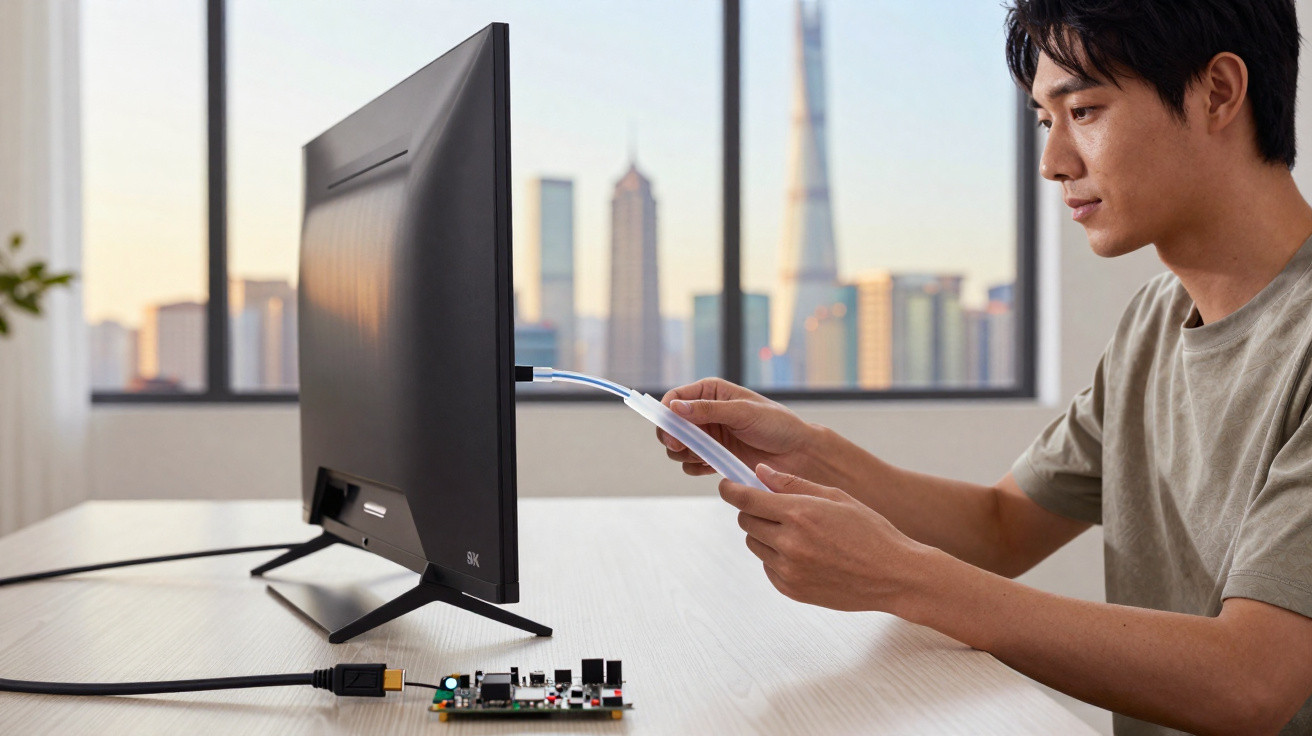
China has developed a new cable standard called GPMI, designed to bring multimedia interfaces together in one place (and, among other things, to put an end to the familiar old HDMI).
Back in the late 2000s, HDMI connections were only just becoming mainstream. Many people first encountered the format when plugging a brand-new PS3 into an HD Ready television (and, for some, even a Full HD set). This unassuming lead finally offered a crisp picture without fuss, taking over from the long-standing SCART connection. Since then, HDMI has quietly kept pace with the rise of digital entertainment, evolving in the background until it became a near-universal standard: ordinary, but still essential.
GPMI in China to shake up HDMI
In China, around 50 companies have pooled their efforts (through SUCA - the Shenzhen 8K UHD Video Industry Cooperation Alliance) to create a new standard: GPMI, short for General Purpose Multimedia Interface. The idea is a single cable that can carry video and audio, but also data and electrical power. In other words, one lead intended to handle everything.
Among the technology names involved in the GPMI project are Huawei, Lenovo, TCL, Skyworth and Hisense, and the proposition is enough to raise eyebrows.
GPMI: one cable for 8K 120 Hz video, data and power
The promise is simple: no more juggling different leads for video, power and data. Instead, one connection would be able to display an 8K 120 Hz image, supply power to devices, and potentially let them communicate with one another - all through a single port. Effectively, HDMI, a power lead and USB/Ethernet would be rolled into one.
GPMI connectors and specifications
On the hardware side, GPMI is set out in two flavours. There is a proprietary connector (Type-B, 24+4 pins) delivering 192 Gbps (four times more than HDMI 2.1) and up to 480 watts of power. There is also a USB Type-C version, which can reach 96 Gbps while providing up to 240 watts.
Looking ahead, China’s goal is for GPMI to become a global reference for multimedia interfaces, in the same way that USB and Ethernet are established worldwide.
It is also worth noting that GPMI can transmit enough energy to power a monitor or television directly, without any separate mains lead, while offering more power than USB-C - which could prove convenient.
Of course, for China, this is also a way to reduce reliance on Western technologies and to keep setting its own standards in strategic areas such as connectors, semiconductors, artificial intelligence and 5G.


Comments
No comments yet. Be the first to comment!
Leave a Comment