
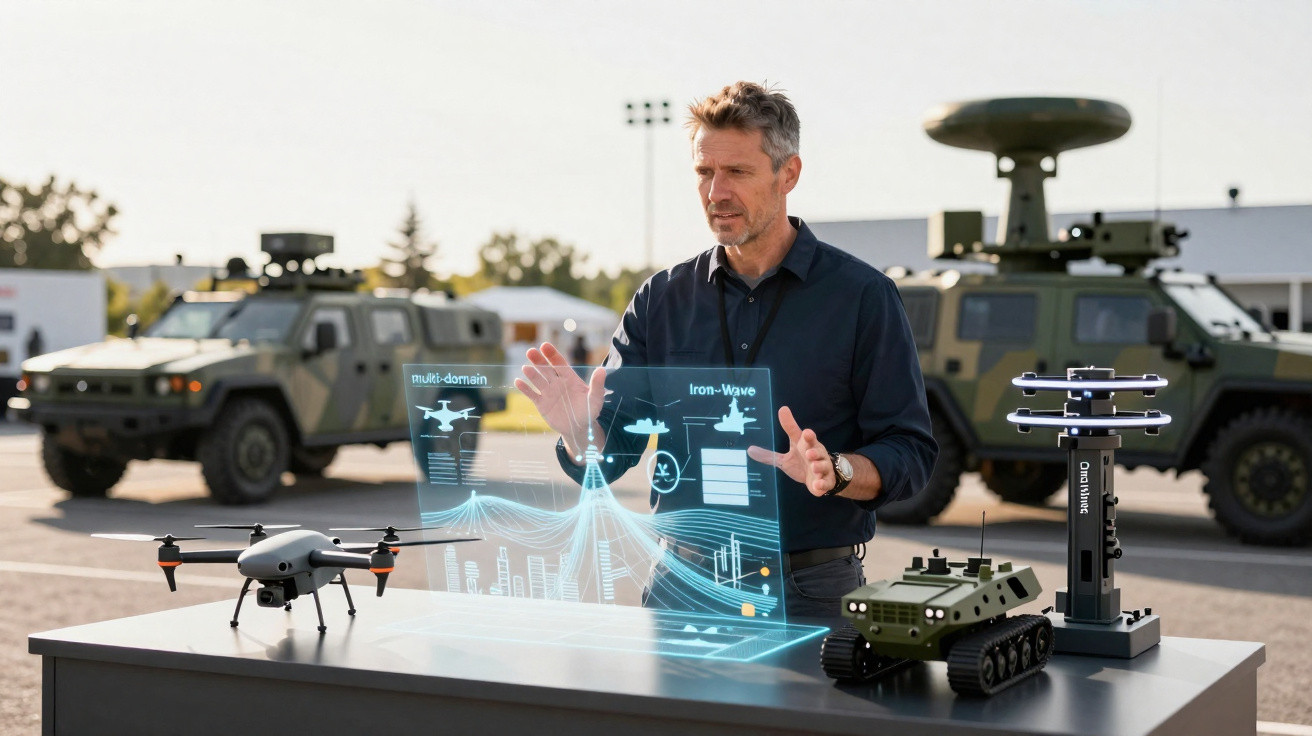
Zona Militar at Eurosatory 2026: interview with Patrick Houston (Ondas)
As part of our continued special reporting from Eurosatory 2026, Zona Militar spoke with retired U.S. Army Brigadier General Patrick Houston. He now serves as Chief Operating Officer (COO) and Chief Legal Officer (CLO) at the American firm Ondas, and he set out the company’s strategic direction, its key technology lines, and the overseas growth plans now underway.
Houston described Ondas as a United States company traded on NASDAQ, with a defence focus centred on autonomous technologies. He argued that the way current conflicts are unfolding has rapidly increased the uptake of systems that can act at speeds that outstrip conventional military decision cycles.
On how these capabilities are taking hold on today’s battlefields, Houston stated that “autonomous weapons are very different. They are the weapons that are currently being selected. They operate at the speed of data, and data literally travels at the speed of light,” pointing to the sweeping changes driven by automation, artificial intelligence, and networked connectivity.
Ondas’ strategy: five pillars and a Palantir partnership
Ondas, with a strong emphasis on autonomous systems and the fusion of multidomain capabilities, is working to establish itself as a leading supplier for modern operational settings. The company builds and integrates solutions for surveillance, strike tasks, ground robotics, and counter-drone defence, bringing together artificial intelligence, communications, and data processing into a single operational architecture.
Houston explained that the company’s approach rests on five core pillars. First, it seeks out and brings in combat-proven technologies-especially those that have shown results in theatres such as Ukraine and Israel, where much of today’s innovation is moving quickly. Second, it focuses on combining those capabilities into one integrated architecture that unites platforms, software, communications, and artificial intelligence.
Third, the strategy relies on collaboration with Palantir, which Houston characterised as Ondas’ most significant technology alliance. The aim is to fuse information, intelligence, and data drawn from multiple systems so commanders can gain stronger situational awareness and speed up, as well as improve, battlefield decision-making.
These efforts are reinforced by access to U.S. capital markets, enabling Ondas to fund acquisitions and add new technologies when the right strategic openings appear. The fifth pillar, Houston said, is the people: a sizeable share of the workforce is made up of military veterans who are used to operating in fast-moving and highly demanding conditions.
Product portfolio: surveillance, strike, ground robotics, and counter-UAS
At the show, Ondas presented a broad set of aerial surveillance systems, spanning everything from small drones up to stratospheric balloons. Alongside that, the company offers strike options including FPV drones, armed aerial platforms, and cruise missiles. It also showcased a range of ground robots in multiple sizes and configurations, with both armed and unarmed variants.
One of Ondas’ most rapidly expanding lines is counter-unmanned aerial systems. The company provides both soft-kill tools that can seize control of hostile drones, neutralise them, and compel them to land, and hard-kill options intended to physically remove the threat, either through interceptors or dedicated net-based solutions.
During the presentation, Ondas representatives said certain capabilities are already in use protecting critical infrastructure and major international events. Examples cited included systems deployed to safeguard stadiums during competitions linked to the 2026 FIFA World Cup, as well as solutions currently operating at European airports.
“Iron Wave”: a battalion-level system-of-systems container
Among the capabilities highlighted at Eurosatory, the “Iron Wave” system drew particular interest. It is designed as an all-in-one solution aimed at battalion-level units, built into a deployable container. Within that container, the company integrates armed ground robots that can transport drones, counter-drone functions, and a fully equipped command-and-control post to run operations.
According to Ondas, the purpose is to bring surveillance, strike, and force-protection functions together into a single system for deployed field units.
Describing the underlying concept, Houston explained that “what we provide is a system of systems,” underlining that Ondas is seeking to deliver a full, interoperable set of capabilities. He added that “we give them a list of options, a menu, and they choose the capabilities they want to incorporate,” stressing the modular, adaptable design philosophy behind the company’s offerings.
Demand signals, manufacturing realities, and international expansion
Asked about the rising requirement for counter-drone solutions, Houston said recent conflicts have made their strategic value clear. While the war in Ukraine initially demonstrated how drones can shape modern combat, he believes more recent developments in the Middle East have further strengthened the case for systems that can detect, disrupt, and neutralise them.
On production capacity, he noted that there is existing industrial capability that could be redirected towards manufacturing autonomous and electronic defence systems-particularly by leveraging facilities that previously served the automotive sector. Even so, he acknowledged that supply-chain limitations remain a significant obstacle.
Among the constraints he highlighted were limits on using components originating in China, driven by both security concerns and tightening regulatory demands in the United States and Europe.
Houston also confirmed that overseas growth is a central company priority. Ondas has already set up a major production site in Germany, created with a partnership involving one of the country’s leading manufacturing firms and located in a former automotive plant, to support NATO member states.
He added that Ondas is looking to widen its footprint into additional regions through local industrial partnerships, with Latin America among the areas it may consider.
“Our intention is to expand across Europe to support our NATO allies,” Houston said. He also stated that the company is assessing a move into the naval systems domain-an area where it does not currently have proprietary products, but which it views as a strategic market with meaningful growth potential in the years ahead.





Comments
No comments yet. Be the first to comment!
Leave a Comment