
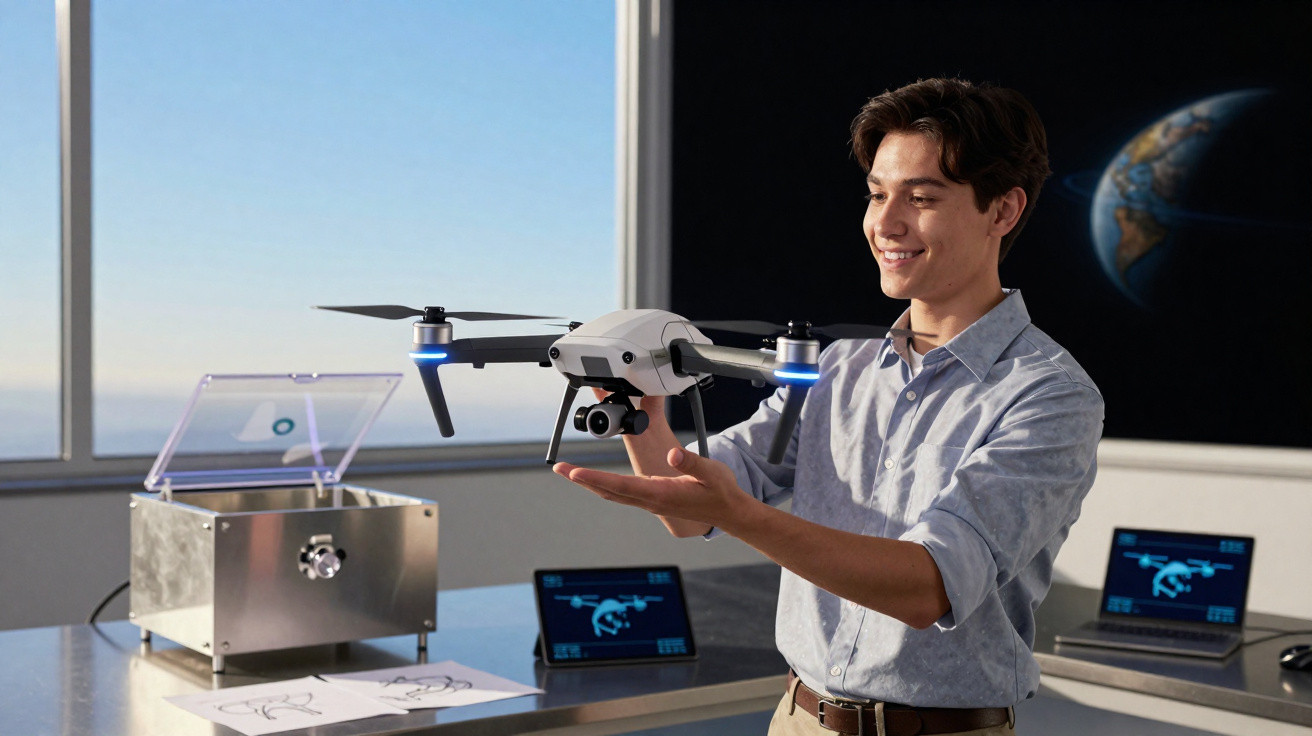
A newly built laboratory prototype overturns the usual rule by abandoning conventional aerodynamics for magnetic propulsion, and it keeps operating whether it is drifting through a draughty hangar or inside a quiet vacuum chamber.
The workshop carried a light tang of cutting oil and warmed acrylic as engineers rolled in a transparent cylinder about the size of a bath. Inside it, a small drone-streamlined, girdled with copper coils and edged with ceramic fins-lifted on a near-whisper in open air, then dropped neatly onto a stand as if it belonged there. The technicians clamped the chamber shut, the pumps spun up, and the sharp hiss softened into a low rumble you could feel through your chest. On a laptop display, the team tracked the readouts: pressure falling, status lights flickering, and a faint blue halo sliding around the drone’s rim. The craft rose again-this time with no air to push against. Then everything went quiet.
A flying paradox, untangled
This is why the prototype feels like it breaks common sense: aircraft depend on air, and space provides none. The engineers sidestepped that problem by changing the underlying physics as conditions change-using electromagnetic fields to draw thrust from ions when atmosphere is present, and switching to plasma acceleration when it is not. What moves with no air to push?
During public demonstrations, the routine is deliberately simple. The drone climbs slowly and smoothly to two metres in open air, holds position, then descends under control onto a platform that slides into a vacuum chamber. Once the chamber reaches near-space conditions, it takes off again. In a pressurized chamber pumped down to 10^-4 mbar, the craft slid sideways on command and rose 30 centimeters, all on electromagnetic thrust. The prototype has a mass of about 380 grams, draws roughly 120 watts in air and 140–180 in vacuum bursts, and remained airborne for just under eight minutes on a compact lithium battery. A student watching from the corner silently mouthed wow.
Propellers generate momentum by pushing on air; the challenge here is producing momentum without any blades. In atmosphere, the drone relies on electroaerodynamic acceleration: it forms a corona around very thin emitters, pulls ions forward, and drags neutral air with them, while shaped magnetic fields near the rim help steer the flow. In vacuum, it shifts to micro-propellant operation-minute pulses of inert gas are ionised and fired through a magnetic nozzle-so each joule produces thrust by accelerating its own plasma mass. It is the same airframe across both regimes, managed by one controller that merges the handover in milliseconds.
How the drone’s hybrid magnetic drive actually works
It helps to think of the system as having two distinct “personalities”. In air mode, carbon needles arranged around a ring generate a high-voltage corona that charges surrounding molecules; magnets positioned behind ceramic struts shape that ionic wind into a downward jet, without any propeller blades. In vacuum mode, the drone cracks open a pinhole argon reservoir, ionises a tiny amount, and uses a pulsed coil to drive the plasma through a magnetic throat and out of the rear. In air it pushes on ions; in vacuum it throws its own ions. The flight computer monitors pressure and field behaviour, then selects which “muscle” to use.
The team also had to deal with practical problems. In humid spaces, electrical arcing is a persistent nuisance, while heat build-up can damage the coils if the pilot holds full thrust for too long; their answer is duty-cycled pulsing plus a ceramic heat spreader that turns a dull orange after a hard sprint. Another headache is electromagnetic interference-radio control links do not enjoy it. They created quiet timing windows for control packets and wrapped the power bus in copper shielding that resembles origami armour. It is, frankly, not standard drone engineering.
“You can feel the moment the air stops being part of the equation,” one engineer told me, eyes fixed on the pressure readout as though it were a pulse. They are well aware of the questions critics will raise: thrust-to-weight, endurance, and whether it can be repaired outside the lab. The responses are careful and systematic rather than showy, which is usually a sign you are seeing hardware, not a highlight reel.
“We didn’t set out to beat propellers. We set out to remove them from the places they can’t go.”
- What’s new: one airframe that can fly in both air and vacuum, with no moving rotors.
- Why it matters: inspection work near spacecraft, exploring lunar caves, high-altitude laboratories, and cleanrooms.
- What’s next: higher energy density, improved coil cooling, and more intelligent mode switching.
What this could unlock next
Consider the tasks that sit in the in-between territory of Earth and space: surveying lunar lava tubes for a future habitat, drifting through the interior of a satellite to inspect components without kicking up dust, or mapping a comet cavity where a propeller would simply chew up regolith. A drone that breathes air when it can and brings its own “air” when it can’t changes the map. Most people have experienced the moment a tool suddenly works somewhere it never could before-and your mind redraws a boundary you assumed was fixed.
| Key point | Detail | Why it matters to you |
|---|---|---|
| Hybrid magnetic propulsion | Electroaerodynamic thrust in air; micro-plasma thruster in vacuum | Understand how one craft flies in two seemingly impossible environments |
| Lab-proven demonstration | Take-off in open air and in a 10^-4 mbar chamber on the same flight day | Signals this is more than a concept render |
| Emerging use cases | Spacecraft inspection, lunar caves, high-altitude science, sterile environments | Helps you picture practical value, not just impressive technology |
FAQs
- Can it truly “fly” in a vacuum? Yes-by switching to a plasma microthruster that expels ionized gas, it produces real reaction thrust with no air present.
- What powers the system? A compact lithium battery for the demo; future versions could tap tethered power or onboard packs with higher energy density.
- Is it safe around satellites and sensitive instruments? The team uses shielded electronics and low-particulate operation; magnetic fields are localized, and thrust can be dialed down for close work.
- How long can it stay aloft? Current tests show about 7–8 minutes mixed-mode; endurance improves with lighter frames, cooler coils, and smarter duty cycles.
- When could this leave the lab? Prototypes exist now; field pilots for vacuum-adjacent tasks could appear within 12–24 months, with space-rated platforms later.






Comments
No comments yet. Be the first to comment!
Leave a Comment