
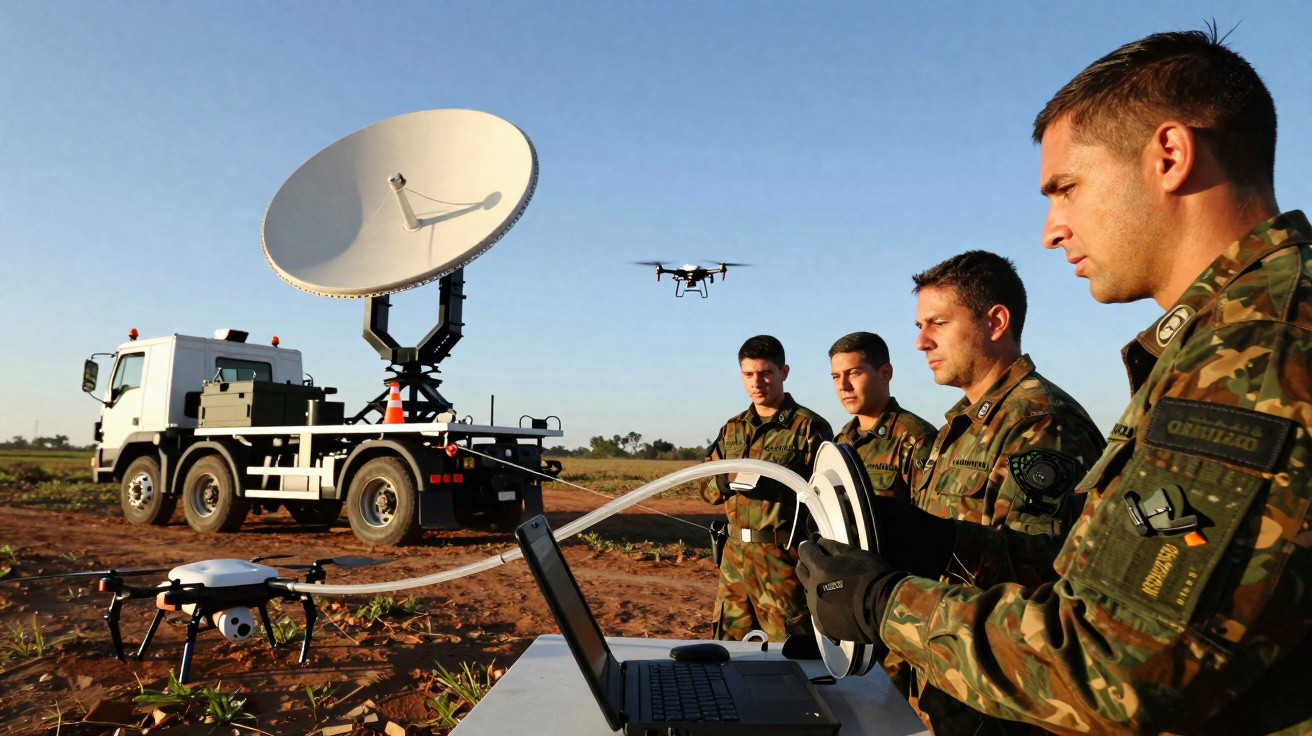
The trial, run by the US defence-technology company Epirus, signals a fresh turning point in the push to counter military drones that are becoming tougher to defeat on today’s battlefields.
Leonidas steps beyond traditional drone jamming
Epirus says its Leonidas high-power microwave system has, for the first time, neutralised a drone that was controlled via a fibre‑optic cable rather than over radio waves.
That distinction is crucial. Most counter‑drone tools go after the radio connection between the pilot and the aircraft. By jamming or spoofing that link, defenders can make a drone crash, return to its launch point or become uncontrollable. Fibre‑optic first‑person‑view (FPV) drones avoid that weakness entirely because neither their control inputs nor their video feed depend on radio transmissions.
Rather than trying to disrupt communications, Leonidas targets the drone itself. It projects carefully shaped bursts of electromagnetic energy at the aircraft’s electronics. If the energy couples into the circuitry, processors, sensors or power‑management components can malfunction, effectively stopping the drone mid‑flight.
Epirus claims Leonidas can render jam‑proof drones useless by directly disabling their onboard electronics with tightly focused microwave pulses.
Epirus also emphasises that Leonidas uses non‑ionising radiation, avoiding the health concerns associated with ionising sources such as X‑rays. Using a phased‑array antenna, operators can concentrate the beam onto a specific point in the sky, helping to reduce unintended impacts on nearby equipment and personnel.
How the Leonidas platform works
Leonidas is a directed‑energy weapon based on high‑power solid‑state microwave technology. Instead of a single discharge, it delivers extremely fast pulses-thousands each second-while steering the effect electronically, without physically moving the antenna.
The heart of the system is a digitally beamformed antenna array. By tuning the timing and phase of the signal sent to each array element, Leonidas can shape and point the beam with a degree of control that mechanical radar dishes or fixed emitters cannot provide.
Modes of operation and deployment options
Epirus supplies Leonidas in fixed and mobile variants. It can be fitted to a lorry to shield manoeuvring forces, or installed at a base to protect critical sites.
- Narrow-beam mode: concentrates energy on one drone, even when the airspace is cluttered.
- Wide-beam mode: distributes energy across a larger volume, intended to engage several drones simultaneously.
- Networked mode: connects to command‑and‑control software to cue, track and engage targets automatically.
In an earlier demonstration, Leonidas was shown defeating a swarm of conventional drones. The new test pushes that concept towards a more challenging target set-drones that are unaffected by classic radio‑frequency jamming.
The same hardware can switch from picking off a single quadcopter to washing an entire air corridor in disruptive energy.
Leonidas is built on an open‑systems architecture, allowing it to plug into a range of existing military command networks. As a result, it can take target information from radar, electro‑optical sensors or other drone‑detection systems, then respond with directed energy rather than missiles or gunfire.
Why fibre-optic drones are so hard to stop
Fibre‑optic‑guided FPV drones have gone from a laboratory novelty to a frontline tool in only a few years. Instead of broadcasting control signals through the air, the operator remains connected through a thin fibre cable that unspools as the aircraft flies. Video, commands and telemetry travel down that line, bypassing the surrounding electromagnetic environment.
In conflicts such as the war in Ukraine, this has become a growing headache for defenders. Russian and Ukrainian forces alike have been experimenting with one‑way attack drones, long‑range reconnaissance runs and precision strikes, all guided over fibre.
Ukrainian officials say Russian units are already fielding fibre‑optic FPV drones with ranges of around 50 km (31 miles). That reach gives operators the ability to threaten supply routes, ammunition dumps and staging areas that were previously seen as beyond the practical range of cheap, small drones.
Traditional electronic-warfare trucks blasting out jamming signals simply do not affect a drone whose lifeline is a cable instead of a radio link.
Epirus chief executive Andy Lowery argues that this creates what he calls an “operational gap” in today’s counter‑UAS (unmanned aerial system) defences. Radar can still detect the aircraft, and acoustic or optical sensors can follow it, but familiar electronic‑warfare techniques have little leverage once the drone is physically tethered to its controller.
Closing the gap with directed energy
Directed‑energy systems such as Leonidas are intended to close that gap by shifting from signal denial to hardware disruption. Rather than attempting to block or confuse communications, the goal is to damage the key components that allow the drone to function.
| Threat type | Control method | Typical countermeasure | Leonidas approach |
|---|---|---|---|
| Standard FPV drone | Radio link | Jamming, GPS spoofing | Microwave disruption of electronics |
| Fibre‑optic FPV drone | Fibre cable | Limited options, often kinetic fire | Targeted high‑power microwaves |
| Drone swarm | Networked radio | Area jamming, air defence guns | Broad-beam electromagnetic pulses |
This shift affects how forces may structure layered defence. Rather than depending only on kinetic interceptors-such as missiles or anti‑aircraft guns-units could pair them with directed energy to conserve munitions and respond more quickly to mass drone attacks.
Safety, collateral effects and real-world use
Any system that radiates energy invites questions about unintended harm. Epirus says Leonidas relies on non‑ionising radiation and tightly directed beams designed to minimise collateral effects.
Non‑ionising radiation lacks the energy needed to strip electrons from atoms-the process associated with radiation sickness and some cancers. That does not make it risk‑free in every context, but it places it in the same broad category as mobile phone signals, Wi‑Fi and radar, rather than X‑rays or gamma radiation.
By controlling the beam precisely, Leonidas is intended to reduce the chance of interfering with friendly electronics or endangering nearby personnel. That accuracy is particularly relevant in urban settings, where defenders may need to stop incoming drones without damaging surrounding infrastructure.
For militaries facing large numbers of low‑cost drones, directed-energy systems promise repeatable shots without depleting missile stockpiles.
Practical uncertainties still apply. Weather, terrain and congested electromagnetic conditions can influence performance. Drones that are heavily shielded or hardened may also demand higher power, repeated engagements or multiple systems working in concert. Deploying the technology widely also means handling power generation, cooling and maintenance under harsh field conditions.
What high-power microwave weapons actually do
High‑power microwave (HPM) weapons are not the same as lasers, which concentrate light into a narrow wavelength. HPM systems instead deliver broader‑band electromagnetic pulses aimed at electronic circuits.
When those pulses couple into wiring or antennas, they can generate unwanted voltages and currents. Delicate microchips may glitch, reboot or fail completely. In some cases, protective parts such as surge suppressors can burn out, leaving the rest of the device more exposed to subsequent pulses.
Military engineers often harden major platforms-such as fighter aircraft or large drones-against these effects. Smaller hobby‑style drones, typically built from commercial components, usually do not have that level of protection. Fibre‑optic FPV aircraft seen on current front lines tend to sit closer to the hobby end of the spectrum, even when modified for combat tasks.
Potential wider uses and risks
The same core technology could be applied beyond active warzones. Governments have discussed using HPM systems to defend airports, power stations or government facilities from hostile drones. Security teams could also deploy them temporarily around major events, stopping intruding aircraft without firing bullets.
There are downsides. If high‑power microwaves are used without adequate control, they could interfere with civilian electronics, from communications equipment to medical devices. Export controls and arms‑control debates are likely to intensify as more nations field similar capabilities. Accountability is another challenge: assigning responsibility for damage caused by invisible radiation can be harder than identifying a missile fragment.
For now, Epirus’s demonstration highlights a wider direction of travel. As drones adopt new ways to evade interference, defenders are shifting from jamming the link to attacking the drone’s hardware. Directed‑energy systems such as Leonidas sit at the centre of that change, offering rapid, repeatable engagements against aerial threats that no longer depend on the airwaves.





Comments
No comments yet. Be the first to comment!
Leave a Comment