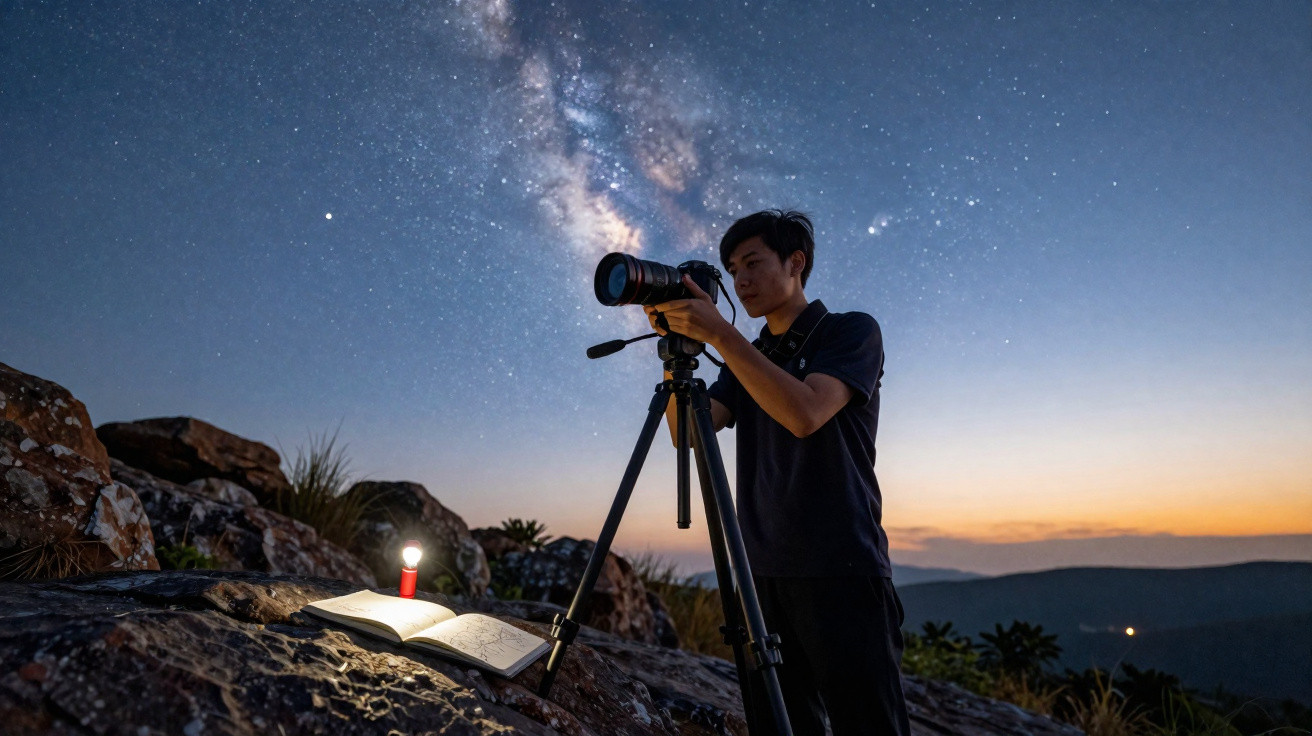
Sony night photographers have found a fresh fixation: a fast 35mm lens that renders stars like crisp points on a page. The Viltrox AF 35mm f/1.2 LAB FE is filling feeds with remarkably clean Milky Way images. Viewers are enlarging them to 200% and still seeing pinpoint detail.
One photographer in a puffer jacket aimed a Sony A7 IV towards Orion, murmuring, “Come on, show me the corners.” Dim stars emerged on the live view, the shutter fired with a thud, and he grinned as though he had recovered a forgotten password.
At the car, he opened the image file. The stars retained their form well into the edges, while the dust lanes appeared like fine calligraphy. Laughing, he almost whispered the lens name as if it were an incantation. What exactly is this lens doing at f/1.2?
That evening, he posted a crop. Comments flooded in, and the momentum quickly grew.
The Viltrox AF 35mm f/1.2 LAB FE makes the night sky feel nearer
The Viltrox AF 35mm f/1.2 LAB FE is gaining serious attention online for good reason. On full frame, a 35mm focal length occupies a useful middle ground for the Milky Way: broad enough to include the arch, yet narrow enough to reveal meaningful detail. At f/1.2, the sky can deliver more signal than noise.
The excitement goes beyond specifications. It comes from the real-world results photographers are sharing at 1 a.m. One desert photographer published 10-second exposures at ISO 6400, with corner stars remaining stars rather than turning into tadpoles. Another creator stacked six frames from a suburban garden, and the dust lanes looked as though they had been pressed flat.
Some of the appeal comes from disciplined optics rather than sheer brightness alone. Fast 35mm lenses can spread the outer image field with sagittal coma. Early image sets suggest this model keeps highlights controlled, without wings shooting from them. Stopping down to f/1.8 can still bring added crispness, but the fact that shooting “wide open” is a viable option says plenty.
Achieving needle-sharp stars at f/1.2
At night, focus is everything, and the process needs to be exact. Choose a bright star, magnify the view to 10x, then adjust manual focus until it becomes the smallest point rather than the brightest blur. Commit that position to muscle memory and secure it with a light touch on the lens barrel.
At 35mm on full frame, test exposures of 8–12 seconds to limit trailing, then choose whether to stack frames or raise the ISO. Everyone has seen a disappointing histogram and felt tempted to extend the shutter speed endlessly. Honestly, though, no one does that every night.
Temperature matters, dew matters, and the corners reveal every weakness. Keep a compact lens warmer close by, and photograph in RAW with long-exposure noise reduction switched off to retain faint stars. For cleaner files, capture a flat, a dark and several light frames to stack later; the lens supplies the signal, while you shape the result.
“I used to babysit corners at 200% and still apologize for coma. With the 35 1.2, I’m apologizing a lot less.”
- Begin at f/1.2 for maximum signal; test f/1.8 if you prefer tighter corners.
- Use ISO 3200–6400 and 8–12 s, then stack 5–10 frames for greater depth.
- Focus manually using magnification, then check the result on a second star.
- Disable stabilisation when using a tripod to prevent minute drift.
- Assign focus magnification to a custom button so you are not navigating menus in the dark.
Why this lens feels different
Photographers are not responding to a laboratory chart; they are responding to what becomes possible on an ordinary Tuesday night. A fast 35mm allows land and sky to be balanced without the distortion of an ultra-wide lens. Its perspective changes when you move a few steps, encouraging visual storytelling rather than simply collecting stars.
Its built-in versatility is also exciting travel photographers. The same lens that photographs the Milky Way above a pier can capture portraits at dawn and street scenes at midday. Its rendering remains crisp, while its speed is useful in daylight and darkness alike.
Viltrox has gradually moved from being a “budget surprise” to a “legit contender”. The brand has added coatings that resist colour shifts, aspherical and ED elements where they matter, and flare control that makes bright stars less intimidating. Discussion also points to a declickable aperture ring, a weather-gasketed mount and firmware updates-small practical details that matter when sand and time are working against you.
Field notes for tonight's shoot
This approach can keep your files consistent. Compose the Milky Way core at 35mm with a strong foreground form, place the brightest star on a third, and meter for the sky rather than the ground. Expose to the right without clipping highlights, take a quick foreground bracket, then construct the composite later with a gentle touch.
Typical mistakes? Perfecting focus at f/1.2, then brushing the focus ring while recomposing. Or starting the lens warmer too late and watching the glass fog during a sequence. Take your time. Once focus is set, mark it with a tiny piece of low-tack tape. Your future self at 3 a.m. will send you a thank-you emoji.
Colour deserves attention too: night is not automatically blue, but full of subtle tones. Choose a neutral white balance around 3800–4200K, then refine it in post-production so stars remain white rather than cyan. If your camera displays “star eater” behaviour during long exposures, use shorter exposures and stack images to maintain detail.
“The big win isn’t just more light, it’s cleaner light. I can spend time directing the scene instead of firefighting aberrations.”
- Pack a small red light; blue light will ruin your night vision.
- Take a microfibre cloth, since dust becomes obvious at f/1.2 around point light sources.
- Photograph a quick lens-profile frame against dusk to correct vignetting later.
- When tracking, reduce to ISO 1600 and target 30–60 s, while watching for wind.
- Label stacks when importing files; organised folders make later edits easier.
What the excitement suggests next
This feels like more than a single-lens moment. A 35mm lens that controls stars makes narrative night photographs more accessible, rather than limiting photographers to proof-of-sky shots. It reduces the barrier for people dividing their time between city life and dark-sky weekends, when cloud cover can change plans quickly.
It also shifts the discussion towards practical excellence. Not chart-chasing perfection, but the kind of excellence that asks whether corner stars kept their hats on while you photographed a meteor above a barn. That is a healthier direction for creativity.
On platforms driven by scrolling and swiping, images that make people pause often share two qualities: detail in the places that count and a choice that feels human. In capable hands, this lens offers both. Use it on a clear weekday evening, then decide for yourself how close the sky can seem.
| Key point | Detail | Reader benefit |
|---|---|---|
| Fast light gathering | f/1.2 aperture with usable sharpness close to wide open | Shorter exposures, cleaner stacks and richer Milky Way detail |
| Corner discipline | Coma and sagittal control visible in early sample sets | Stars remain stars, including at the frame edges |
| Field usability | Native FE mount, tactile controls and a weather-conscious build | Greater confidence at night, less adjustment and more creating |

















Comments
No comments yet. Be the first to comment!
Leave a Comment