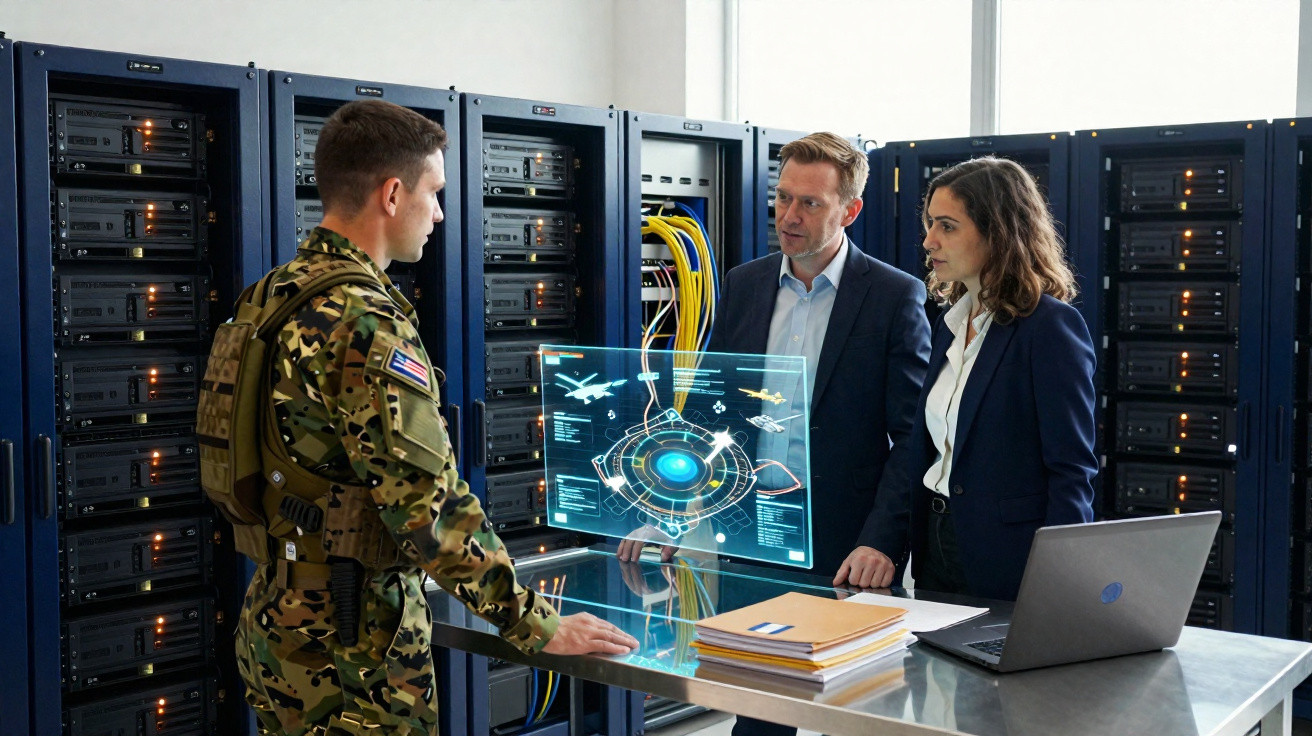
Far removed from the polished campuses of Big Tech, France has created Asgard, a classified supercomputer designed to train military artificial intelligence using genuine combat data while remaining entirely disconnected from the internet. Whereas Washington is pursuing a heavily connected, cloud-centred approach, Paris has chosen the reverse direction.
A secret machine supplied with unprocessed war data
Asgard has been in service since late 2025 at a secured military location close to the French capital. It is not connected to public cloud services and has no access to open networks. Instead, it operates within a physically segregated environment in which the armed forces control every cable, port and node.
The rationale is straightforward: the information it processes must remain under military control. Rather than relying on synthetic training footage or cleaned-up archives, it uses unprocessed operational material collected under real-world conditions:
- multi-pulse radar strikes across contested airspace;
- acoustic returns from submarines and surface vessels;
- video from combat areas captured by drones and crewed aircraft;
- electromagnetic signatures recorded amid intense jamming.
Every dataset represents genuine deployments, actual weapons and real tactics. France concluded that moving this material to commercial cloud platforms, including supposedly “secured” services, would create an unacceptable strategic risk.
Asgard ingests unfiltered combat data and turns it into constantly updated AI models, without ever touching the public internet.
Each computing node is isolated, every operation is recorded, and human access is subject to strict control. This uncompromising security model is central to France’s radical decision.
Reducing the time from battlefield to algorithm
From months of delay to adaptation in days
Contemporary military operations produce vast streams of information every minute. Until recently, that analysis was divided between laboratories and contractors, while feedback reaching personnel in the field could take months. Asgard was developed to eliminate much of that lag.
Consider the detection of drones through sound and radio signatures. Under the previous process, units gathered information, anonymised it and sent it to authorised facilities. They then waited for scarce computing capacity before newly trained models could be manually reintegrated into systems used in the field. By the time the upgraded algorithms became available, adversary equipment or tactics could already have evolved.
Asgard allows teams to test multiple algorithm versions simultaneously, assess them against enormous datasets and return the strongest model to deployed units while the same exercise remains in progress.
The ambition is clear: tighten the feedback loop so that what soldiers see one week shapes the AI they use the next.
Under this model, AI is treated as an asset that can develop almost in real time, rather than as a fixed product refreshed only every few years.
An architecture for contested, data-intensive warfare
Vast memory, enormous files and firm physical segregation
Within the protected site, Asgard connects sizeable clusters of AI accelerators - GPUs or specialist chips - through ultra-low-latency links. Its architecture is intended for extended, demanding training sessions involving huge batches of multi-sensor information.
Its principal technical characteristics include:
- very high-bandwidth memory to supply data-hungry AI accelerators;
- a parallel file system built to absorb tens of terabytes of varied data;
- storage configured for complete ISR mission replays, including full-resolution video, synthetic aperture radar images and raw infrared captures;
- strict separation between service planes to prevent unintended data sharing between missions or military branches.
This arrangement is designed for some of military computing’s most difficult challenges: sensor fusion, target identification in poor weather, resilience during electronic saturation, and the coordination of autonomous systems in hostile settings.
France and the US: two approaches to military AI
Cloud-reliant America and single-site France
The United States mostly uses a hybrid classified-cloud framework. Defence and energy laboratories, air bases and contractors share distributed high-performance clusters, and capacity can expand rapidly across providers including the Pentagon’s Joint Warfighting Cloud Capability. Industry occupies a major role in this system.
France has instead opted to place its most sensitive AI capabilities in one sovereign supercomputer, directly controlled by the Ministry of the Armed Forces. There is no outside operator and no exposure to foreign legal systems. Capacity is fixed, but oversight is complete.
| Approach | Main strengths | Main risks |
|---|---|---|
| United States – hybrid classified cloud | - rapid scalability - large commercial ecosystem - flexible distribution of workloads |
- industrial dependence on major vendors - complex governance across agencies - cross-border legal and supply-chain exposure |
| France – sovereign single supercomputer | - full national control of hardware and data - stable, predictable access for defence users - clear legal framework under French jurisdiction |
- finite capacity, harder to scale overnight - long-term dependence on chosen hardware stack - risk of bottlenecks if demand outgrows the site |
France is accepting slower scalability in exchange for legal, industrial and strategic independence on its most sensitive AI workloads.
The decision is both political and technical. Paris is making clear that certain defence technologies will not be contracted out, including to companies from allied countries.
AI across the French armed forces
From targeting and logistics to drone swarms
Asgard is not simply a resource for intelligence agencies. It supports numerous operational applications across the armed forces:
- air-to-ground targeting using optical, infrared and radar imagery;
- emitter classification in electronic warfare;
- underwater acoustic identification for anti-submarine missions;
- predictive logistics planning when supply routes are disrupted;
- coordination and deconfliction within tactical drone swarms.
Early feedback from French officers highlights several practical benefits:
- fewer false positives in sensor feeds;
- quicker handover of targets between platforms;
- algorithms that remain more reliable as conditions become chaotic;
- improved management of fuel, components and stock through data-led logistics.
These advances may attract less attention than a new fighter aircraft, yet they can determine whether an operation succeeds or fails, particularly during lengthy, attritional campaigns.
Sovereignty, law and the contest for military computing capacity
Why an air-gapped system is important
“Air-gapped” describes a system with no physical connection to unsecured networks. In Asgard’s case, this isolation is more than a matter of technical good practice: it creates a legal and strategic boundary. Sensitive operational information remains in France, is processed on French-controlled hardware and falls under French law.
That distinction becomes important in a crisis, when allied cloud suppliers could face political demands, sanctions or cyber incidents. A sovereign system removes one dependency from political leaders’ concerns when decisions must be made under exceptional time pressure.
Asgard in an international context
In terms of pure processing power, Asgard is not intended to surpass the largest American or Chinese systems. US defence and energy laboratories collectively operate much greater capacity, while China has announced exascale-class machines, although the figures remain unclear. Russia and India run smaller systems focused on their respective regions, with differing levels of independence from overseas suppliers.
Asgard’s distinguishing feature is its combination of specialisation and sovereignty. It is devoted to military AI, separated from civilian cloud services and described by officials as uniquely independent in Europe. In practical terms, this may make France an appealing partner for European defence initiatives requiring both substantial computing resources and strong data protection.
Key concepts and possible future scenarios
What “sensor fusion” means in practice
A frequently used term in discussions of Asgard is “sensor fusion”. Put simply, it means merging separate sources of information - radar, thermal cameras, radio signals and acoustic recordings - to form one consistent picture. A tank concealed by smoke may not be visible to optical cameras, but it could still appear clearly on radar or in infrared imagery.
Teaching AI systems to assess these signals accurately while opponents attempt to deceive or jam them demands enormous volumes of realistic information. This is precisely the type of work Asgard is intended to manage at scale.
Future risks and ethical tensions
By speeding up military AI development, Asgard also creates difficult questions. Shorter cycles between the battlefield and the laboratory could encourage armed forces to grant weapon systems greater autonomy. Although current French doctrine maintains the requirement for human control, the pressure to hand more choices to machines will increase as algorithms perform better than fatigued, overloaded operators.
Technical dangers also exist: a centralised supercomputer is a valuable target. Despite being disconnected from the internet, it may still face threats from insiders, supply-chain attacks or physical sabotage. France will need to keep investing in security, hardware renewal and robust testing to ensure Asgard remains an advantage rather than becoming a weakness.
For the moment, however, Paris’s message is clear: AI for warfare is too strategically important to depend on foreign cloud services. Through Asgard, France has selected a slower and more controlled route than the US model, betting that firm sovereignty will deliver value over time both on the battlefield and at the negotiating table.













Comments
MichaelKed
Эксклюзивная мебель нестандартных размеров и эксклюзивного дизайна, изготовленная из редких материалов делается на заказ https://mebel-er.ru/privacy-policy
В таком случае мебель будет более технологичной, с использованием только качественных материалов https://mebel-er.ru/portfolios/dusevye-i-vannye-komnaty
Процесс создания эксклюзивной мебели на заказ
Ассортимент готовой мебели на рынке позволяет быстро подобрать доступные и разнообразные варианты предметов интерьера https://mebel-er.ru/about
После подписания договора фирма-изготовитель приступает к созданию мебели https://mebel-er.ru/portfolios/raznoe
Создавая новые и необычные варианты мебели, производители становятся настоящими законодателями мод в мире мебели https://mebel-er.ru/portfolios
Leave a Comment