
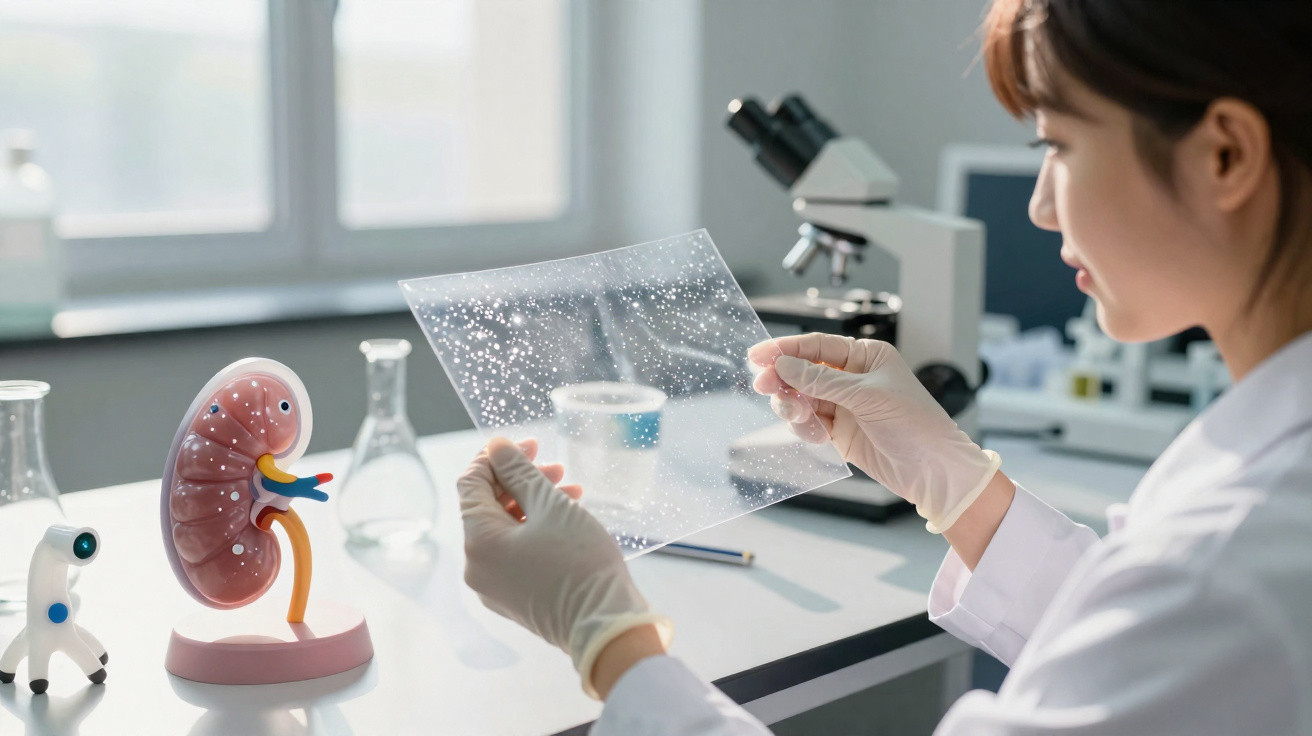
Your kidneys are always working as a highly selective filter for your blood. They retain the salts, sugars and water your body requires, and flush everything else away as waste.
So far, no machine made by humans has been able to reproduce that level of sorting outside a living organism.
Researchers at the University of Texas at Austin have now created a material that comes close. It is formed from billions of minuscule water droplets packed tightly together.
Like living tissue, it can screen molecules selectively-allowing some to pass through while stopping others.
Solving the scale problem
For years, scientists have been able to make small samples of materials that behave like tissue. The persistent obstacle has been producing enough of them to be genuinely useful.
Existing techniques for constructing these tissue-like materials do not scale up to the sizes needed for real-world deployment.
The team tackled that speed-and-scale barrier with a more straightforward method. Using standard mixing followed by a centrifuge, they compress billions of tiny water droplets into a dense structure. The entire material assembles in only a few minutes.
Each droplet is enclosed by a thin membrane, and these membranes join to neighbouring ones in the same way cells connect in real tissue-creating the filtering function.
“ Tissues can separate and transport ions and molecules; that’s how our kidneys or intestines work, taking only what they need and leaving the rest behind,” said the study’s lead author, Manish Kumar, an engineering professor at The University of Texas at Austin.
One idea changed everything
The study builds on more than a decade of work in Kumar’s lab. Aida Fica, a graduate student in the group, was the person who ultimately combined the key elements.
For years, Fica had repeatedly faced the same issue: droplet formation that was slow and prone to instability. Then, after hearing something at a conference, she arrived at a fresh approach.
She and her colleagues advanced the method through emulsification, blending two oils with different solubilities to create droplets and then using a centrifuge to pack them together.
“This technology now offers a simple, scalable process with endless applications that could be implemented in any laboratory since it only requires basic equipment,” said Fica.
A flexible material with big potential
The researchers call the material a jammed interconnected bilayer emulsion, and the results have already gone through peer review.
Every millilitre of the material contains billions of droplets wrapped in bilayers. Despite that density, the team can make several ounces (about 100 mL, roughly one decilitre) within minutes.
The formulation is not limited to a single ingredient either: it can be made using a broad selection of fat-like building blocks.
Because it is so adaptable, scientists can tune it to act like different tissues, including the filtering tissue found in kidneys. The material can also be 3D printed using biocompatible materials.
From replacement tissue to soft robots
In time, the team thinks the material might be used as a scaffold on which living cells could grow into replacement tissues-or potentially even organs.
That remains a longer-term ambition. The researchers have not evaluated the material in animals or humans, and all demonstrations so far have been confined to the material itself.
Its flexibility also points to another use: soft robots designed to move and flex more like living organisms than conventional machines.
The researchers propose that, one day, such robots could help with surgery, support search-and-rescue work, and operate in hazardous settings where rigid machines are hard to use.
Programming the tiny droplets
By adding particular proteins, the team can alter what the material does. Insert one kind of protein channel and the droplets start to conduct ion currents, in the same way nerve cells transmit electrical signals.
The paper also reports that this configuration shows memristance-meaning the material’s electrical resistance shifts depending on what has recently passed through it.
That is precisely the sort of behaviour sought by researchers developing brain-inspired computers.
Replace that protein channel with a different one and the material behaves more like kidney tissue, selectively removing ammonium from other ions in wastewater-including water produced by oil and gas extraction as well as municipal sources.
Kumar has studied this type of water-treatment filter for years. This kind of selective separation could enable facilities to reclaim valuable minerals and nutrients from wastewater rather than losing them.
“We encourage interested researchers to try this out, and we will heartily support anybody who would like to work in this field through visits and discussions,” said Kumar.
The complete study appeared in the journal Nature Materials.






Comments
No comments yet. Be the first to comment!
Leave a Comment