
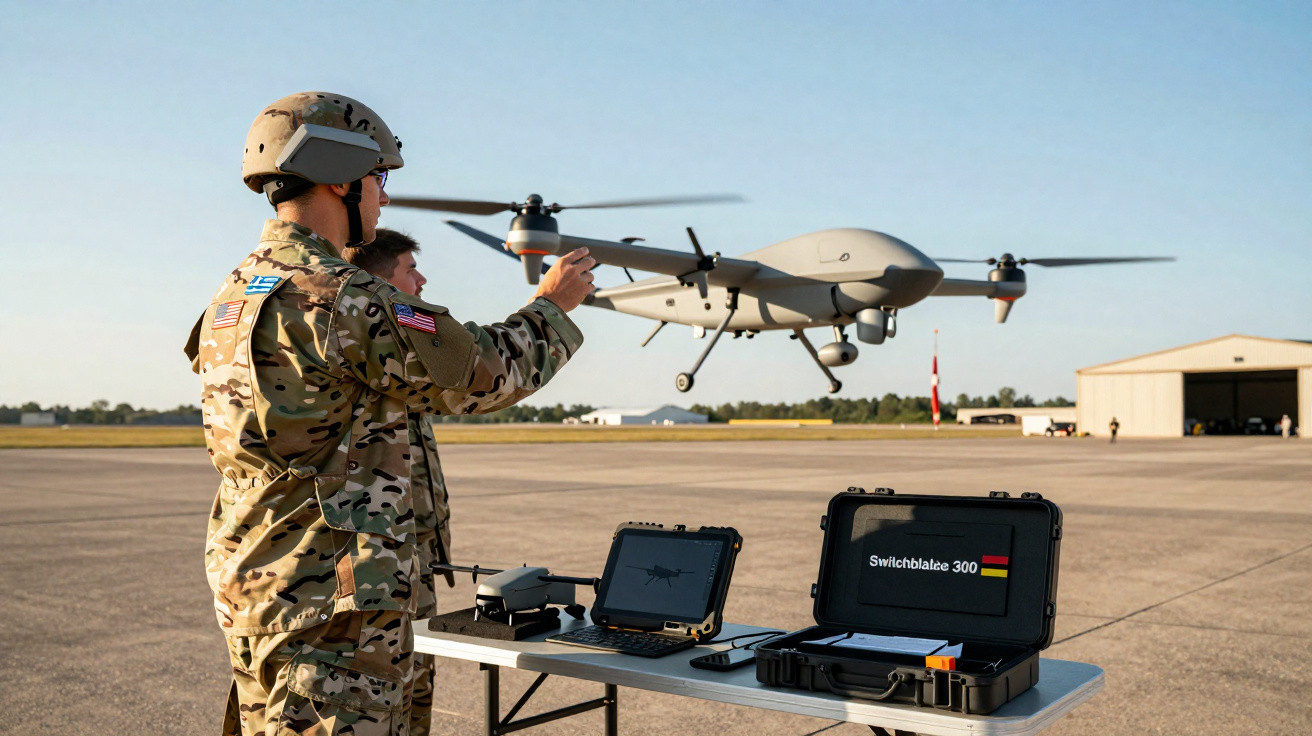
AeroVironment-one of the world’s leading makers of drones and loitering munitions-has had a strong month, announcing fresh contracts for international customers that include the United States Army as well as the armed forces of Greece and Germany.
AeroVironment P550 eVTOL UAS: US Army award for long-range reconnaissance
On 20 July, the company revealed it had been awarded a US$ 117,3 million contract by the United States Army for its P550 unmanned aircraft system (UAS), an electric vertical take-off and landing (eVTOL) platform. These aircraft will support the Army’s Long Range Reconnaissance programme. The contract, according to the information released, was signed via the US Army’s UAS Marketplace Initiative-a new government programme designed to streamline and speed up procurement of unmanned technologies.
In total, 82 P550 unmanned aircraft systems will be delivered for the US Army’s Battalion Reconnaissance Unmanned Aircraft Systems initiative.
The P550 is described as offering endurance of more than five hours, a range between 40 and 59,5 kilometres, a maximum take-off weight of 24,9 kilograms, and the ability to carry payloads of up to 6,8 kilograms. As the company states, “payloads and batteries can be replaced in the field in less than five minutes and without the need for tools”. The platform can be used for intelligence, surveillance and reconnaissance (ISR) missions, precision strike, electronic warfare, and communications relay across air, land and maritime operations.
AeroVironment has not said when deliveries will begin.
Greece: possible FMS for Switchblade 300 Block 20 LMAMS
What is clear, however, is that other armed forces are also looking closely at AeroVironment’s family of systems. On 16 July, the US Department of State announced a possible Foreign Military Sale (FMS) to Greece covering 350 Switchblade 300 Block 20 Lethal Miniature Aerial Missile Systems (LMAMS) and 35 SB300B20 LMAMS fire-control systems, with an estimated value of US$ 80,1 million.
The Switchblade loitering munition is listed as having a range of more than 28 kilometres-when using an extended-range antenna-endurance of more than 20 minutes, a loiter speed of 55 knots, and a top speed of 87 knots. It can carry a payload of up to 1,6 kilograms.
Germany: Puma AE and Puma LE drones under the Bundeswehr’s LARUS programme
Earlier this month, the company named another European customer: Germany. AeroVironment’s Puma AE (All Environment) and Puma LE (Long Endurance) drones will be operated by the German armed forces (Bundeswehr) under its air reconnaissance programme Luftgestützte Aufklärung mit Unbemannten Systemen (LARUS, or Air Reconnaissance using Unmanned Systems). The deal is valued at US$ 30,9 million, arranged through the NATO Support and Procurement Agency (NSPA) under the UAS Partnership.
Drone warfare momentum and US training initiatives
The era of drone-centric warfare is now fully under way, as militaries worldwide continue to draw lessons from ongoing conflicts in Ukraine and Iran. Armed forces are buying drones and loitering munitions across a broad spectrum of types and capabilities for missions ranging from ISR and electronic warfare to one-way attack platforms. They are also seeking to field drones and loitering munitions at multiple tiers of their organisations-from divisions and brigades down to man-portable systems for squads and platoons.
Alongside the United States Army, the US Marine Corps is also reshaping units and training pathways to adopt these systems at different levels. In early July, the service created the Marine Corps Robotics Integration Group, intended to integrate, standardise and institutionalise training in Group 1 and 2 unmanned systems, as well as counter-UAS systems, across the force. The group is assigned to the Marine Air Ground Task Force Training Command, part of the Marine Corps Air Ground Combat Centre, based at Twentynine Palms, California.
At the same time, the Tennessee National Guard has recently graduated the first class of the Small Unmanned Aircraft System (SUAS) Master Instructor course. Twelve soldiers completed the programme, which ran for two weeks.
Looking ahead, the expectation is that the US Armed Forces will continue establishing new centres and programmes to train troops, while also developing new strategies and operational concepts to bring different drone types-including one-way attack drones and loitering munitions-into combat operations.






Comments
No comments yet. Be the first to comment!
Leave a Comment