
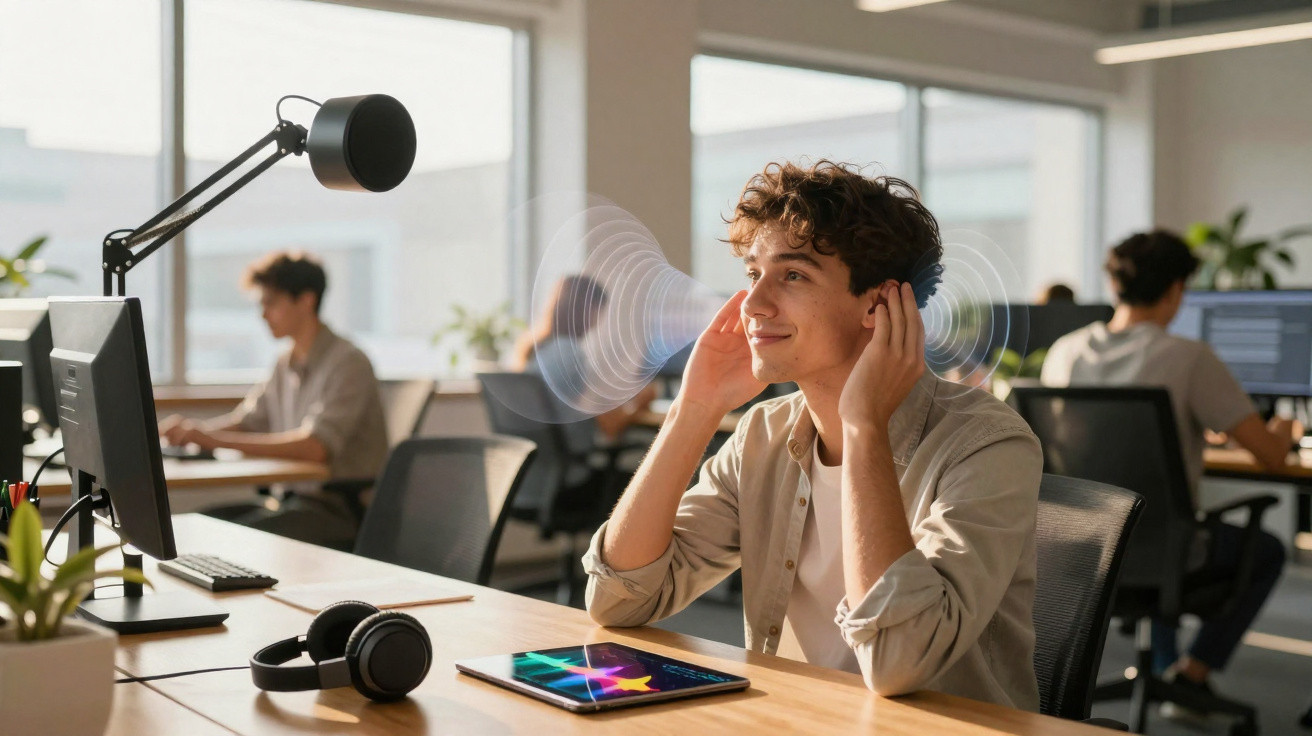
Imagine being able to listen to music or a podcast with no headphones or earbuds, while the people nearby hear nothing at all. Or picture having a private chat in a public place without anyone else being able to make out a word.
In our recently published research, we set out a method for producing audible enclaves: small, localised regions of sound that remain separated from the surrounding space. Put simply, we’ve created an approach that can make sound appear only where it is needed.
If audio could be delivered so that it becomes audible only at a chosen spot, it could reshape entertainment, communication and spatial-audio experiences.
What is sound?
Sound is a vibration that moves through the air as a wave. These waves arise when something oscillates back and forth, alternately compressing and rarefying the air molecules.
How fast those vibrations occur determines the pitch. Lower frequencies produce deeper sounds, such as a bass drum; higher frequencies create sharper sounds, such as a whistle.
Directing sound to a particular place is hard because of diffraction-the way sound waves spread as they propagate. Diffraction is especially pronounced at low frequencies because their wavelengths are longer, which makes it extremely difficult to keep the sound restricted to a defined area.
Some audio systems-parametric array loudspeakers, for instance-can form narrow beams of sound aimed in a particular direction. Even so, those systems still generate sound that can be heard all along the beam’s route through space.
The science of audible enclaves
We identified a different route to delivering sound to a single listener, using self-bending ultrasound beams together with a principle known as nonlinear acoustics.
Ultrasound is sound at frequencies above the range of human hearing-anything higher than 20 kHz. Ultrasound waves travel through air in much the same way as ordinary sound waves, but people cannot hear them.
Because ultrasound can pass through many materials and interacts with objects in distinctive ways, it is widely used in medical imaging and in a range of industrial uses.
In our research, ultrasound serves as a carrier for audible audio. It can move sound through space silently, and then become audible only where we intend. So what makes that possible?
In typical situations, waves combine linearly: they simply add together in proportion to create a larger wave. Yet when waves are intense enough, they can interact nonlinearly, producing entirely new frequencies that were not present to begin with.
That mechanism underpins our method. We transmit two ultrasound beams at different frequencies; each beam is completely silent by itself. When the two beams intersect, nonlinear interactions generate a new wave at an audible frequency-so the sound is heard only within that specific region.
A crucial part of the design is that the ultrasonic beams can bend without needing to be reflected or blocked. Under normal conditions, sound travels in straight lines unless it meets an obstacle. By using acoustic metasurfaces-engineered materials that reshape sound-we can make the ultrasound beams curve as they propagate.
Much as an optical lens redirects light, acoustic metasurfaces alter the trajectory of sound waves. By carefully controlling the phase of the ultrasound waves, we can form curved paths that steer around obstacles and then converge at a chosen target point.
The central effect here is called difference frequency generation. When two ultrasonic beams with slightly different frequencies-such as 40 kHz and 39.5 kHz-overlap, they create a new wave at the difference between them: 0.5 kHz, or 500 Hz, which falls well within the range people can hear.
As a result, the audio is audible only where the beams cross. Away from that crossing point, the ultrasound remains inaudible.
This makes it possible to deliver sound to a particular location or individual without bothering others while the audio “travels” through the air.
Advancing sound control
The capacity to form audio enclaves suggests a wide set of possible uses.
Audible enclaves could make personalised audio feasible in shared public environments. Museums, for example, could offer different spoken guides to different visitors without issuing headphones, and libraries could let students use audio-based learning without disrupting everyone else.
Inside a car, one passenger might listen to music while the driver still clearly hears navigation prompts. Offices and military contexts could similarly make use of localised speech regions to support confidential discussions.
The same idea could also be adapted for noise reduction in selected areas, creating quiet zones that help concentration in workplaces or lessen noise pollution across cities.
This is not a product that will appear on shelves any time soon. There are still technical obstacles, including nonlinear distortion, which can reduce audio fidelity. Power efficiency is also a concern: converting ultrasound into audible sound relies on high-intensity fields, which can be energy-hungry to generate.
Even with these limitations, audible enclaves represent a significant change in how sound can be controlled. By rethinking the way sound occupies space, we can explore new kinds of immersive, efficient and personalised listening experiences.
Jiaxin Zhong, Postdoctoral Researcher in Acoustics, Penn State and Yun Jing, Professor of Acoustics, Penn State
This article is republished from The Conversation under a Creative Commons licence. Read the original article.


Comments
No comments yet. Be the first to comment!
Leave a Comment