
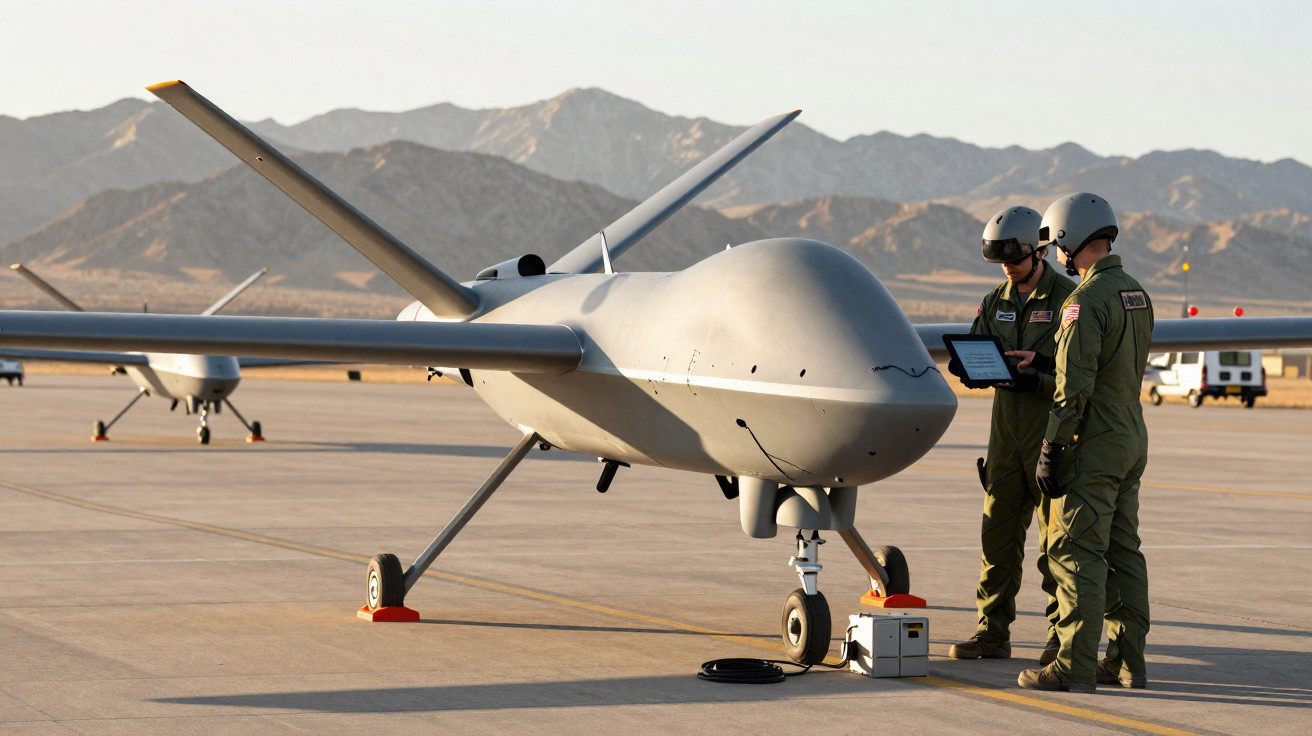
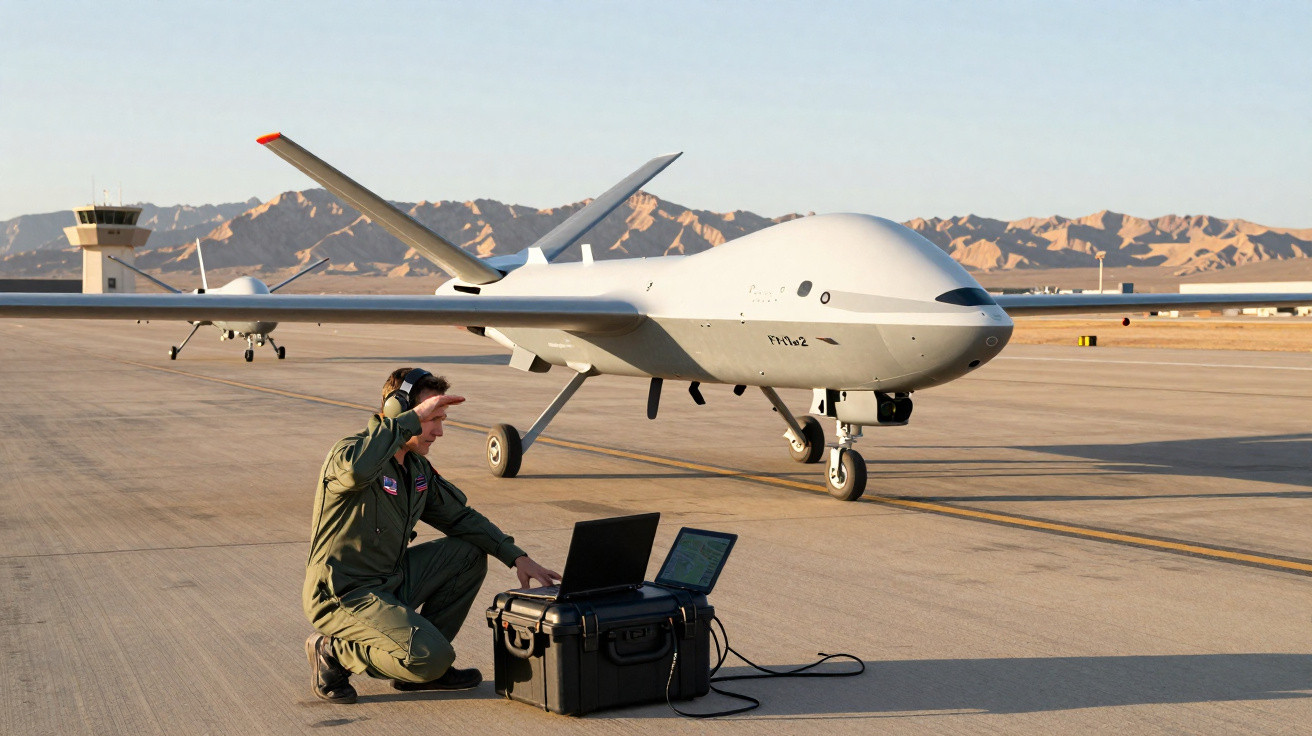
As part of an exercise run at Creech Air Force Base, the United States Air Force (USAF) trialled the new YFQ-44A Fury collaborative combat drone in the Nevada desert. The aim was to push forward the integration of uncrewed aircraft with crewed fighters and to validate operational concepts for the Collaborative Combat Aircraft (CCA) programme.
Creech Air Force Base hosted new operational trials.
The trials were led by the Collaborative Combat Aircraft Experimental Operations Unit (CCA), set up by the USAF to speed up the development of Manned–Unmanned Teaming (MUM-T) joint operations concepts. Creech Air Force Base already has deep experience with uncrewed systems, as it is home to the 432nd Wing, which operates MQ-9A Reaper and RQ-170 Sentinel drones.
Across the exercise, the unit flew multiple mission profiles intended to confirm platform reliability, extend operational reach and connect the uncrewed aircraft with crewed platforms in a realistic flight environment. The activity also enabled the simulation of a range of scenarios that will help shape future tactics, techniques and procedures for bringing CCAs into the Air Force force structure.
The USAF Chief of Staff, General Ken Wilsbach, set out why the programme matters strategically. “Air superiority in today’s increasingly contested environments requires the rapid fielding of large numbers of affordable systems. Combat Air Defence Systems (CADS) are essential to that effort. By integrating uncrewed systems to fly alongside our aviators, we extend our reach and increase our combat capacity,” he said.
The YFQ-44A Fury and YFQ-42A took part in the sorties.
USAF-released imagery confirmed flights involving both the YFQ-44A Fury, developed by Anduril Industries, and the YFQ-42A, produced by General Atomics. According to official information, activity began on 21 July and focused on assessing how these aircraft could be used in distributed operations under the Agile Combat Employment (ACE) concept.
Lieutenant Colonel Matthew Jensen, commander of the Experimental Operations Unit, stressed that the priority was moving capability from a test setting into an operational context. “This exercise was designed to put the systems in the hands of the warfighter. We focused on operating Combat Air Defence Systems (CADs) outside a traditional test environment to keep learning, gather information and move quickly through continuous improvements,” he stated.
The trials were also observed by staff from the Air Force Operational Test and Evaluation Center (AFOTEC) as part of a new accelerated assessment approach. The centre’s commander, Brigadier General Jesse Friedel, noted that exercises of this kind enable data collection and analysis that support decisions on integrating CCA ahead of the completion of traditional evaluation processes.
YFQ-44A Fury mass production continues to gather pace
Even as operational trials continue, industrial progress is advancing in parallel. Anduril Industries recently confirmed that the first YFQ-44A Fury built at its Arsenal-1 facility in Ohio has rolled off the production line, while General Atomics has started producing the first YFQ-42As. These milestones reinforce the Collaborative Combat Air (CCA) programme’s development and underpin the USAF goal of fielding a new generation of collaborative combat drones designed to operate alongside crewed aircraft in future combat scenarios.




Comments
No comments yet. Be the first to comment!
Leave a Comment