
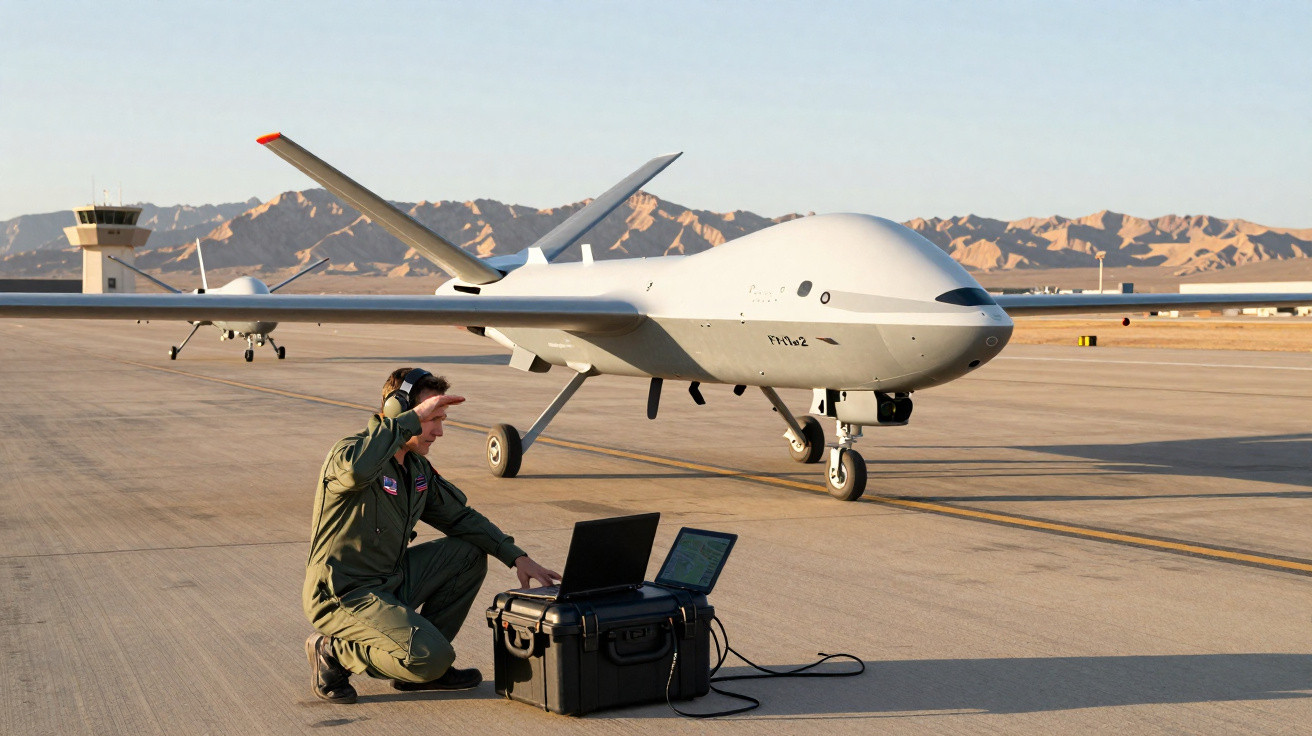
During an exercise at Creech Air Force Base, the U.S. Air Force (USAF) put the new YFQ-44A Fury collaborative combat drone through its paces over the Nevada desert. The aim was to push forward the integration of unmanned aircraft with manned fighter jets and to validate operational concepts tied to the Collaborative Combat Aircraft (CCA) programme.
Creech Air Force Base hosted fresh operational trials.
The sorties were run by the Collaborative Combat Aircraft Experimental Operations Unit (CCA), a USAF element set up to speed up the development of Manned–Unmanned Teaming (MUM-T) concepts. Creech Air Force Base brings longstanding experience with unmanned operations, as it hosts the 432nd Wing-fielding MQ-9A Reaper drones-alongside RQ-170 Sentinels.
Across the exercise, the unit flew multiple missions intended to confirm platform reliability, expand effective operating reach, and link the drones with manned aircraft in a realistic flight setting. The activity also supported the rehearsal of varied scenarios, feeding into the future tactics, techniques and procedures that will shape how CCAs are folded into the force structure.
The USAF’s Chairman of the Joint Chiefs of Staff, General Ken Wilsbach, set out why the programme matters strategically. “Air superiority in today’s increasingly contested environments requires the rapid deployment of an affordable mass. Combat air defense systems (CADS) are essential to this effort. By integrating unmanned systems to fly alongside our airmen, we extend our range and increase our combat capability,” he stated.
The YFQ-44A Fury and the YFQ-42 took part in the sorties.
Air Force imagery released after the event confirmed participation by both the YFQ-44A Fury-developed by Anduril Industries-and the YFQ-42A, produced by General Atomics. Official details say the activity began on 21 July and focused on assessing how these aircraft could be employed in distributed operations under the Agile Combat Employment (ACE) concept.
Lieutenant Colonel Matthew Jensen, who commands the Experimental Operations Unit, said the central goal was to move these capabilities beyond controlled testing and into an operational setting. “This exercise was about putting the systems in the hands of the combatant. We focused on operating the Combat Air Defenses (CADs) outside of a traditional testing environment to continue learning, gather information, and move quickly through continuous improvements,” he stated.
Staff from the Air Force Operational Test and Evaluation Center (AFOTEC) also monitored the trials as part of a new, accelerated evaluation approach. The centre’s commandant, Brigadier General Jesse Friedel, noted that exercises of this kind make it possible to collect and analyse data that supports decisions on bringing CCAs into service ahead of completing the usual evaluation pathways.
YFQ-44A mass production keeps moving forward
Even as operational testing progresses, industrial work is advancing in parallel. Anduril Industries recently confirmed that the first YFQ-44A Fury built at its Arsenal-1 facility in Ohio has come off the production line, while General Atomics has started manufacturing the first YFQ-42As. These steps reinforce the development of the Collaborative Combat Air (CCA) programme and support the U.S. Air Force’s objective of fielding a new generation of collaborative combat drones designed to operate alongside manned aircraft in future combat scenarios.





Comments
No comments yet. Be the first to comment!
Leave a Comment