
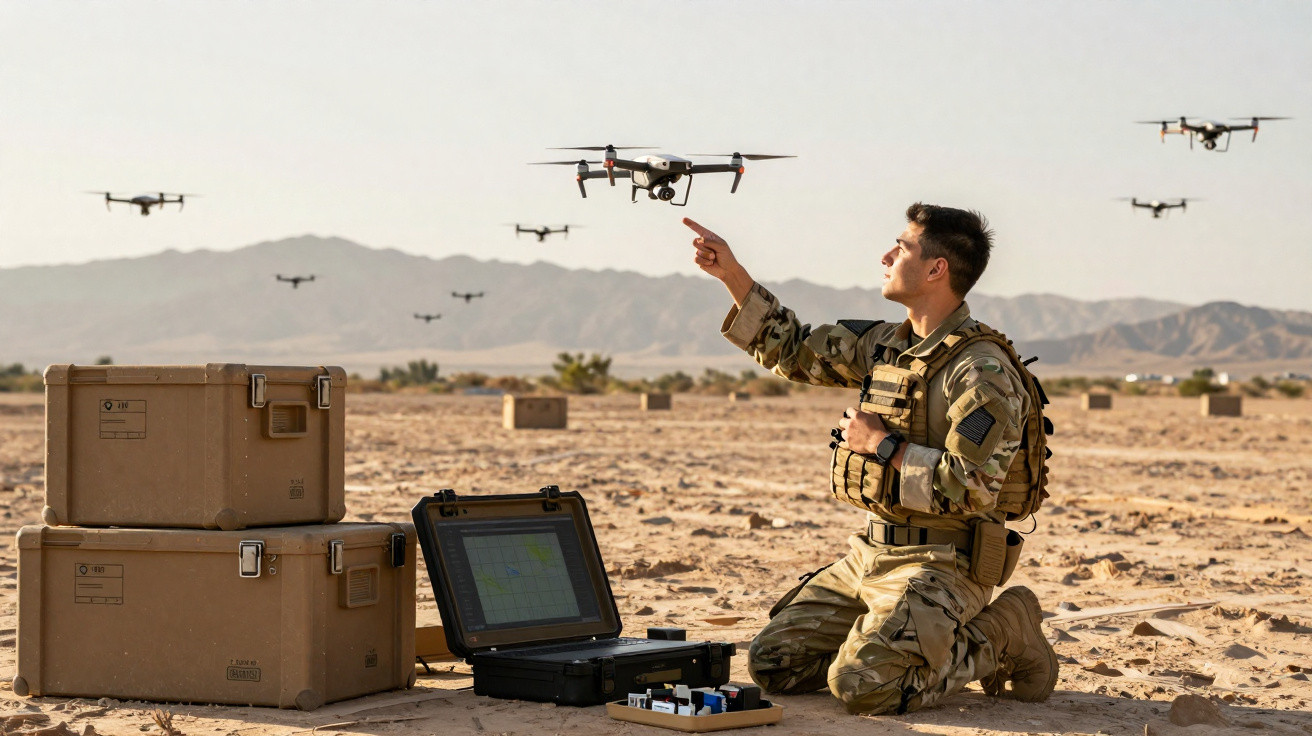
As part of efforts to modernise the United States Armed Forces with around 200,000 new unmanned systems by 2027, the Ukrainian company F-Drones has delivered 2,000 F10 FPV drones to the US Army. The company itself confirmed the information to the local outlet Militarnyi. According to the cited sources, the equipment will go through an evaluation and acceptance process and, once that stage is completed, it may begin to be used in the training of US service personnel.
F-Drones F10 FPV drones within the Drone Dominance Program
F-Drones is now waiting for the outcome of these assessments and the potential placement of an order by the US Army for up to 1,000 additional units. If this new request is confirmed, it will mark an important milestone for the company, as the F10 would become the first Ukrainian-origin unmanned system exported to the US Army.
Deliveries made so far fall under the Drone Dominance Program, more specifically its Gauntlet I phase.
Gauntlet II and the prospect of up to 9,000 drones
In the next stage, known as Gauntlet II, the company aims to supply a further 120 unmanned systems, intended for troop training. Over the medium term, the F10 passing the trials could pave the way for contracts covering up to 9,000 drones for the US Army.
This potential agreement-along with other possible exports from Ukraine’s defence industry-could be supported by new mechanisms introduced by Kyiv to make overseas arms sales easier.
Production capacity and US component restrictions
Opportunities for Ukrainian companies to supply drones to the US Armed Forces are expected to grow while the Pentagon develops its own industrial base dedicated to producing these systems. As the United States is still in the early stages of that effort, analysts in both countries point to a large gap in current manufacturing capacity, which at present favours Ukraine-whose industry is said to be capable of producing roughly 500,000 unmanned systems per month.
Another factor that could work in favour of Ukrainian manufacturers relates to restrictions the United States imposes on domestic firms: they must use locally produced components and cannot rely on Chinese-origin parts. Although building a domestic supply chain is a strategically important long-term objective, the US industry is likely to face significant initial difficulty in securing the necessary components and materials-a challenge that affects sectors beyond the drone market as well.



Comments
No comments yet. Be the first to comment!
Leave a Comment