
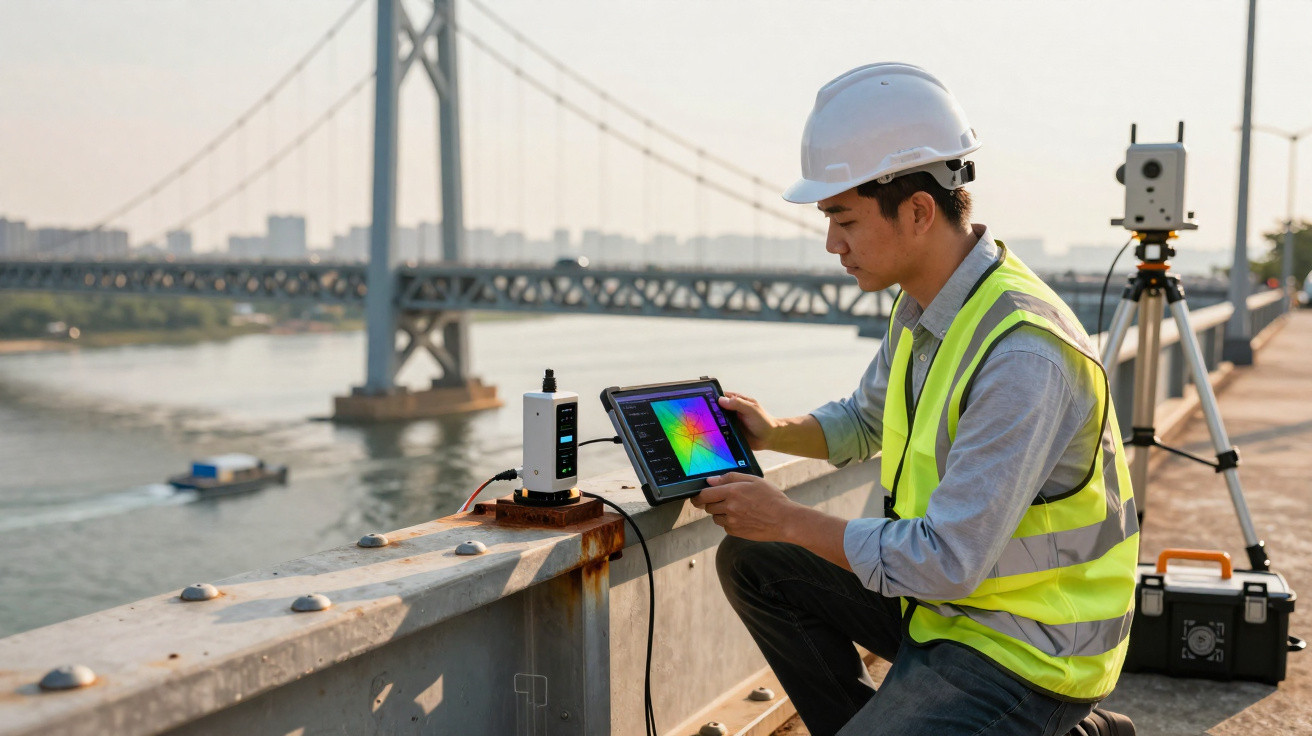
Keeping ageing structures safe demands new technological approaches to prevent serious incidents in towns and cities. Using efficient non-destructive inspection methods has become an essential alternative for accurately tracking the condition of viaducts and structurally deficient bridges across the country.
How do quantum sensors identify invisible faults in bridges?
These innovative devices are engineered to be highly sensitive to changes in magnetic fields in the area being examined. With that heightened capability, engineers can chart internal cracks that would be entirely missed during conventional surveys, flagging early signs of hidden corrosion in US infrastructure.
By detecting extremely faint signals produced by compromised ferromagnetic materials, the technology can surface major risks before they turn into catastrophic failures. In this way, deploying quantum sensors enables thorough assessments without any need for destructive intervention in structural civil engineering.
How do sound vibrations reveal hidden tunnels beneath roads?
Deep acoustic waves can map what lies underground and pinpoint concealed passages without excavation, uncovering intriguing details that help to… Read more
Which technologies underpin the accuracy of these modern inspections?
The monitoring relies on advanced approaches such as optically pumped magnetometers, which have shown excellent real-world performance. These instruments are paired with diamond-based systems that use nitrogen-vacancy centres to produce detailed maps of hidden corrosion in structurally deficient bridges.
While optical versions deliver an impressive response to shifts in magnetism, diamond crystals can generate remarkable microscopic images of defects. Together, these strengths establish quantum magnetometers as transformative tools for safeguarding US infrastructure.
Below is a video from the YouTube channel Quantum Tech Explained that explores the points discussed in this topic:
Why is the stability of quantum magnetometers crucial?
Measurement consistency over time is a decisive advantage for continuous structural monitoring. Because quantum defects in diamonds are anchored within a stable crystal lattice, the latest quantum sensors can operate efficiently within national civil engineering.
These innovative systems can suppress irrelevant environmental noise, recording only the data with genuine technical value. As a result, quantum magnetometers remove time-based distortions and deliver dependable reports on the progression of any damaging hidden corrosion.
Structural advantages of the system
Operational benefits of magnetometers: quantum technology offers revolutionary attributes for field assessments:
- High temporal stability thanks to the stable diamond matrix;
- Efficient filtering of unwanted environmental noise in measurements;
- Strong durability to withstand harsh field conditions.
What are the main practical applications of this advanced monitoring?
Practical trials show excellent effectiveness in locating early-stage material fatigue and micro-cracks in complex metal components. This technology delivers precise non-destructive inspection, protecting the stability of a wide range of ageing structures within neglected US infrastructure.
Beyond use on above-ground surfaces, the systems also perform strongly when mapping underground pipes and buried electrical cables. Using efficient quantum sensors, technicians can identify anomalies without excavation, streamlining routine inspections of structurally deficient bridges.
Advanced monitoring with this technology covers several important urban-sector scenarios:
- Three-dimensional mapping of magnetic anomalies;
- Early detection of fatigue in metal alloys;
- Precise location of deeply buried pipelines.
How does this innovation reduce infrastructure costs?
Immediate identification of hidden damage prevents minor issues from escalating into complete and expensive structural failures. In that sense, investing in quantum sensors reduces excessive emergency spending on complex viaduct repairs in modern civil engineering.
Because inspections do not require dismantling components, the approach improves maintenance teams’ operational efficiency. This model of non-destructive inspection supports high public safety and helps protect the asset value of affected structurally deficient bridges.






Comments
No comments yet. Be the first to comment!
Leave a Comment