
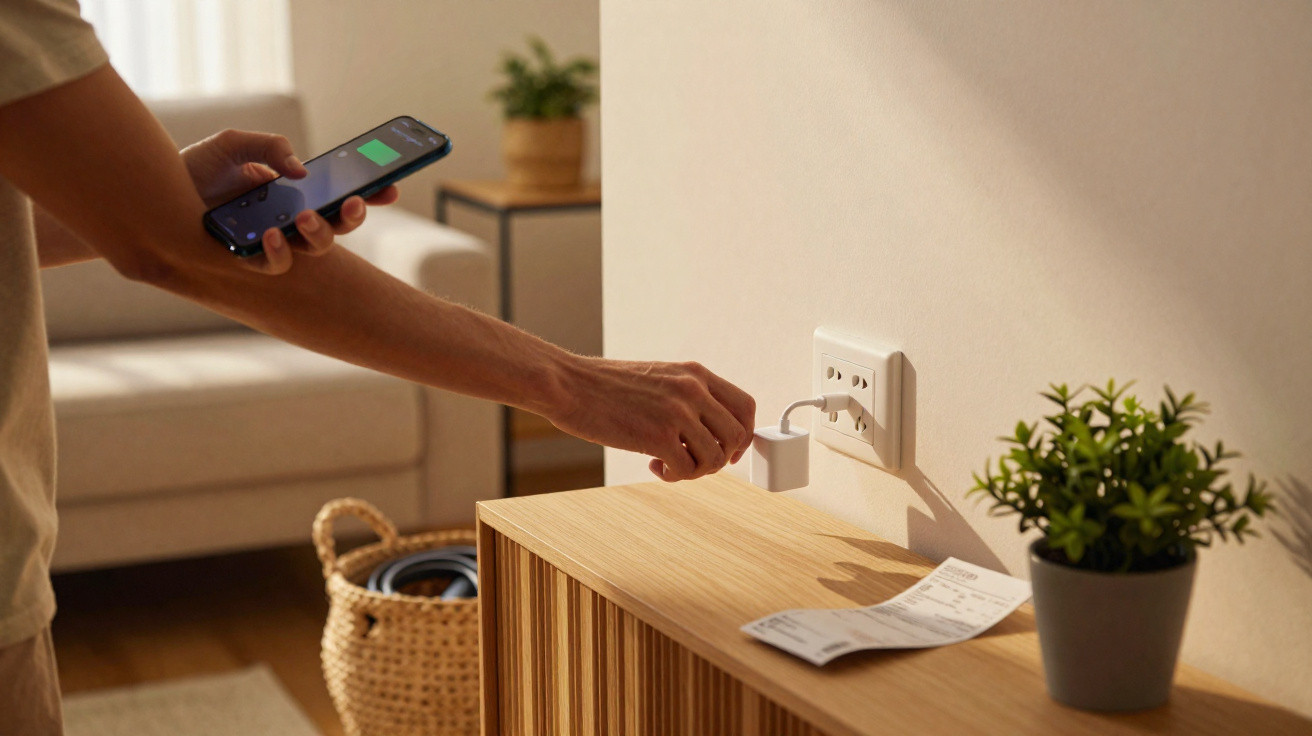
You turn the light off, set your phone down on the bedside table, and plug it in “for tomorrow”. Then it hits you: you already topped it up earlier. You pull the cable out of your phone… but the charger stays in the socket. It feels like nothing to worry about. That little white block gives off the faintest glow in the dark - quiet, constant, easy to ignore.
Time drifts on. Weeks. Maybe months. The same adapter remains there, drawing power around the clock. Before long, the sockets in your home start to resemble mini charging bays, even when nothing is actually being charged.
Power feels inexpensive, chargers feel insignificant, and nobody wants another bedtime chore. Still, that “leave it plugged in” routine is steadily wearing down something you can’t see - and once you spot the pattern, it’s hard to forget it.
Why that lonely charger in the wall isn’t really “doing nothing”
At first glance, a phone charger left in the wall looks inert. There’s no warm cable, no handset vibrating, no obvious sign it’s alive. Yet inside the casing, parts remain energised, quietly converting high-voltage mains electricity into low-voltage standby power.
That ongoing activity produces warmth, even if it’s subtle. It also creates small electrical stresses that continue through the night, every night. Over time, that permanently energised state slowly cooks the charger’s internals - capacitors, the small transformer, and the safety components designed to protect you. The adapter can feel cool externally while, inside, it’s ageing far faster than most people realise.
Picture the colleague whose charger lives permanently under their desk. In the first year it’s flawless. In the second, they start muttering that their phone “charges weirdly”, dropping out at 60 % or taking forever to reach 100 %. By the third, they’re wiggling the lead, trying different USB ports, blaming the handset - until a whiff of hot plastic or a wisp of smoke finally convinces them to bin the charger.
Brands don’t tend to highlight it, but standby wear genuinely happens. Research into household electronics has found that devices left on standby can remain powered for 20 hours a day. Your charger may only do “real” charging for a couple of those hours, but it’s still energised almost continuously - and that gap accumulates where it matters most: the charger’s lifespan.
In plain terms, here’s what’s happening. A phone charger is a compact switching power supply. It’s built to take 230 V or 120 V from the wall and turn it into the 5–20 V your devices need. Even when nothing is connected, the circuitry still pulls a small amount of current.
That trickle of current creates heat - and heat is electronics’ biggest enemy. Components dry out, minute solder joints weaken, and insulation slowly deteriorates. Across months and years, the adapter becomes less consistent. Voltage spikes, electrical noise, and tiny failures begin to appear. Then, when you do plug in your phone, earbuds, or smartwatch, they can be fed power that’s slightly harsher and less stable than when the charger was new. That’s how one seemingly harmless habit can gradually harm more than just the charger.
How to break the habit and protect your gear without going crazy
There’s one dull but effective step that helps electronics last longer: unplug chargers when nothing is attached. That applies to your phone charger, the tablet power brick tucked behind the sofa, and the third-party USB hub on the kitchen worktop.
The key is turning it into a default action rather than another thing to remember. A switched multi-socket extension beside the bed lets you cut power to all chargers with a single press. A smart plug can be scheduled to turn off at 1 a.m. every night, with no effort from you. Once the routine shifts, chargers spend more time cool, sockets look less cluttered, and your devices are less exposed to rough, “dirty” power.
On a human level, this isn’t about becoming an energy monk. Some nights you’ll still collapse into bed with leads draped everywhere. Let’s be honest: nobody truly does this perfectly every single day.
What makes a difference is simply having fewer chargers permanently energised. Set up one charging corner, use one power strip, and make one nightly switch-off part of the rhythm. It lowers the fire risk, reduces phantom power draw, and eases the constant low-level stress on your gadgets. You don’t need perfection - just fewer invisible drains running 24/7 in the background.
There’s a quieter, emotional benefit too. When your desk isn’t dotted with random glowing bricks, you only see the devices you actually use and the chargers you genuinely need. The subtle “always plugged in” hum starts to disappear.
“The biggest damage from leaving chargers plugged in isn’t the bill at the end of the month,” explains one independent repair technician I spoke to. “It’s the silent wear on components and the nasty surprises when a tired adapter finally fails.”
- Unplug chargers when no device is connected, or use a switchable power strip.
- Swap out very old or yellowed chargers, especially generic or unbranded models.
- Place chargers on hard surfaces, not under pillows, books, or blankets.
- Look out for ageing signs: buzzing noises, overheating, or loose USB ports.
- For costly devices like phones and laptops, choose certified, original chargers.
What this tiny habit says about our relationship with our devices
That solitary charger glowing in the socket is more than plastic and a plug. It represents how our technology never fully rests. Even when you stop scrolling, something is still sipping electricity and quietly ageing out of sight.
Once you begin noticing it, your home feels different. The outlet behind the TV, the plug by the hallway table, the socket near the kettle - all of them become small centres of invisible activity, constantly warm, constantly on. Pulling a charger out can feel oddly old-fashioned, like putting down a landline handset.
Practically speaking, the benefits are modest but genuine. Chargers tend to last longer. Your phone and earbuds deal with fewer charging quirks. And the chance of a worn, overheated adapter damaging a port, a cable, or worse, the device itself, drops. In a world where so much is treated as disposable, making one thing last a little longer is a quiet form of resistance.
Most of us have lived the moment: a trusted charger dies mid-trip - in a hotel, on an airport floor, at the worst time. A few seconds of daily care at home can make that situation less likely, even if it doesn’t vanish entirely.
It can also start a small chain reaction. You mention “ghost power” to a mate and they unplug a couple of bricks. They pass it on. Children grow up seeing a charger as a tool you take out and put away, not permanent furniture.
A tiny change at a wall socket becomes a small shift in how we look after the tools that run our lives: less hidden wear, fewer minor risks, and more deliberate choices about what keeps humming in the dark while we sleep.
| Key point | Detail | Why it matters to the reader |
|---|---|---|
| Standby wear on chargers | Chargers left plugged in stay powered, generating heat and electrical stress over time. | Understand why “resting” chargers fail sooner and become less dependable. |
| Impact on connected devices | Ageing chargers can output less stable power, raising the risk of slow, irregular damage to phones and accessories. | Protect expensive devices from hard-to-spot power issues. |
| Simple prevention habits | Unplug when unused, use switched strips or smart plugs, and replace old or unsafe adapters. | Reduce risk, save a little energy, and extend everyday electronics’ lifespan. |
FAQ:
- Does leaving a charger plugged in with no phone attached really use electricity? Yes - it draws a small idle current. It won’t send your bill through the roof, but the adapter still runs, warms slightly, and ages.
- Can a charger left plugged in start a fire? It’s uncommon with high-quality, certified chargers, but the risk rises with worn, cheap, or damaged adapters - particularly if they’re covered by fabric.
- Does this harm my phone even when it’s not connected? The main wear is on the charger. However, as the adapter deteriorates, it can deliver “dirty” power that puts extra stress on your phone once you plug it in.
- Is it safer to use a power strip with a switch? Yes. A switched strip or smart plug lets you cut power to several chargers at once, reducing wear and phantom draw in one action.
- How often should I replace my chargers? There’s no set schedule. If a charger runs unusually hot, makes noise, smells strange, or charges inconsistently, replacing it is the sensible choice.






Comments
No comments yet. Be the first to comment!
Leave a Comment