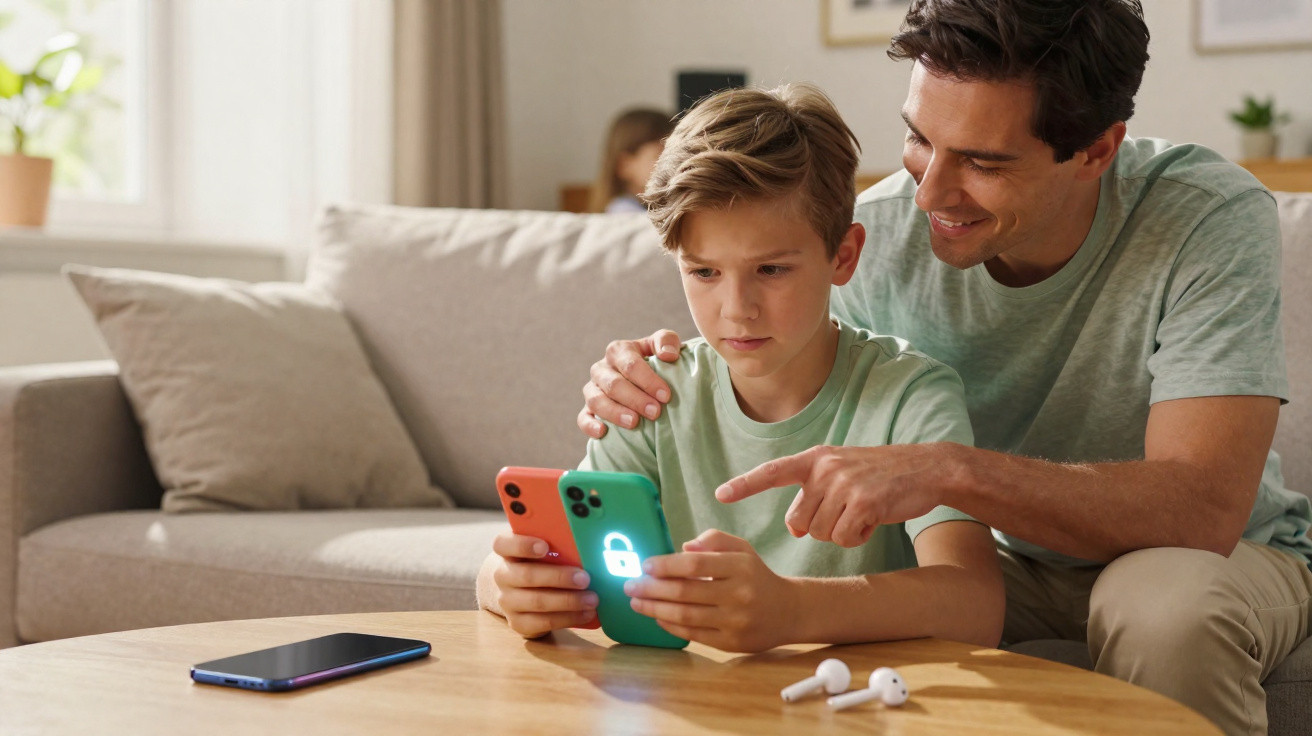
The Neow Safe Plus is a smartphone designed for pre-teens. With no social media, no web browser and strengthened parental controls, could it be the ideal answer for parents? We asked a teenager to try it out.
As parents, we all dread the day: children grow up and eventually ask for a smartphone. This usually happens when they start secondary school. In a world dominated by screens and notifications, the request is understandable. Giving a pre-teen a smartphone has its benefits, not least the reassurance of being able to contact them whenever necessary. On the other hand, there are understandable concerns about social media and everything that comes with it. So what is the answer? This is where Neow, a brand selling “limited” smartphones, comes in.
The Neow Safe Plus aims to reassure parents
Neow is a brand from HEM, a Marseille-based technology wholesaler. Its premise is straightforward: create smartphones for teenagers that are intended solely for communication. These devices run a highly restricted version of Android, with no pre-installed apps, browser, social networks or Play Store, while parents can manage them remotely, as Neow’s Luc-Marie Brisset explains:
“Generally, parents give their child an old smartphone that has been sitting in a drawer. Our aim is to replace that habit with a suitable first smartphone.”
As any parent will know, it can be difficult to let children loose in the wider digital world. Pre-teens encounter online pornography at a very young age, 11 on average, while cyberbullying has become commonplace. Yet leaving children without any option when all their friends have phones is not ideal either: on average, a young person in France gets their first smartphone at 11. Is Neow’s approach dependable? Can this type of phone work as a first device for a secondary-school pupil? We put it to the test.
Is it a secure solution?
Neow sells ready-to-use smartphones running a heavily restricted Android version, without a browser or the Play Store. Rather than simply offering a locked-down handset, the French company is effectively selling an entire ecosystem.
It provides a family-focused interface, for example. After linking the Neow phone to their Google account, parents can use a web page to approve or refuse particular applications:
“Through the Family page, and soon the app, you can allow certain apps and set a time limit for them. For instance, my teenager has friends over. They want to play Roblox together, so I can unlock the app and set a usage limit, such as a maximum of 45 minutes.”
This is Neow’s central selling point: complete control over how the device is used. There is no Play Store, but there is a dedicated shop that filters and selects applications from Google:
“Some applications are on a whitelist, such as the school canteen card or bus pass.”
Neow also includes useful features such as GPS location tracking. It is not permanently enabled, but it allows parents to establish their teenager’s location if required. That remains reassuring.
We gave the Safe Plus to a pre-teen - and they were not convinced
The smartphone sits at the centre of this ecosystem. Neow lent us its top-of-the-range model, the Safe Plus, which costs €150. It makes a decent first impression, with styling reminiscent of the Galaxy S26. However, its shortcomings quickly become apparent once it is used. From a technical perspective, it is a very basic device, even dated. The Safe Plus has a modest Unisoc Tiger T606 processor, a 6.6-inch IPS display with a 1,280 × 576-pixel resolution, 4 GB of RAM and a 13-megapixel camera. At this price, the technical compromises are understandable. Even so, those limitations make for a difficult experience, including for younger users.
The poor screen is difficult to read outdoors, while the underpowered processor causes frequent slowdowns when moving around the interface. It is frustrating. Roblox, or any other demanding game, is effectively out of the question. That is not necessarily a problem, as this is not a handset built for entertainment, but a smoother experience would still have been welcome. Add the complete lack of biometric security and a camera worthy of a 2015 entry-level phone. To be fair, as technology journalists, we are not really the target audience. We therefore tried giving the Safe Plus to a pre-teen. They were equally unconvinced, to the point that they did not even want to use it properly. Their friends have conventional Android smartphones or their parents’ older iPhones, after all. Turning up with a Neow and facing ridicule would be unthinkable.
Luc-Marie Brisset is aware of this issue:
“Obviously, moving from an iPhone to a Neow can be frustrating. Our smartphones were designed as a first phone, a first experience before moving on to something else. Welcome to Year 7: here is your Eastpack, your bus pass and your Neow; it is a gradual, rather than forced, process.”
Unfortunately, the Neow is unlikely ever to be a pre-teen’s true first phone. Even if they have never owned one, they already understand the format, the freedom it provides and its performance. They will inevitably have used a more premium phone belonging to a friend or parent, whether for a video call or to play games at family gatherings. Still, Neow could offer peace of mind to parents who want to impose it on their teenager. There is genuine reassurance in knowing that a son or daughter is using a highly protected, controlled product designed to avoid unpleasant surprises. Whether they will like it is another matter. Our young tester even described it as a punishment, which says it all. As adults, however, we saw the benefit: we knew we could reach them.
It could be argued that Neow offers a solution already available by default on standard Android and iOS handsets. Google, for instance, includes the highly comprehensive Family Link parental-control app. It lets parents manage screen time, permitted apps and even locate another smartphone in real time. iOS offers the same kind of solution. These features can, however, be bypassed fairly easily with a little ingenuity. That is not the case with Neow, and it is one of its strengths.
Should you buy one?
Why choose a Neow Safe Plus over a standard Android smartphone for a pre-teen? The French brand’s strength lies in its ready-to-use package. With Android locked down at its core and no browser or Play Store, it is difficult for teenagers to be sneaky or get around the restrictions. Its other major advantage is the price. At €150, this first phone remains a reasonable expense for a family. Unfortunately, although the Neow is likely to win over parents, it may not satisfy children faced with a slow device, a poorly legible screen and a camera incapable of taking attractive photos.
That is a shame, because the French brand’s underlying philosophy is compelling. Why not apply the idea to more capable smartphones? In any case, Neow intends to keep expanding its offering:
“We have already sold 25,000 phones, and our goal is to double that figure this year.”
That ambition will need to be supported by more pleasant products that do not lag with every interaction. The brand is very young and still has time to establish itself in its segment. Until then, the Neow Safe Plus may serve as a stopgap option for concerned parents who do not entirely trust Android or iOS parental controls.










Comments
No comments yet. Be the first to comment!
Leave a Comment