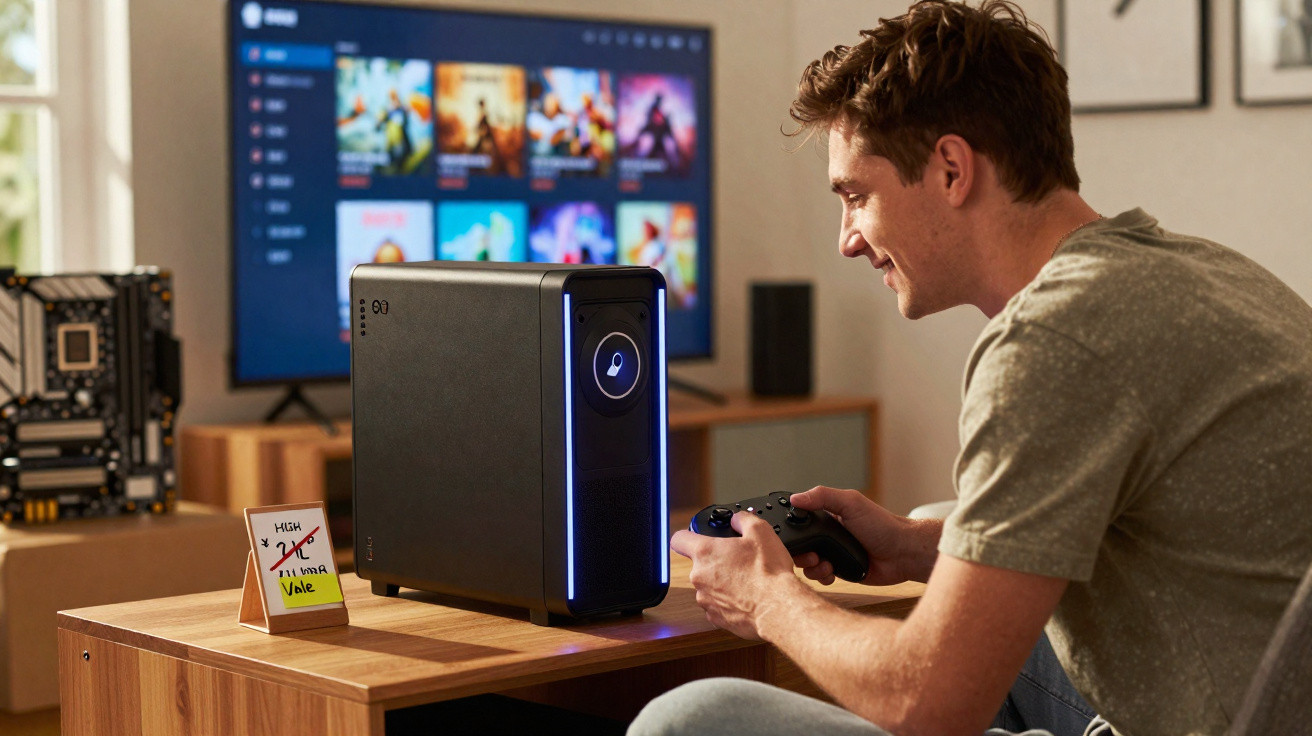
Despite its excessively high price, driven by the memory chip shortage, Valve’s Steam Machine does not appear to be a commercial failure for now.
The Steam Machine arrived at arguably the worst possible time, making a flop seem almost inevitable. By way of reminder, Valve launched the console with a starting price of €1,039 for the 512 GB model. That rises to €1,428 for the 2 TB version supplied with a Steam Controller. Why are the prices so steep? The memory chip shortage, caused by the race for artificial intelligence. Like many electronics manufacturers, Valve had no option but to raise its prices above the levels originally planned.
Steam Machine sales estimates
Valve has not released official sales figures for the console. However, available estimates suggest that, while it cannot be described as a runaway success, the Steam Machine is not the flop many expected either. Is this down to “early adopters”, or to the anticipation surrounding the product? Valve is reportedly selling between 12,000 and 15,000 units each week. This is the estimate from Boiling Steam, which based its calculations on available data, including the Steam chart, where the Steam Machine is among the Top 3 best sellers.
“At the moment, this does not appear to be a commercial failure, but rather a niche device,” comments Boiling Steam. However, it also notes that demand is likely to fall once the launch excitement has passed.
Valve had hoped to sell the Steam Machine at a more reasonable price
In any case, Valve acknowledges that the Steam Machine is substantially more expensive than the price originally envisaged for the console. When the company designed the Steam Machine, it expected component prices to decline over time as new technologies emerged. However, the situation developed differently, particularly for RAM and storage. As a result, Valve’s initially planned price was no longer viable in 2026.
“The prices we are announcing today therefore reflect current global manufacturing conditions. Or, more precisely, the cost of components as we negotiated them over the past six months,” the company explains. Moreover, these costly components are sometimes simply unavailable. “At certain times, we found that it was simply impossible to obtain some of the required components, regardless of the price. More than anything else, this affected the number of units we were able to produce before the product launch,” the company explains.
The impact of the memory chip shortage
Our view
Because of this situation, some technology products simply disappear or are cancelled. Apple, for example, stopped selling the cheapest version of its Mac mini. Nothing has also admitted that it simply cancelled a smartphone because of the memory chip shortage.












Comments
No comments yet. Be the first to comment!
Leave a Comment