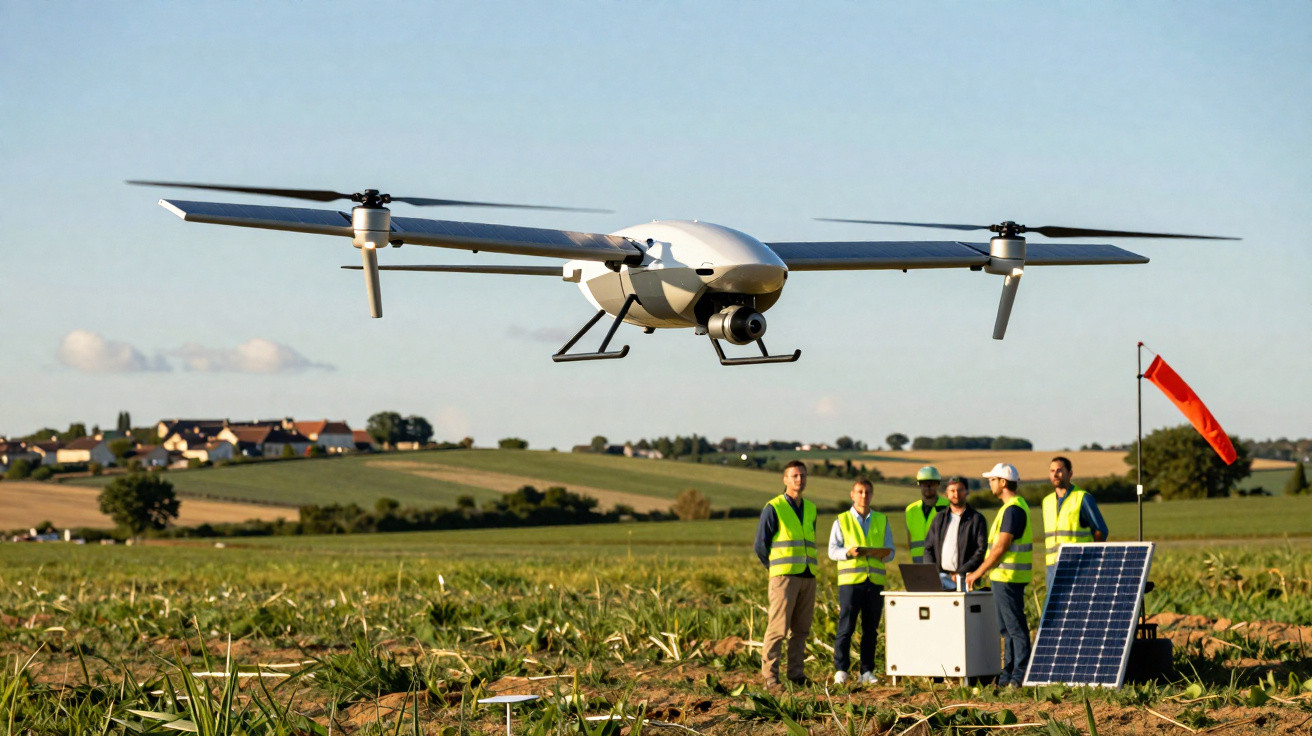
Inspired by nature, the French solar drone Heliblade has successfully completed its first-ever flight test. It marks a decisive initial step for this revolutionary aircraft, which has been designed to remain at an altitude of 20 km for several months.
Heliblade’s first controlled flight
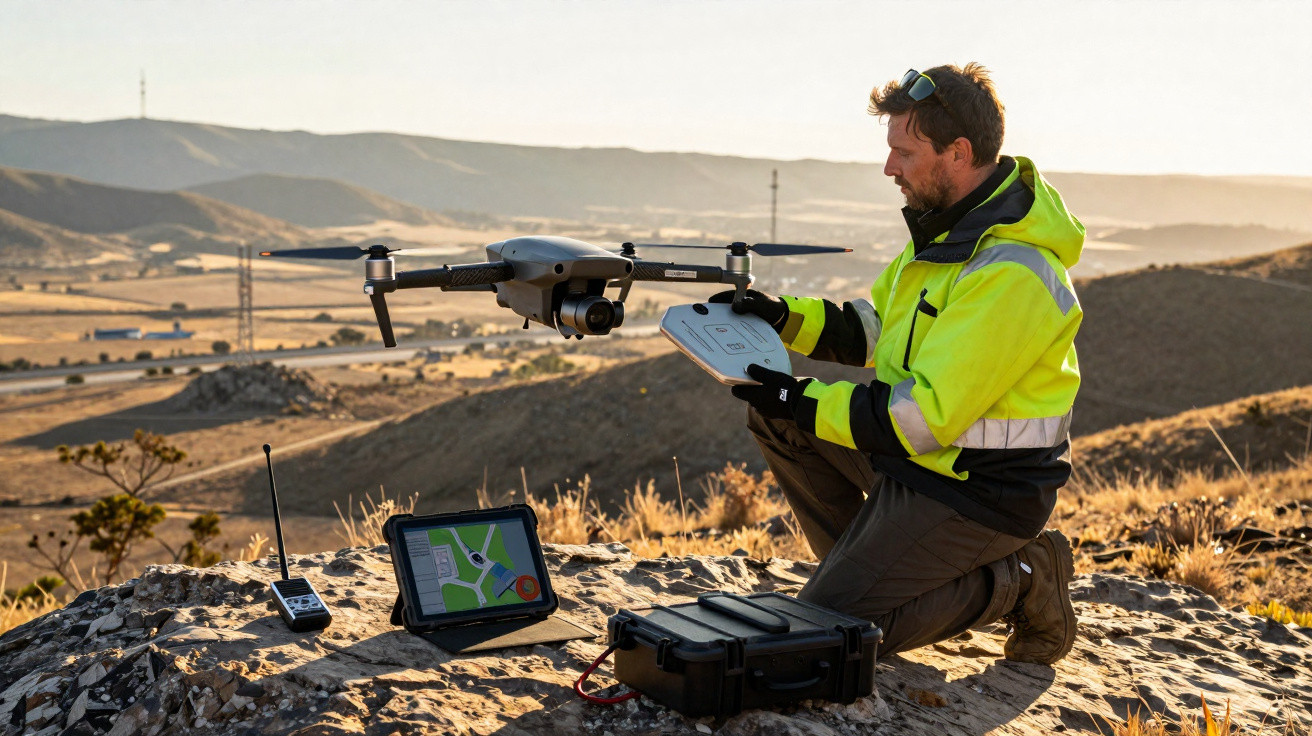
The Heliblade programme, a stratospheric solar drone project with rotating wings, has reached its first tangible milestone. X721 has officially announced the success of its inaugural mission, named M001, carried out on 24 July 2026 in Nouvelle-Aquitaine. During this outdoor test, which lasted around ten minutes, the “model 11” demonstrator confirmed the concept by completing a controlled flight at two successive levels: 15 and then 35 metres above the ground.
Although this is currently only a small prototype, with an 18-metre wingspan and weighing less than 4 kilograms, the trial confirms the aircraft’s fundamental principles. “Today, centrifugal forces have won a small battle against gravity… Just a few minutes ago, Heliblade was only a prototype. Today, it has become an aircraft by demonstrating its ability to fly in a controlled manner,” said Pierre-Eric Lys, chief executive and chief engineer of x721.
How the Heliblade solar drone works
To develop Heliblade, its engineers took their inspiration from the samara, the maple seed that spins as it falls. The project is built around a clear principle: using natural forces intelligently to achieve more with less.
Unlike conventional drones, it relies on an ultra-light rotating-wing architecture. Its stiffness and in-flight stability therefore do not depend on a heavy structure, but on the centrifugal force created by its own movement. In its final form, the aircraft will have a 50-metre wingspan and weigh less than 70 kilograms.
Powered by solar energy and high-tech batteries, the aircraft will take roughly 9 hours to reach the stratosphere, more than 20 km above sea level. It will be able to hold position there for several weeks, or even several months, while withstanding extreme temperatures ranging from -40 to -80 degrees Celsius.
Subscribe to Presse-citron
Multiple uses for Heliblade
Able to carry up to 10 kg of payload, including cameras, sensors or telecommunications relays, Heliblade is intended for a wide range of applications. It is no coincidence that this first test was conducted for, and with the support of, the French Air and Space Force, the Directorate General of Armaments (DGA) and the Defence Innovation Agency (AID). Easy to transport thanks to its low weight and capable of being deployed anywhere in the world in less than 72 hours, it fits directly into France’s strategy for very high-altitude operations.
The drone could, among other roles, carry out intelligence missions, electronic listening and the detection of strategic movements, troops or missiles. In civilian use, it will provide a cost-effective and environmentally friendly alternative to traditional satellites, without producing space debris. It could notably be used to spot forest fires quickly, monitor vast natural areas or restore communications above regions affected by a natural disaster.
x721 is targeting its first stratospheric flights by 2028, followed by commercialisation by 2030.










Comments
No comments yet. Be the first to comment!
Leave a Comment