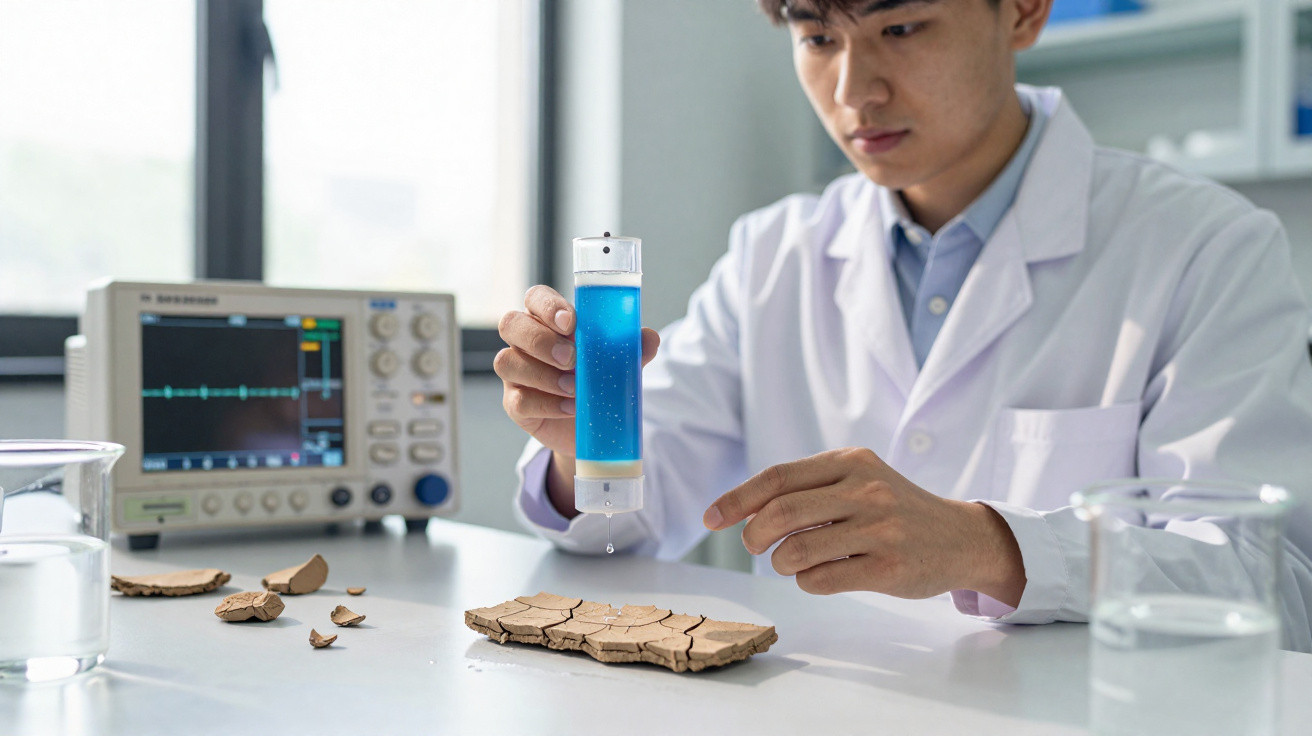
Nobody deliberately puts water into an energy-storage device. Batteries and supercapacitors are all made to exclude it: water corrodes electrodes, weakens electrolytes and, in most cases, damages performance. The accepted view has been that water and stored electricity are incompatible.
Researchers at a Swiss university have now identified an exception to that rule. When water is enclosed in channels only around one nanometre wide within an ordinary clay mineral, it begins to transport electrical charge itself.
Charge without the chemistry
The device is a form of supercapacitor, related to a battery but storing charge physically rather than by chemical reactions. Its creators at the Swiss Federal Institute of Technology in Lausanne (EPFL) have named it the blue capacitor.
The research was led by Professor Aleksandra Radenovic, whose EPFL laboratory examines the behaviour of water and ions compressed into gaps just a few atoms across. Her team set out to test whether this unusual behaviour could power an actual device.
Conventional supercapacitors and batteries depend on concentrated salts or specialised solvents to carry charge. These components make recycling more difficult and increase environmental costs. Radenovic’s team instead aimed to use as few materials as possible.
Water charge in clay
Water forced into a channel roughly a nanometre across-the span of several molecules-no longer acts like water in a glass. Protons pass through it more readily, while the way it holds charge also changes.
Physicists have recorded these effects for years using small laboratory arrangements, while a recent study followed how confined water transports charge along such narrow layers. However, those systems remained microscopic and were difficult to develop into practical technology.
Clay provided a possible solution. Layered clays including montmorillonite, one of the most widespread minerals in the Earth’s crust, form stacks of sheets that hold water in nanometre-wide spaces when wet.
Building the EPFL blue capacitor
The team made the device by layering clay sheets with graphene, the highly conductive carbon material that is one atom thick. The materials were deposited one layer at a time by filtering water-based mixtures through a fine membrane.
The resulting film is slim and flexible, measuring no more than the thickness of a couple of sheets of paper. It consists of two graphene-clay electrodes enclosing a pure-clay layer, with water-filled channels about one nanometre wide extending through the stack.
Its distinguishing feature is the absence of free-flowing liquid. There is no reservoir of liquid electrolyte and no container of salty solution. Instead, the electrodes, separator and water that carries charge make up a single continuous structure. Before this, no full-sized device had operated using confined water alone.
Protons in water carry charge
The evidence indicates that protons are the principal charge carriers. They are the exposed positive cores of hydrogen atoms, present in small quantities in plain water.
As voltage is applied across the film, the protons move through its water channels towards the electrodes.
They are not thought to cross the entire route as individual particles. More probably, a proton jumps along a chain from one water molecule to the next, moving charge much more quickly than the water molecules could move themselves.
Once the protons arrive at the graphene, charge accumulates at the interface between the carbon and water. This is the point at which the energy is stored.
The team verified the protons’ part by introducing a chemical that absorbs them, which greatly reduced the charge the device could retain.
Dry clay loses charge
The most direct evidence that water performs the function came when it was removed. After the researchers dried the clay membranes, their charge-storage capacity fell dramatically to a very small share of its earlier level.
When water was restored, the device operated again. This reversible result showed the researchers that the water itself, rather than the surrounding dry clay, was responsible for storage: a straightforward on-off experiment.
They also produced devices using several distinct clays, each possessing its own inherent lattice charge.
The outcomes were generally alike, suggesting that the specific mineral mattered less than the existence of nanometre-wide water channels.
How it performs
The device maintained its performance under demanding conditions. It completed more than 60,000 charging and discharging cycles without visible degradation, a lifetime that would wear out many conventional cells.
Ordinary water usually separates into hydrogen and oxygen at around 1.23 volts, limiting the voltage at which water-based equipment can operate. The confined water remained stable until 1.6 volts before this decomposition began, providing greater capacity for energy storage.
It delivered back about 97% of the charge it received, close to the upper limit for this category of device.
Its performance equalled the energy performance of commercial supercapacitors. According to a review of aqueous battery designs, these conventional products use concentrated electrolytes, which this device avoids.
Toward cleaner storage
The study demonstrates something specific: water contained in one-nanometre clay channels can act as the complete electrolyte in an operational, full-sized energy-storage device.
Its components are inexpensive and widely available-clay, graphene and water. There is nothing scarce and no material requiring costly refining. As noted in a recent paper, these materials also avoid the substantial mining impact associated with lithium cells.
At present, it is a proof of concept rather than a product available to purchase. Even so, it gives researchers a functioning device, rather than a nanoscale novelty, on which to develop renewable energy storage using readily obtainable materials.
For the first time, the research demonstrates that a full-size device can store charge through a markedly different mechanism.















Comments
No comments yet. Be the first to comment!
Leave a Comment