
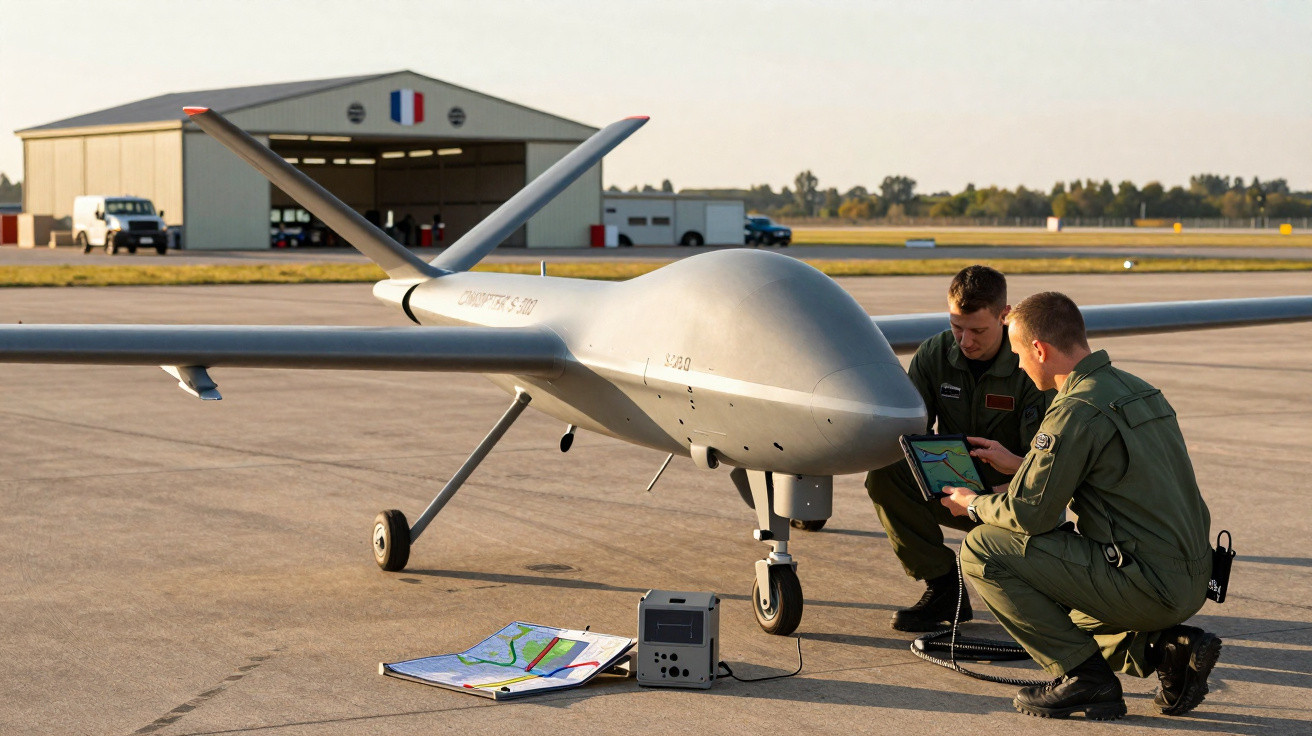
What may appear to be a compact helicopter is actually a sophisticated unmanned aircraft. France’s choice to base it on French territory points to a change in how European armed forces intend to conduct combat, patrols and intelligence collection over the next decade.
Austrian combat drone quietly reaches 100 hours over France
Above Gironde’s pine woodland, the CAMCOPTER S-300 has reached a notable benchmark: 100 hours of test flying from the CESA Drones facility in Sainte-Hélène. Manufactured by Austrian company Schiebel, this helicopter-type drone is undergoing demanding trials in France to demonstrate that it can meet the requirements of contemporary military operations.
These flights are far more than routine demonstrations. Engineers and military personnel have been widening the S-300’s flight envelope by testing varied speeds, heights and flight profiles, while placing its systems under pressure across realistic mission situations.
The S‑300’s test campaign in France suggests European forces are getting serious about long-endurance, carrier-capable unmanned helicopters.
By carrying out a substantial part of the programme from French sites, Schiebel is making its intentions clear: it views France both as a proving ground and as an important prospective customer, at a time when naval and air forces are moving quickly to incorporate more autonomous technology.
A growing Schiebel-France partnership
Schiebel is no newcomer to France. Through its French subsidiary, Schiebel Aéronaval SAS, the manufacturer has worked with the French Navy for many years. The S-300 has been developed as a larger and more capable successor to the extensively deployed S-100, which is already operated from vessels worldwide.
For France, accommodating the tests brings a number of benefits. Domestic trials enable French officers to influence the drone’s development around European operational requirements, while allowing national industry and regulators to observe directly how these systems function in shared airspace.
- Access to comprehensive flight data and performance records
- Early participation in operational concepts and training approaches
- Possible industrial offsets and maintenance work in France
- Closer compatibility with future European drone standards
This collaboration is underpinned by a wider goal: creating a more sovereign European unmanned aviation ecosystem rather than depending wholly on American or Israeli platforms.
How the CAMCOPTER S‑300 performs in flight
At Sainte-Hélène, test teams have been assessing the S‑300’s stated performance capability point by point. They are observing its behaviour in tight turns, its capacity to hold an accurate hover in gusting conditions, and its reactions when the ground control station replicates data-link disruptions or sensor faults.
Environmental factors are just as important as software. Operations in humid Atlantic conditions, heat, cold and crosswinds help establish whether the airframe and avionics can withstand demanding maritime missions, where salt, spray and abrupt weather shifts are commonplace.
Every extra validated flight hour makes the S‑300 less of a prototype and more of an asset that commanders can realistically plan around.
Derived from a proven bestseller
The S‑300 is not being developed from a blank page. It draws on extensive design experience from the smaller CAMCOPTER S‑100, which has accumulated hundreds of thousands of flying hours with navies and coastguards. The S‑100 has supported shipborne surveillance, anti-submarine operations and coastal observation, including the release of sonar buoys and real-time signal relay.
The S‑300 takes that concept further. Its larger size gives it greater range and increased payload capacity, enabling it to carry heavier radar systems, electro-optical sensors, electronic warfare pods or logistics cargo. Operationally, this could provide longer sorties over open water, more intelligence-collection bandwidth and the ability to operate multiple sensors during one flight.
Designed from the outset for international operators
While the present test programme is based in France, the S‑300 is plainly intended for an international customer base. Its avionics and data links follow NATO standards, simplifying integration with established command-and-control networks.
Its modular architecture allows users to exchange payloads: during one week, it may conduct naval maritime surveillance, while the following week it could help a civil authority monitor wildfires or assist search-and-rescue operations. Governments seeking dual-use capability are likely to take close notice of this adaptability.
The same unmanned helicopter that spots enemy patrol boats one month could be flying above burning forests or flood zones the next.
Towards more connected and autonomous combat aviation
The S‑300 is more than an airborne platform; it serves as a node within a broader digital ecosystem. Schiebel has equipped it with high-bandwidth communications and autonomy features supported by onboard software and AI algorithms. Crews set the mission profile in practice, after which the drone can fly most of its route independently while sending sensor information back to ships or ground centres.
This semi-autonomous model reduces the interval between detection and decision-making. If an S‑300 identifies a suspicious vessel, it can alert a frigate’s combat system within seconds, helping commanders determine whether to monitor, challenge or intercept it. During joint missions, its data may be combined with information from satellites, crewed aircraft and other drones.
Next steps in the CAMCOPTER S‑300 test schedule
Schiebel has already outlined the stages planned after the French land-based trials conclude. Attention will move increasingly towards maritime use and operational integration.
| Stage | Planned timeframe | Main objective |
|---|---|---|
| Sea state trials | Q1 2026 | Validate handling and sensor performance in rough seas |
| Military network integration | Q2–Q3 2026 | Connect to national tactical data links and command systems |
| Partner deployments | Late 2026–2027 | First export contracts and operational deployments |
Provided the timetable is maintained, the S‑300 may progress from a test-range prospect to a frontline asset by the end of 2026 with at least one partner force.
Why France’s choice matters for future conflicts
France’s role in hosting this programme is not merely a technical detail. As a nuclear power with a blue-water navy, Paris influences NATO thinking on maritime security and power projection. Validation of the S‑300’s abilities by the French Navy and Air and Space Force could prompt other European nations to pursue it.
The wars in Ukraine, the Red Sea and the eastern Mediterranean have illustrated how drones alter the balance of risk. Unmanned systems can scout, jam, follow and even strike without exposing a pilot to danger. A helicopter-style aircraft such as the S‑300 also provides vertical take-off and landing, an important advantage on confined decks and in remote, difficult terrain.
However, associated risks remain. Extensive dependence on autonomous systems raises concerns over hacking, jamming and rules of engagement. Armed forces will require strong safeguards to retain control of these platforms and avoid incidents in congested airspace.
Key terms and scenarios to watch
Two concepts regularly associated with platforms such as the S‑300 merit explanation.
Flight envelope describes an aircraft’s safe operating boundaries: the maximum and minimum speeds, altitudes, bank angles, temperatures and wind conditions it can manage. Extending the S‑300’s envelope in France means demonstrating that it remains safe when operating nearer to those boundaries.
Interoperability describes a drone’s ability to communicate with other systems without requiring bespoke work on every occasion. For instance, within a NATO naval task group, an S‑300 launched from a French vessel could send video and radar tracks directly to a British destroyer or a US operations centre through shared communications standards.
In a plausible crisis, several S‑300s could circle over a section of coastline to create a persistent surveillance screen. One aircraft could carry radar to detect low-flying missiles, another might use an infrared camera to search for small boats, and a third could relay information to a command ship. Together, they could extend the coverage of crewed aircraft, allowing those aircraft to concentrate on interception instead of continuous patrols.
Civil applications are also likely to form part of the offering. Large unmanned helicopters can inspect pipelines, survey offshore wind farms or operate as airborne communications relays during natural disasters when ground infrastructure has been damaged. For states funding both defence and resilience, such dual-use capability may make the investment easier to support.




Comments
No comments yet. Be the first to comment!
Leave a Comment