
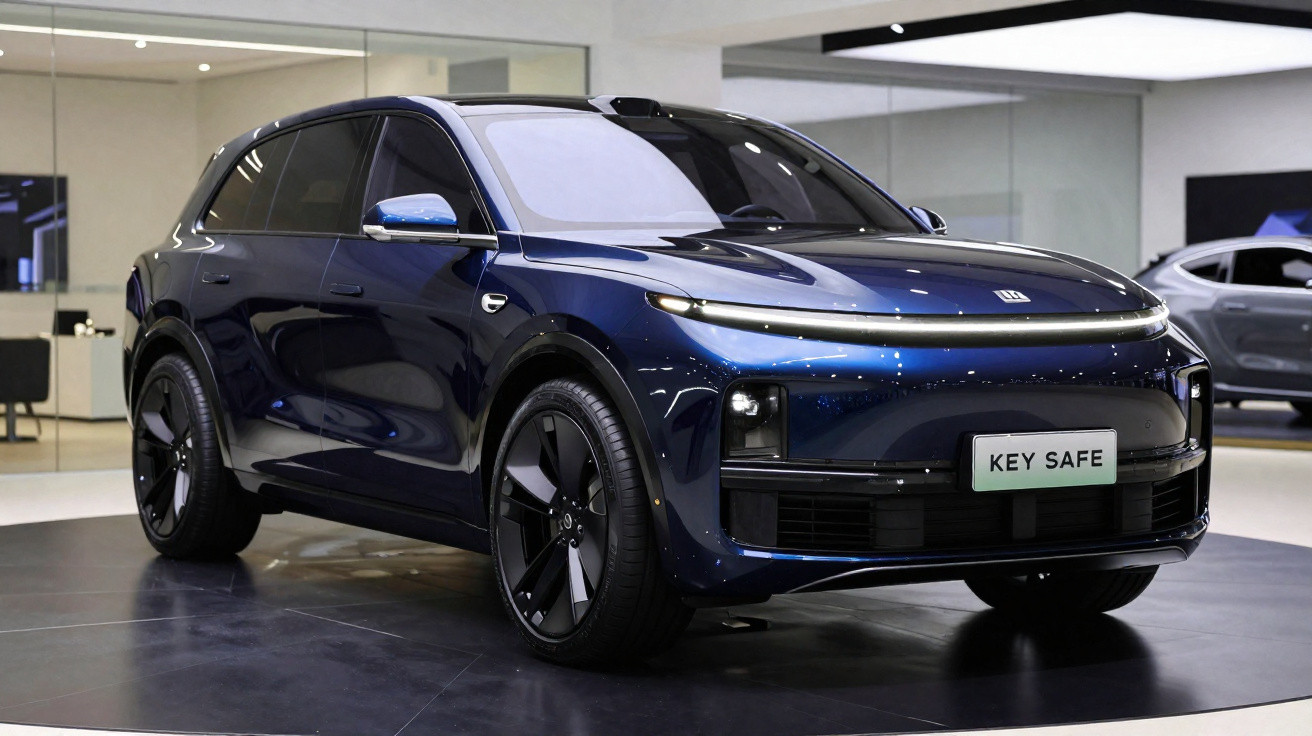
A hoodie, trainers and a phone in his hand. He is not picking a lock or smashing a window; instead, he is holding a small dark gadget loosely towards the property. Half a minute later, the lights on your car flash in the drive. The doors open, while the alarm remains silent.
Meanwhile, you are in the kitchen washing up, with no idea that the signal from your car key has been captured through a wall and extended directly to the vehicle. There is no broken glass and no revving engine. It is a silent theft, completed faster than reheating leftovers in a microwave.
When you realise the following morning that the car has vanished, all that remains is an empty patch at the kerb and one persistent question: how did they get access so easily?
The explanation may be lying beside your front door.
Why criminals love your “smart” keys more than you do
Take a walk along almost any residential road late at night and the picture is familiar: cars parked neatly in a row, their keyless-entry systems silently active and waiting for a signal. The “smart” keys that rarely leave your pocket are continually communicating with the car, even when you are not using them.
For you, that means effortless convenience. For a particular kind of thief, it represents a round-the-clock invitation.
Keyless-entry fobs send out a low-power radio signal. When you are nearby, the vehicle detects the fob and unlocks. However, the definition of “nearby” can be manipulated. Using inexpensive amplifiers available online, thieves can collect that weak signal from your hallway and extend it across to the drive.
It may sound like science fiction, yet it is occurring on completely ordinary streets.
Police reports throughout Europe, the UK and the US increasingly include terms such as “relay attack” and “signal amplification theft”. In certain cities, insurers privately acknowledge that a substantial proportion of thefts involving modern cars happen without a window being smashed.
This is the usual sequence. One thief approaches your front door or an external wall carrying a signal booster about the size of a paperback book. A second waits beside the car with another device. The first device searches for the faint radio transmission from the key fob inside, which may be on a console table or thrown into a bowl.
After picking up the signal, the device strengthens it and sends it to the accomplice. The car then believes that its key is beside it. The doors open and the engine starts. No codes have been cracked and no alarm is activated. It is simply a ghost key produced in mid-air.
In 2023, a number of European insurers reported that particular keyless SUVs and premium cars were being stolen with this exact technique in under 90 seconds. Some makes were targeted so often that owners saw their premiums rise solely because of the key system.
Victims often describe an unsettlingly similar experience. There was no sound overnight and no CCTV footage showing anyone forcing entry. Instead, a hooded person lingered briefly by the front door before the car quietly disappeared along the road.
Technology marketed as “effortless convenience” has given organised gangs a discreet shortcut.
So what does kitchen foil have to do with it?
How a simple sheet of aluminium foil can shut the door on relay attacks
The radio signal produced by your key fob is like a tiny, invisible beam of light. Aluminium foil works like a shutter. Wrapping the key in foil creates a basic Faraday cage, blocking, reflecting or reducing the signal until relay equipment has nothing useful to amplify.
There is nothing magical about it; it is simply basic physics used in a very low-tech manner.
The process at home is almost comically straightforward. Pull off a reasonably large sheet of kitchen foil, wrap the car key fob until it is entirely covered, and keep the small silver parcel away from doors and windows. No subscription is needed, nor an app or firmware update.
Is foil flawless? No. Thin, ripped or poorly wrapped foil can still allow some signal to escape. For many keyless systems, though, even a basic foil covering makes the thief’s task considerably more difficult. That is often enough to make them look for an easier target two houses away.
It offers another advantage, too: wrapping the key at home disrupts the routine of dropping it into the bowl beside the front door. That bowl may as well be a beacon for relay thieves walking along the pavement.
At a human level, this is not about being frightened. It is about introducing one small obstacle into a crime that has become far too seamless.
When people hear “wrap your keys in foil”, they tend either to laugh or to feel slightly silly. It can sound like the sort of advice a paranoid uncle would post in a Facebook group at 2 a.m.
However, speak with cyber-security specialists and car-crime investigators and a trend soon emerges: many use some type of signal blocking at home, particularly for keyless cars. Some choose sophisticated Faraday pouches, while others rely on metal tins. A surprisingly high number quietly acknowledge using aluminium foil at some point, even if only to test whether their key was constantly signalling to the car.
One driver based in London discovered the issue accidentally. He noticed that his car occasionally unlocked when he walked past his own front door from inside the house. The key was on a hook less than a metre from the wall. He wrapped it in foil, and the phantom unlocks stopped overnight.
Once you recognise the risk, it is difficult to overlook it. Everyday routines can suddenly appear to be invitations.
The reasoning behind foil is straightforward: thieves cannot amplify a signal that does not reach outside. Blocking or weakening radio waves at their origin is not an attempt to outwit advanced hackers. It is simply closing a window that was left open by design.
There is a psychological change, too. Once you view a key as a broadcasting device rather than an ordinary object, you start reconsidering where it is left, how it is stored and what happens overnight. It moves you away from passive faith in “smart” technology and towards a more alert relationship with your belongings.
Turning foil into a simple, daily security habit
How can you use foil without making your home feel like a DIY bunker? Begin with a single car key. Tear off a rectangular piece of aluminium foil large enough to cover the fob at least twice. Put the key in the centre, fold the edges over it, then fold it again so that no clear gaps remain and no corners protrude.
After wrapping it, walk towards your car while leaving the foil in place. If the doors do not unlock automatically, that is a positive indication that the signal is blocked or heavily reduced. If they still unlock without difficulty, add another layer or try slightly thicker foil.
Choose one regular place at home for the wrapped key: a drawer, a metal biscuit tin or a small box on a shelf away from the front door. The aim is to make it a short ritual: keys in, lid shut, day finished. It takes less time than checking your notifications once more before going to bed.
There are several very human ways this can go wrong. You may forget to wrap the key again after driving. You may leave the fob on the table “just for tonight”, then return to the old habit for months. Your partner may also quietly decide that you have become slightly excessive with the silver parcels.
A little empathy is useful here. Most people are tired in the evening, and nobody wants an extra task in an already chaotic routine. Do not seek perfection; aim for “most nights, without stressing about it”.
Let’s be honest: nobody really does this every day.
If foil seems too strange, use it as a short-term test before buying a small Faraday pouch or metal key box when you are satisfied the risk is genuine. The important benefit is not the foil itself, but breaking the unseen connection between your sofa and your car door.
“I used to laugh at the idea of wrapping my keys,” says Mark, a 38‑year‑old engineer who had his SUV stolen from right outside his home. “The police officer showed me CCTV of the guy standing by my front door with some kind of antenna in his hand. I went out the next day, bought foil and a metal tin, and I’ve never left my keys by the door since.”
Treat foil as a basic first shield rather than a permanent way of life. For many readers, it can also prompt stronger routines:
- Keep keys further away from doors and windows.
- Use foil or a Faraday pouch overnight, particularly when the car is parked on the drive.
- Check with your dealer whether the keyless system has a “sleep” mode.
- Consider a visible steering-wheel lock as an additional deterrent.
- Discuss relay theft with neighbours, so the whole street becomes less appealing to thieves.
At a deeper level, this small silver wrapping is symbolic. It is a quiet decision not to let convenience automatically take priority over security.
A small piece of foil, a bigger conversation about “smart” life
There is something almost poetic about countering high-tech car theft with the same material used to wrap leftover pizza. It reveals the divide between the polished promise of “keyless” living and the harsher reality of how the technology works in the real world.
We are now surrounded by objects that communicate with one another: keys, locks, cameras, thermostats and even fridges. While we sleep, they exchange data and signals. On most days, nothing goes wrong. Then, one morning, a car is missing from the kerb and a family must reconsider their commute, finances and sense of security.
Relay theft can feel especially intrusive because nothing appears damaged. You wake up to an intact house, untouched windows and a locked front door. The violation cannot be seen. That is why an act as visible and physical as covering keys in foil can strike a nerve. It gives you something practical to do with your hands, rather than merely sitting with your fears.
We have all double-checked the door, checked it again, then lain awake replaying the sound of the lock. Wrapping a key does not make you a paranoid prepper. It merely puts another layer between your private life and people who regard your car only as a resellable item on a list.
Some readers will try it tonight and feel slightly less exposed. Others will see it as excessive. Both are honest responses. The understated reality is that car thieves usually choose places with the least resistance, where signals travel freely and no one has considered them. Foil is resistance in its most basic form.
Perhaps the real subject is not “aluminium foil vs high-tech thieves”. It is learning to understand everyday gadgets as elements of a wider system, rather than isolated little miracles in our pockets. The moment you ask, “What is this thing broadcasting? To whom? When?”, you begin a different form of digital adulthood.
And perhaps that small, slightly crumpled ball of foil on your shelf will start a conversation with your children, partner or next-door neighbour: a discussion about trust, convenience and what we quietly give up when we allow our possessions to communicate behind our backs.
| Key point | Detail | Why it matters to the reader |
|---|---|---|
| Keyless systems constantly emit signals | Your fob communicates with the car even while it is sitting in a bowl at home | It helps explain why thieves do not need to break in to steal your car |
| Relay attacks use cheap signal amplifiers | Thieves extend your key’s signal from inside the house to the drive | It makes the danger feel real and specific, rather than mere “tech jargon” |
| Aluminium foil can block or weaken the signal | Wrapping the key creates a simple Faraday-style shield at home | It provides a cheap, immediate step to protect your vehicle tonight |
FAQ:
- Does wrapping my car key in aluminium foil really work? In many cases, yes. Properly wrapped foil can block or seriously weaken the radio signal from your key, making relay attacks harder or impossible for thieves targeting your driveway.
- Isn’t a Faraday pouch better than aluminium foil? Faraday pouches are neater and designed for daily use, but foil is a cheap, quick alternative that lets you test the idea and get protection straight away while you decide if you want a dedicated product.
- Can thieves still clone my key if it’s wrapped? Wrapping the key at home blocks the live signal, so relay-style theft is much more difficult. No solution is perfect, yet reducing the signal exposure significantly lowers your risk for this kind of attack.
- Where should I keep my wrapped keys at night? Store them away from doors and windows – for example in a drawer, metal tin or box in the kitchen or hallway, rather than on a hook or tray right by the front door.
- Will aluminium foil damage my key fob or stop it working later? No. Foil doesn’t harm the electronics. Once you unwrap the key, it should work exactly as before, unlocking and starting the car normally.



Comments
No comments yet. Be the first to comment!
Leave a Comment