
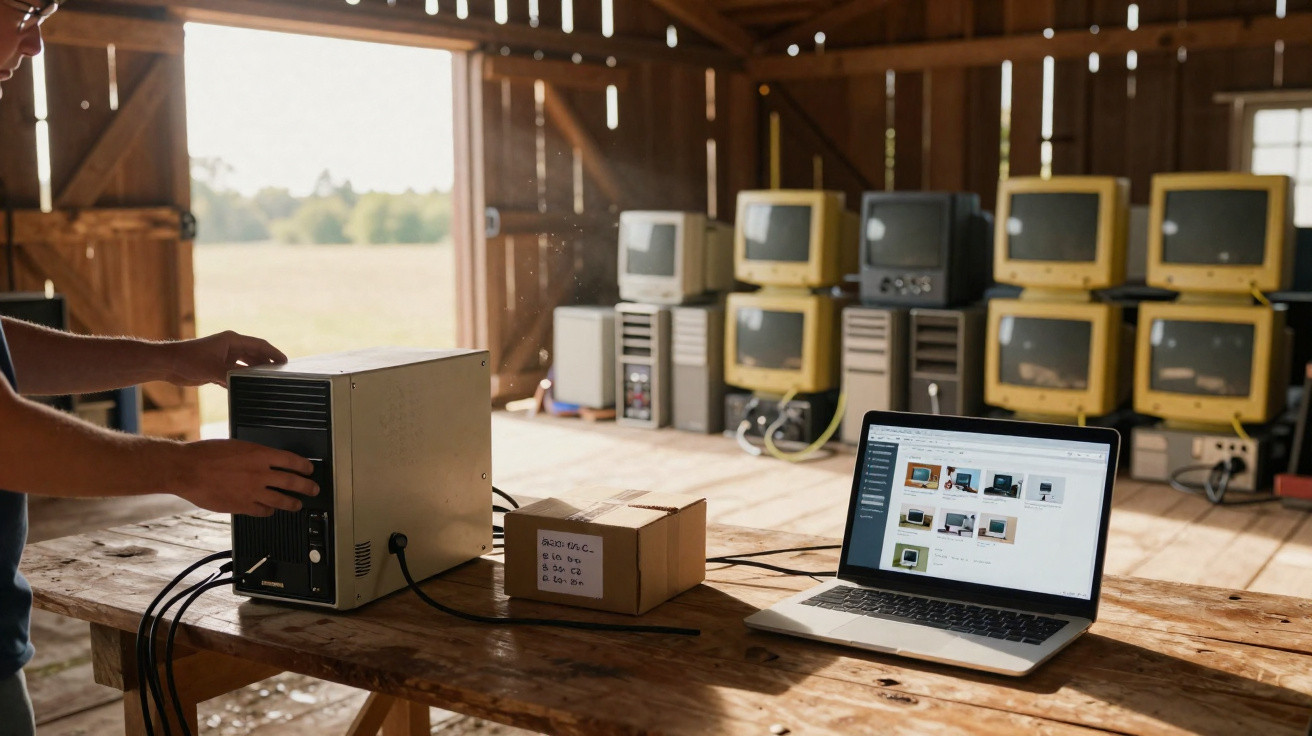
The barn door creaks open and dust twists through the early-morning sunlight. But rather than hay bales or corroded tools, the space contains row upon row of metal towers, standing like soldiers left behind. There are beige computer cases, bulky monitors and cables tangled into rigid knots by age. Twenty-three years of silence sit piled on wooden pallets. The owner brushes a hand across a case that may have cost a month’s wages in 2001, then shrugs and gives a quiet laugh.
Hardware that was once at the cutting edge is now listed on eBay for under €100 each.
Some adverts fail to attract even a single watcher.
How 2,200 forgotten computers became “junk bargains”
This began in the late 1990s, when computers hummed loudly and arrived with substantial manuals. A small business purchased a large batch, placing a major bet on machines that seemed to represent the future. The firm then collapsed, gradually and without much noise, leaving unopened boxes and disconnected towers behind.
Rather than being sent for recycling, the entire stock was taken to a family barn “for later”.
That later date never arrived.
As each year passed, the barn acquired more clutter: bicycles, cartons and damaged furniture. Meanwhile, the computers remained where they were, steadily becoming less relevant. Specifications that had once been impressive became obsolete as laptops grew slimmer and smartphones became dominant.
When the owner eventually put them on eBay, technology had advanced by three or four generations.
The computers themselves had not gone anywhere.
The listing photographs reveal the reality: yellowed plastic, dust-choked fans and connections from a different age. A few potential buyers are collectors with an interest in older technology. Others are schools or makers searching for inexpensive equipment. Most simply continue scrolling.
The eventual selling price is often below €100. Some batches sell for less than the price of one mid-range GPU cable today.
Their value did not merely decline - it disappeared.
Why old tech loses value so ruthlessly
There is a straightforward explanation for why these 2,200 computers became digital fossils. Technology does not mature in the way furniture or vinyl records do. It goes off like milk.
Performance improves at a dramatic pace, software requirements increase, and before long, what was yesterday’s “power machine” cannot run a modern browser smoothly.
A barn can become a time capsule that few people genuinely want to unlock.
Consider what may be inside these towers: Pentium 4 processors, 256 MB or 512 MB of RAM, and mechanical hard drives left unused for decades. In their day, each machine may have cost €800–€1,200. Across 2,200 units, that represents a stockpile worth comfortably more than €1 million when purchased.
More than two decades later, many are suitable only for spare parts, scrap metal or specialised retro projects.
That million has quietly fallen to four or five figures.
The harsh calculation of technology depreciation is simple: most computers lose a significant share of their worth during their first three years. Leave it for ten years and it enters “giveaway or scrap” territory. Leave it for twenty-three years and you are no longer selling a computer, but a curiosity.
The barn did not simply hold computers; it held unrealised potential.
Value does not rest peacefully; it drains away when nobody is watching.
How to stop your own devices becoming barn ghosts
The strongest “anti-barn” approach begins on the day you buy a device. View every new computer or phone as something that will eventually be resold, donated or repurposed, rather than an item meant to last forever. Store its box, cables and invoices together in a labelled place.
Take a photograph when the device is new, then another before you let it go.
When selling time arrives, those details can genuinely add €50–€100 to its resale value.
Another practical step is to set yourself a technology deadline. Allow three to five years for a laptop, or perhaps six years for a desktop if its components can be upgraded. Beyond that point, actively consider selling it or passing it on while it can still run current software.
This also matters on a human level. The “old” laptop sitting ignored on your shelf could make a real difference to a student or a charity.
Financially, it can mean the difference between recovering €300 and paying someone to remove it.
Let’s be honest: hardly anyone does this consistently. We all have a drawer, cupboard or forgotten corner where cables, phones and ageing routers disappear. On a smaller scale, that is exactly how barns like this come into being.
“The best time to sell a computer is while it still annoys you a little, not when it has totally given up on you,” jokes one refurbisher who spends his days rescuing forgotten machines.
- Set aside an annual “digital attic day”: bring out old technology and decide whether each item should be sold, donated or recycled.
- Put the purchase year on a small label beneath every device, making it easy to see when it is time to move it on.
- Think in terms of stories rather than specifications: who could use this now, before it becomes unusable?
What this barn full of computers really reveals about us
There is something quietly affecting about these 2,200 computers. They were acquired with ambition behind them: plans to expand, hire more people and take on larger projects. Then business and life took an unexpected turn, making the machines feel too difficult to confront.
So they were put away. Neither properly discarded nor truly valued.
They were simply kept out of sight, which is often where regret ends up.
At a personal level, the gesture is familiar. On a Sunday evening, you put an old laptop into a box and tell yourself that you will “sort it out later”. Later turns into years. Eventually, you may not even remember the password or what the hard drive contains.
Old devices become emotional clutter just as much as physical clutter.
And, sooner or later, emotional clutter always becomes costly.
We live in an age when a four-year-old phone can seem ancient, despite still working perfectly. The pressure to upgrade can lead to odd behaviour: keeping old devices out of guilt, or throwing them away without considering whether they could be reused.
This barn story lies directly between those two extremes.
It demonstrates what happens when every small decision is delayed until it becomes one enormous, weighty and dusty problem requiring a forklift and an eBay marathon.
| Key point | Detail | Why it matters to the reader |
|---|---|---|
| Technology ages exceptionally quickly | Computers that originally cost more than €1,000 can be worth under €100 after two decades | Shows why waiting “too long” to sell destroys value |
| Plan the end from the beginning | Keeping boxes, invoices and a resale timeframe increases future value | A practical way to recover money instead of storing “digital fossils” |
| Make clutter an opportunity | Review older devices every year for resale, donation or recycling | Frees up space and supports people who genuinely need working hardware |
FAQ:
- Are 20-year-old computers completely useless? Not always. Some can be used for retro gaming, lightweight tasks or as teaching tools, but most are inefficient for modern everyday use.
- Could the owner have sold the 2,200 computers for more? Probably, if they’d been sold within the first 5–7 years, when the specs still matched current software and parts had real demand.
- What’s the best age to sell a computer? Many refurbishers say around 3–4 years, while it still runs current systems and has acceptable battery or component life.
- Is it safe to sell old computers with data on them? You need to wipe drives securely or remove them. A simple delete isn’t enough; use proper erasing tools or ask a professional.
- What should I do with devices that really have no value left? Take them to certified e-waste recycling points so metals and components can be recovered instead of ending up in landfill.






Comments
No comments yet. Be the first to comment!
Leave a Comment