
The video constantly buffers, subtitles lock up and the spinning icon becomes a silent nuisance halfway through a Sunday binge-watch. Shift your phone by a fraction and, somehow, the signal bars spring back to life. In a compact flat, just a few centimetres can make the difference between flawless Wi-Fi and no usable connection at all. Routers are often left on a shelf, on the floor or concealed behind the television, while every wall seems to take another bite out of the signal. You sigh, your partner sighs and the group call cuts out yet again. Before long, you are wondering whether you need a replacement router, a different broadband package or an entirely new set-up.
Then somebody puts an ordinary household item beside the box, and the signal graph suddenly appears… steadier. Less erratic. More consistent. It may sound like a gimmick, but it is not.
Why a simple mirror can settle chaotic Wi-Fi
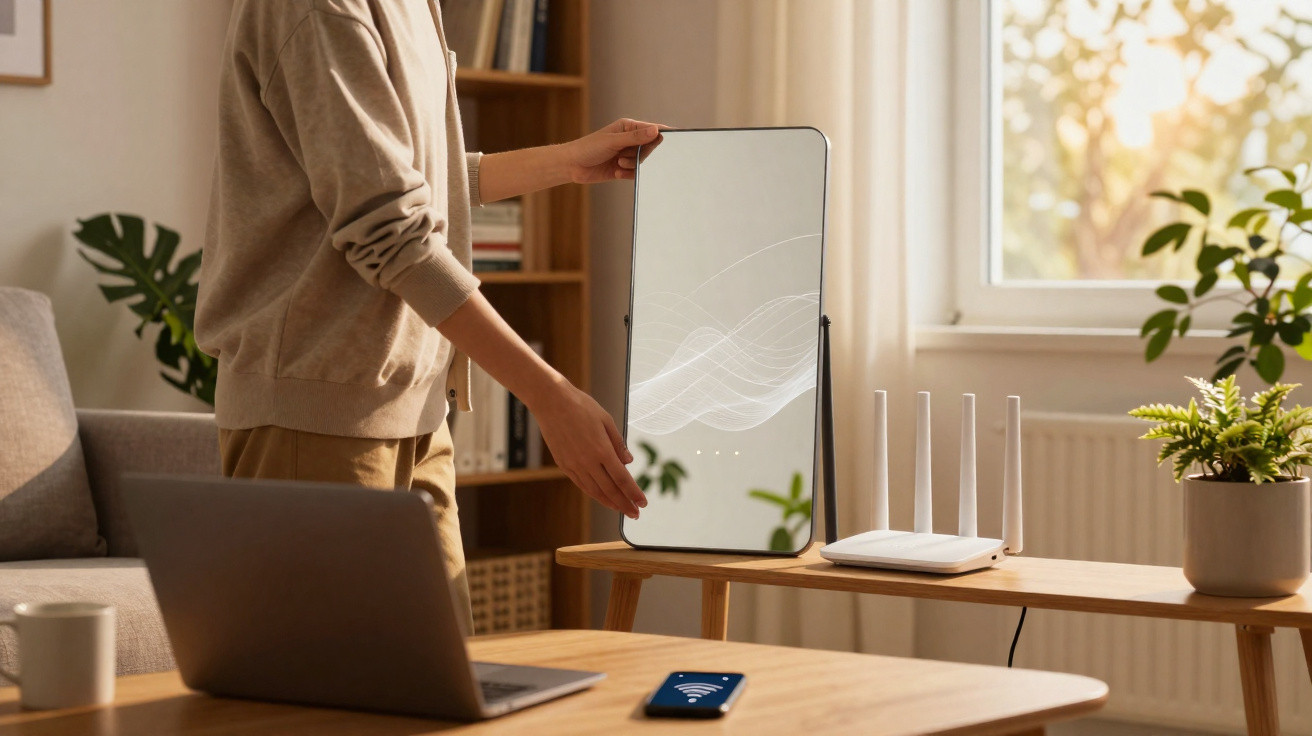
The idea began in a cramped east London studio, where the kitchen, workspace and bedroom more or less occupied the same patch of floor. Its router was positioned near the front door, with two plaster walls and a large wardrobe between it and the streaming area. The resident did not switch providers, upgrade their package or purchase an elaborate gadget. Instead, they put a small freestanding mirror beside the router and tilted it gently towards the living space.
The following evening, their video calls no longer dropped every ten minutes. Speed tests showed the same results on paper, yet the connection seemed less “nervous” and less prone to jitter. The signal hadn’t magically become stronger - it had become smarter.
One wet Tuesday, a friend who worked as a network engineer visited. He was the sort of person who loved acronyms and signal charts, so he opened a Wi-Fi analyser app and walked around the flat. Before the mirror was introduced, the signal-strength line resembled a rollercoaster, with steep highs and severe troughs. Once the mirror was in place, the peaks did not suddenly become taller, but the deepest dips became less pronounced.
He laughed and took a screenshot. “You didn’t boost your Wi‑Fi,” he said, “you redirected the mess.” In a small flat, that can often be enough. What is needed is not extra power, but better direction.
This modest method works because Wi-Fi waves act rather like light: they bounce, reflect and encounter obstructions. Unlike a larger aerial, a mirror does not “amplify” the signal. Instead, it changes the route the waves take through the home. In many compact flats, routers are tucked into corners beside walls or solid doors, allowing much of the signal to disappear into unused dead zones.
Placing a mirror behind or alongside the router, with its reflective surface facing your main living or working area, encourages those waves back towards the places where you actually spend time. It is geometry rather than magic, and in certain layouts the improvement in stability can feel remarkably significant.
How to position a mirror for steadier Wi-Fi in a small flat
The most straightforward version of this approach may look slightly absurd. Put the router in the most open location your cable permits, then set a mirror immediately behind it, much like a small stage backdrop. Its reflective side should face the room where you do most of your online activity, whether that is the sofa, desk or bed. Consider the mirror a means of directing the signal forwards rather than allowing it to escape behind the router.
In narrow flats or properties with long corridors, tilting the mirror slightly towards the hallway may help carry the signal further indoors, so the far end of the home no longer feels like a digital wilderness.
In practical terms, the strongest results generally come from a mirror that is at least somewhat larger than the router. A small freestanding bathroom mirror or a slim wall mirror propped directly behind the box will often be sufficient. There is no need to cover an entire wall or buy an expensive “Wi-Fi reflector” from a technology retailer.
There is a more human consideration too: few people want their sitting room to resemble a science experiment. Try incorporating the router and mirror into the décor instead-on a sideboard behind a plant, on a chest-height shelf or beside some books. Let us be honest: nobody really does this every day, so the adjustment needs to remain easy, quick and unobtrusive.
Many people discover the method entirely by chance. One reader said they had leaned a mirror behind their router simply because they wanted the reflection to disguise a tangle of cables. Their video calls near the kitchen then “magically” stopped freezing.
“I thought it was the new fiber plan,” they admitted later, “but when I moved flats and forgot the mirror, the same annoying glitches came back. I tried again with a cheap IKEA mirror, and boom - the connection calmed down.”
The technique can be even more effective when combined with a handful of straightforward habits:
- Keep the router raised off the floor and clear of large metal items.
- Do not shut it inside a television cabinet or place it behind a sofa.
- Experiment with mirror positions using a Wi-Fi analyser app.
- Give priority to the room where you work rather than the hallway.
- While testing, move phones and laptops 1–2 metres away.
What Wi-Fi mirrors reveal about homes, technology and invisible waves
A mirror will not transform an outdated router into a rocket. Nor will it solve a poor internet package or a provider whose service repeatedly fails. Its effect is more subtle: it shows just how physical, tangible and unexpectedly delicate our supposedly wireless lives are. Moving a sheet of glass and metal by ten centimetres can determine whether a job interview stutters or runs smoothly, or whether Friday film night is interrupted.
We often imagine Wi-Fi as an abstract cloud, yet in a small flat it is heavily influenced by furniture, doors, mirrors and even your own body.
There is also a quiet comfort in realising that improving a connection does not always require another device or subscription. Sometimes the answer is already in the room, standing plainly against a wall. That does not mean technology firms are misleading people when they sell mesh systems or new routers; these products are genuinely helpful for many households, particularly larger homes.
In small city flats, however, a little DIY experimentation and observation can make a considerable difference. The mirror becomes less of a hack and more of a way to negotiate with the space around you, adjusting reflections, corners and shadows until the invisible behaves a little more reliably.
On a more personal level, this minor adjustment connects with something broader. We arrange homes for light, comfort and style, but seldom for waves. Yet the quality of those invisible waves now influences our days as much as daylight does. A cheap mirror that shifts Wi-Fi from “temperamental” to “reliable enough” may sound like a minor detail. Even so, it alters the feel of daily life: fewer frozen faces, fewer awkward silences and less frustration simmering beneath the surface.
On a peaceful evening, when the film streams without interruption and the call remains connected, you may hardly register it. Quietly, though, your nervous system does.
| Key point | Detail | Benefit for the reader |
|---|---|---|
| Place a mirror behind the router | The mirror reflects Wi-Fi waves towards the living area rather than the wall | Improve signal stability without purchasing new equipment |
| Router height and positioning | Keep the router raised, away from the floor and substantial obstacles, and close to the area of use | Reduce dead zones in small flats |
| Test different angles | Use a Wi-Fi measurement app and adjust the mirror slightly | Tailor the approach to the actual layout of the home |
FAQ:
- Does the mirror actually boost Wi-Fi speed, or just stability? It generally does not raise the raw speed displayed in tests, but it may reduce dropouts and signal dips, making streaming and calls feel smoother.
- Can any mirror work, or do I need a special “Wi-Fi” reflector? Any ordinary household mirror will do; there is no need for a specialist product or costly panel.
- Where should I avoid putting the mirror and router? Avoid enclosed cabinets, locations immediately beside large metal surfaces, and positions behind thick walls or appliances such as refrigerators or boilers.
- Will this trick help in a big house with several floors? In larger homes, a mirror may provide some help in one area, but mesh systems or additional access points are generally more effective.
- Is this safe for the router or my health? The mirror does not alter the router’s power, only the way waves reflect, so the level of safety stays exactly the same.



Comments
No comments yet. Be the first to comment!
Leave a Comment