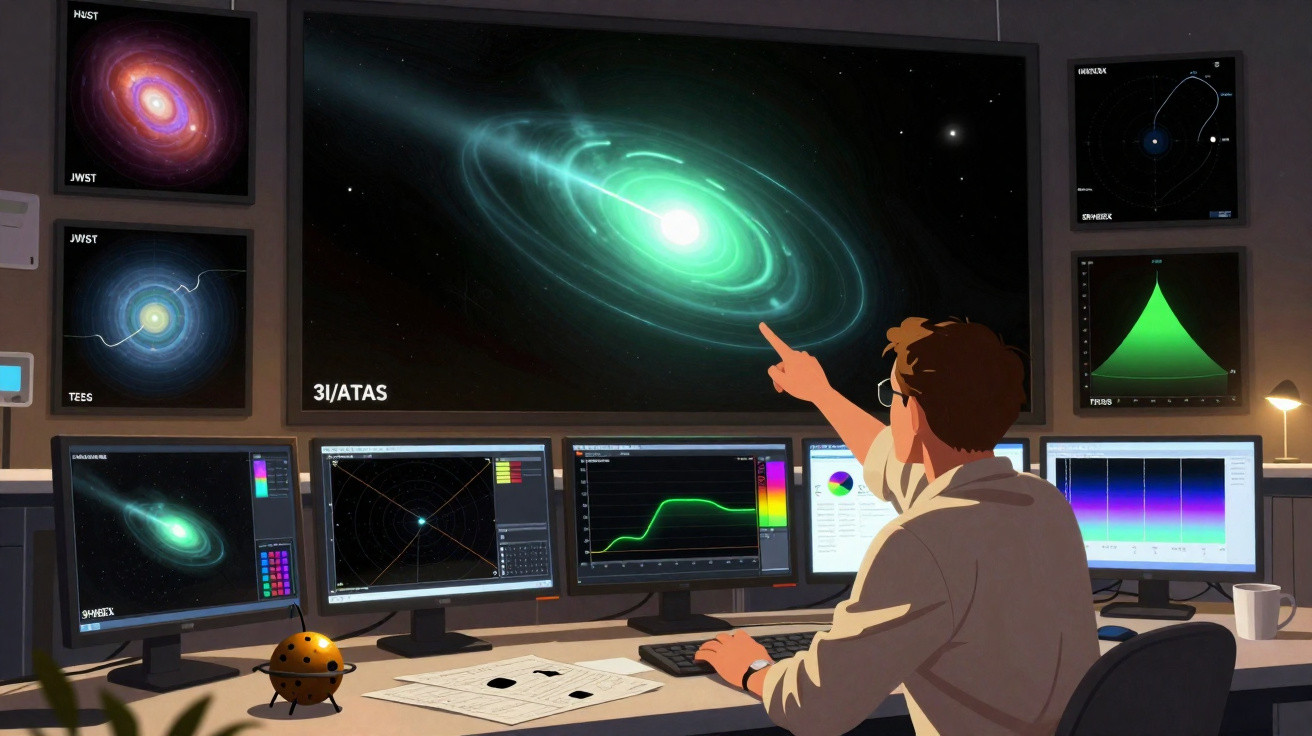
We already knew that interstellar comet 3I/ATLAS differed from the other two interstellar objects known to have passed through the Solar System, yet a wave of fresh observations indicates it could be stranger still.
NASA and ESA observatories Hubble, SPHEREx, JWST and TESS have all recorded the object as it travels towards the Sun. Their findings indicate that 3I/ATLAS was not only releasing gas well before it was detected, but that its atmosphere, or coma, contains a larger share of carbon dioxide than scientists normally find in comets, whether interstellar or not.
That could reveal details about the environment where 3I/ATLAS formed, the conditions of space it has crossed, or even the comet's internal make-up.
Early observations of interstellar comet 3I/ATLAS
The comet was first noticed on 1 July 2025, and astronomers have been eagerly studying it ever since - partly because their opportunity is extremely limited. It will reach its closest point to the Sun, known as perihelion, on 29 October. By then, however, it will be on the far side of the Sun from Earth and concealed by the star's intense glare.
As a result, the prime period for observing the comet before perihelion is quickly disappearing. Scientists are therefore using some of our most capable instruments to examine it or, in TESS's case, searching data collected before its discovery for earlier sightings.
That work has revealed that 3I/ATLAS was first glimpsed in May, almost two complete months ahead of its official discovery. Since the comet was travelling far faster than the objects TESS was built to investigate, researchers needed image-stacking methods to uncover it.
TESS reveals unusually distant comet activity
This is where the story becomes especially intriguing. TESS data indicate that the comet was already active at about 6 astronomical units (AU) from the Sun in May - beyond Jupiter's orbit. That is much farther out than anticipated, as most comets do not begin displaying activity until they are within 5 AU of the Sun.
A comet is described as active when it has warmed sufficiently for ice on and just beneath its surface to sublimate, changing directly from a solid to a gas. This creates a coma and, eventually, cometary tails if the object gets close enough to the Sun for radiation pressure to affect it.
In their preprint paper, the researchers behind the TESS finding suggest that the comet's early activity could be linked to its composition. Certain ices sublimate more readily than others, and carbon dioxide is among them.
Two distinct and independent observations, made with different instruments, confirmed this. In mid-August 2025, NASA's newly launched SPHEREx space telescope conducted multispectral observations of the comet while it was between 3.3 and 3.1 AU from the Sun. It clearly detected a coma rich in carbon dioxide as well as water.
No tails or jets were seen at that point, while the coma extended to a measured radius of 23 kilometres, indicating that production rates were fairly high. Hubble measurements put the radius of the comet itself at roughly 2.8 kilometres.
JWST observations support this conclusion. The telescope examined the comet in early August, when it was 3.32 astronomical units from the Sun. Its data suggest that carbon dioxide and water are present in the coma at a ratio of 8 to 1 - one of the highest carbon dioxide proportions ever observed in a comet.
Why 3I/ATLAS may be rich in carbon dioxide
Several explanations may account for this.
"Our observations are compatible with an intrinsically CO₂-rich nucleus, which may indicate that 3I/ATLAS contains ices exposed to higher levels of radiation than Solar System comets, or that it formed close to the CO₂ ice line in its parent protoplanetary disk," the researchers explain in their preprint paper.
"A low coma H₂O gas abundance may also be implied, for example, due to inhibited heat penetration into the nucleus, which could suppress the H₂O sublimation rate relative to CO₂ and CO."
More information about the comet will be needed before scientists can draw firmer conclusions, and that may require a wait. As shown in the animation above, its path will take it behind the Sun from Earth's perspective, although at perihelion it could pass close enough to Mars for orbiters around Mars to capture a view.
The period after perihelion could prove even more exciting. The comet will then make its nearest approach to Earth as it races out of the Solar System. In theory, Juno could intercept it as it passes Jupiter in March next year.
It is a remarkably compelling object, and astronomers will be keen to learn what further observations can uncover.
The Hubble, TESS, SPHEREx and JWST results have not yet been peer reviewed and are available as separate entries on the arXiv preprint server.

















Comments
No comments yet. Be the first to comment!
Leave a Comment