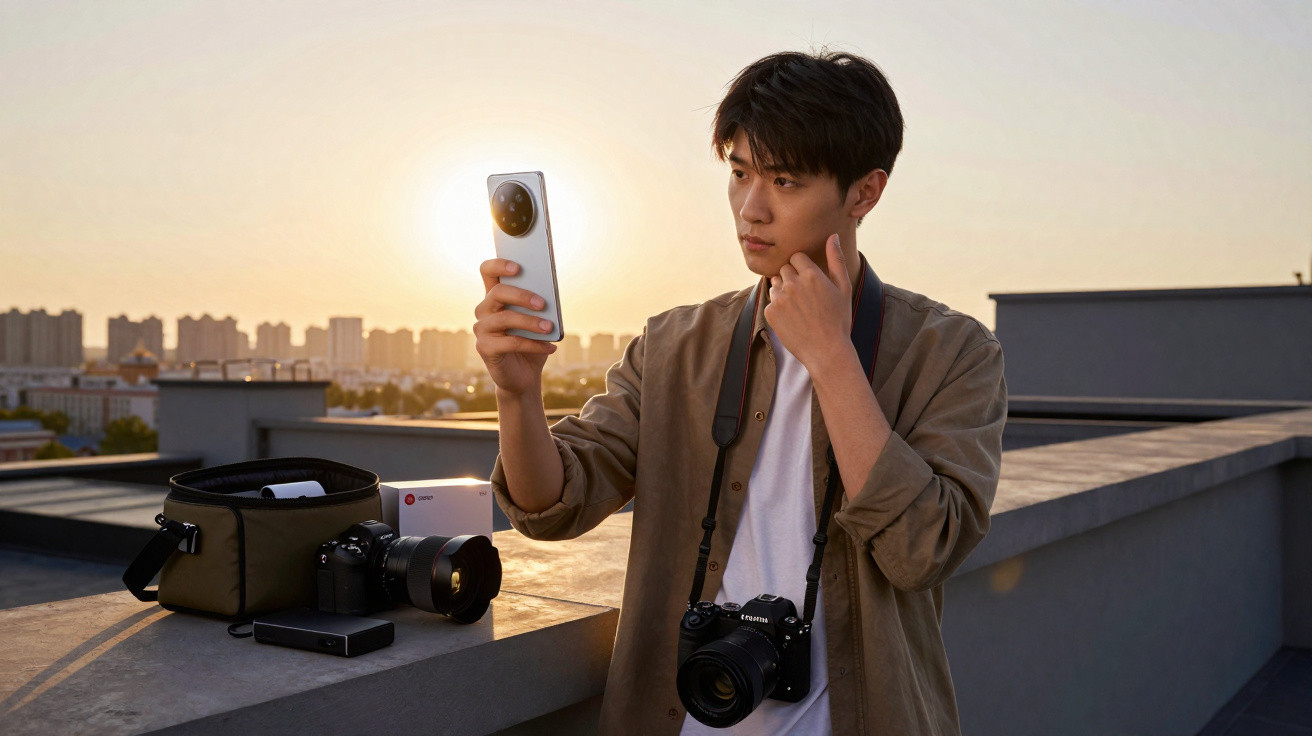
Xiaomi and Leica now promise a “deep technological fusion”. Beyond the marketing language, can the 17 Ultra, priced at €1,499 in its 512 GB version, genuinely compete with a camera body sold for the same price? That is, after all, what both manufacturers claim. To find out how it performs in real-world use, I used it for a month. Here is the verdict.
Xiaomi 17 Ultra at the best price
Base price: €1,499
| Retailer | Discount | Price | |
|---|---|---|---|
| Rakuten | -23% | €1,149 | Check offer |
| eBay | -15% | €1,269 | Check offer |
| Amazon | -5% | €1,420 | Check offer |
| Rueducommerce | €1,499 | Check offer | |
| Boulanger | €1,499 | Check offer | |
| FNAC | €1,502 | Check offer | |
| Darty | €1,502 | Check offer | |
| Xiaomi | €1,503 | Check offer |
See more offers
An imposing smartphone
There is a welcome surprise when opening the box: the Xiaomi 17 Ultra has slimmed down. The rounded curves of the 15 Ultra are gone, replaced by a flatter, more angular design that gives it a pleasingly professional appearance. At 219 g and 8.29 mm thick, it is Xiaomi’s thinnest and lightest Ultra model to date. It remains a large handset, with its 6.9-inch display, but it is noticeably more comfortable to hold than before.
The camera module sits slightly higher than on the previous generation and still protrudes from the chassis, yet Xiaomi has gained a few millimetres that make a real difference. When taking pictures, my fingers naturally sit beneath the camera, so I no longer risk photographing them rather than my subject. Sometimes, the smallest details make all the difference.
IP68 certification, a highly rigid aluminium frame and faultless build quality are all to be expected at this price point. I also like the supplied transparent protective case, which does not spoil the phone’s look. It would have been even better if Xiaomi included a charger in Europe, or at least allowed customers who want one to receive it free of charge.
A highly accomplished display
The 17 Ultra’s LTPO AMOLED panel retains the same size while offering a lower resolution than the 15 Ultra. It may seem tempting to complain, but that would miss the point: Xiaomi is debuting its HyperRGB technology here. In practical terms, every pixel has its own red, green and blue sub-pixels, whereas conventional panels share some of them with neighbouring pixels. The result is that, despite the lower resolution, perceived sharpness is equal to-or even better than-before. Power consumption is also reduced. Clever. To spot a difference, you would need to press your face close to the display-and have very good eyesight.
Peak HDR brightness reaches 3500 nits, meaning in specific areas of the panel when watching HDR video. The screen remains entirely readable in direct sunlight. Colours are accurate, while Dolby Vision and HDR10+ are both supported. Put simply, it is among the finest displays I have used.
| Xiaomi 17 | |
|---|---|
| Dimensions | 151.1 x 71.8 x 8.1 mm |
| Weight | 191 grams |
| Display | 6.3-inch LTPO AMOLED 2656x1220 pixels 3500 nits (HDR peak) |
| Processor | Qualcomm Snapdragon 8 Elite Gen 5 |
| RAM | 12 GB |
| Storage | 256/512 GB |
| OS | Android 16/HyperOS 3 |
| Camera sensors | + 50-megapixel f/1.7 wide-angle sensor + 50-megapixel f/2.4 ultra-wide-angle sensor + 50-megapixel f/2.0 telephoto sensor, X2.6 optical zoom |
| Selfie sensor | 50 megapixels |
| Biometrics | Under-display fingerprint sensor |
| Battery | 6330 mAh, 100 W fast charging |
| IP certification | IP68 |
| Colours | Black, white, pink, green |
Performance and battery life: the right balance
The Xiaomi 17 Ultra is powered by Qualcomm’s Snapdragon 8 Elite Gen 5 SoC, the company’s very best offering in 2026. Its processing power is extraordinary and never falls short. Whether playing Genshin Impact or pushing multitasking to the limit, it handles everything without hesitation. Thermal management is well controlled: the rear warms up a little during gaming, but never to an alarming extent.
Battery capacity has risen from 5,410 to 6,000 mAh compared with the 15 Ultra, and the improvement is clear. With typical use-social media, messaging, browsing and a few photos-I regularly got beyond a day and a half. More intensive usage, including extended photography sessions and video streaming, still requires some care towards the end of the day, but it is no longer the anxiety-inducing experience of the 15 Ultra, which could run out of power as early as 6 pm.
Wired charging reaches 90 Watts with Xiaomi’s power adapter, which is once again not included. Expect roughly 20 minutes to reach 50%, and 51 minutes for a full charge. 50 W wireless charging is included too.
HyperOS 3 and AI: improved, but…
The 17 Ultra runs Android 16 with Xiaomi’s HyperOS 3 interface. Xiaomi promises 5 major Android updates and 6 years of security patches. That is good, though still behind the 7 years offered by Samsung and Google.
The interface is pleasant to use and offers extensive customisation, including AI-generated wallpapers, icons and fonts. On the artificial intelligence front, Google’s ever-present Gemini is joined by HyperAI, Xiaomi’s own solution. I spent considerable time using intelligent cut-outs, unwanted-object removal and photo expansion: the results are convincing, although Samsung Galaxy AI retains a slight edge in precision.
The flood of pre-installed bloatware does rather spoil the experience. Finding a “More apps” folder filled with unnecessary software and disguised adverts on a €1,500 smartphone is genuinely irritating. Thankfully, these apps can be uninstalled, but the very principle is hard to accept at this price.
Photography: the Xiaomi 17 Ultra’s strongest asset
Photography is the 17 Ultra’s raison d’être. Xiaomi and Leica have made a radical decision: they have dropped the 15 Ultra’s dual telephoto setup in favour of a single module with continuous mechanical zoom. It is a smartphone first. The gamble was risky, but after a month of use, I can say it has paid off.
The telephoto lens covers a continuous 75 to 100 mm range, with no jumps or changes in rendering. It is perfectly smooth. Thanks to the 200 MP sensor, digital zoom can be extended to 400 mm while maintaining very respectable quality. The lens carries Leica APO certification, ensuring an almost total lack of chromatic aberration: images are sharp and clean, without unwanted coloured fringing.
The 50 MP, 1-inch main sensor performs wonderfully in daylight. Dynamic range is impressive, while colours are rich without becoming over-saturated. The two Leica profiles-Vibrant for a punchier look and Authentic for greater fidelity-provide genuine flexibility. In low light, the 1-inch sensor benefits from its size: digital noise remains controlled and detail is retained. It is not full-frame, but it comes close.
The 50 MP ultra-wide completes the trio with a 115° field of view. It does not transform the category, but it delivers what is needed: good central sharpness, well-corrected distortion and, most importantly, colour consistency with the main sensor. This avoids the jarring shift in rendering still found on many rivals. Portrait mode has also received careful attention: subject separation is accurate, even around hair, and the simulated bokeh looks natural.
For video, 4K at 120 frames per second in Dolby Vision is a delight. Log mode, intended for videographers who want to edit their footage in post-production, is a welcome addition. That leaves the €1,500 question: can the 17 Ultra replace a camera? My answer is yes. No, it will not replace a full-frame camera body. However, for travelling light on an assignment without making excessive compromises on quality, it is now a credible option.
Xiaomi 17 Ultra or Leica Leitzphone?
To mark Leica’s 100th anniversary, the two partners are also releasing the 17 Ultra as the Leitzphone. It has the same technical platform, but gains a fully nickel-anodised aluminium chassis, an exclusive black finish and a knurled metal ring around the camera module that recalls the focusing rings of Leica M lenses. Leica Essential mode can digitally recreate the rendering of legendary cameras such as the M9 and M3, while black-and-white enthusiasts will benefit from the Leica MONOPAN 50 profile.
The Leitzphone is available only with 16 GB + 1 TB for €1,999, which is €300 more than the 17 Ultra with equivalent storage. Is that premium technically justified? No: the sensors, processor and battery are identical. However, the Leitzphone is a collector’s object before it is a rational purchase. For everyone else, the 17 Ultra offers the same photographic performance for a less expensive outlay.
What I think of the Xiaomi 17 Ultra
The Xiaomi 17 Ultra is the best camera phone I have tested to date. Its continuous mechanical zoom is an innovation that makes a genuine day-to-day difference, the HyperRGB display is superb, battery life has improved significantly and performance is outstanding. AI integration in HyperOS 3 is making progress too, even if Samsung remains ahead.
There are still two drawbacks. First is the price: €1,499 is luxury-product territory. At least it has remained unchanged from the 15 Ultra, which itself cost the same as the 14 Ultra. That is quietly reassuring. More importantly, there is the bloatware, which has no place on a smartphone of this calibre. Xiaomi will need to resolve that issue if it wants to be taken seriously alongside Samsung and Apple in the premium market. Yet for photography-and photography alone-the 17 Ultra currently has no equivalent in the Android world.
Xiaomi 17 Ultra
€1499
Overall score: 9.5
| Category | Score |
|---|---|
| Display | 9.5/10 |
| Performance | 10.0/10 |
| Battery life and charging | 9.0/10 |
| Photography | 10.0/10 |
| Value for money | 9.0/10 |
What we like
- Photographic quality
- Excellent display
- IP68 certification
- Faultless construction
What we like less
- Bloatware (unacceptable)
- No charger included
- High price (but justified)
Buy the Xiaomi 17 Ultra








Comments
No comments yet. Be the first to comment!
Leave a Comment