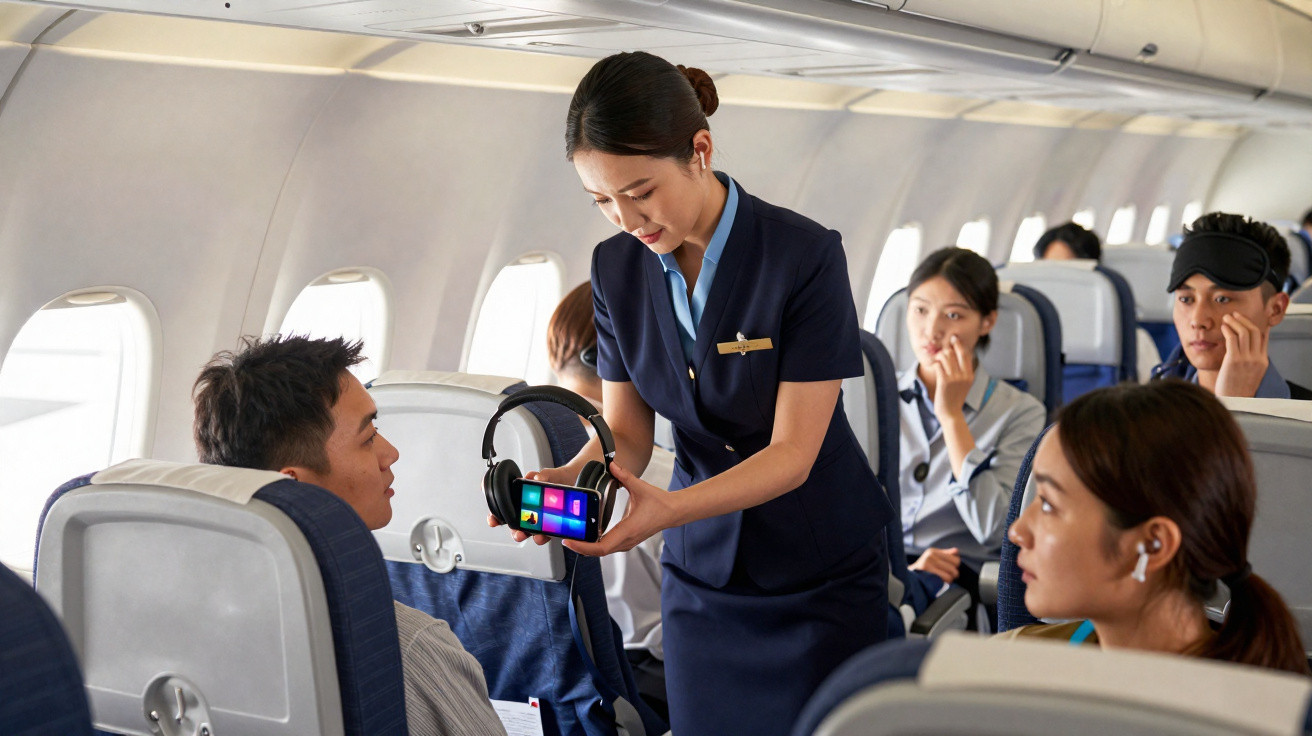
On US domestic flights, loud music played from a phone could soon prove costly – not just for fellow passengers’ ears, but potentially for the ticket itself.
A major US airline is taking a tougher stance on cabin noise: passengers who play audio through speakers rather than using headphones may soon be prevented from flying altogether – or, in the most serious cases, required to leave the aircraft. The move has won support but also prompted debate: how far should consideration for others go before flying becomes an acoustic zero-tolerance zone?
New rule: no headphones could mean losing your ticket
United Airlines quietly updated its contract of carriage at the end of February, but the consequences are clear. It now explicitly states that passengers playing audio content without headphones can be barred from a flight. The policy covers music, social media videos, films, television programmes – in short, anything emitting sound through a speaker.
“Passengers who stubbornly continue playing loud sound from their phones on board may, in extreme cases, have to leave the aircraft.”
According to the airline, headphone use had already been “requested” for some time. However, the requirement is now set out in black and white within the official terms and conditions. This changes the situation: what was once a polite request becomes a basis for the crew to take firm action where necessary.
There is also a helpful point for anyone who forgets their own pair. United says it will provide passengers with complimentary headphones when needed, provided supplies are available. That removes one argument from critics: nobody has to turn up the volume simply because they left their earbuds at home.
Why the airline is now officially penalising noise
The decision has not come out of nowhere. In recent years, the US aviation authority, the FAA, has repeatedly reported significantly higher numbers of disruptive incidents on aircraft. Its figures record more than 1,600 such cases, ranging from heated arguments to aggressive outbursts.
Loud smartphones are only a small part of those statistics, but they fit the wider pattern: cramped cabins, lengthy flights and full aircraft, with people playing TikTok videos at maximum volume in between. Frequent flyers will know the situation well: one clip follows another, and an entire section of the cabin is forced to listen.
For travel experts, the new rule is primarily a signal. United is making clear that consideration is not merely an optional courtesy, but part of its official code of conduct. That gives crews greater scope to halt conflicts early, before they escalate on board.
Symbolic policy or a genuine game changer?
Travel analysts describe the measure as largely symbolic, yet one that could still have an effect. In reality, it is usually only a small number of disruptive passengers on each flight who test everyone else’s patience. The new clause lets cabin crew take a firmer approach: anyone ignoring instructions risks consequences, including being refused travel on that particular flight segment.
Until now, many airlines have confined similar advice to codes of conduct or in-flight magazines. The fact that one carrier has now placed the issue so prominently in its contract of carriage is seen as a first. Critics fear the flight experience is becoming “overregulated”. For the majority of passengers seeking peace and quiet, however, the direction of travel is likely to appeal.
- Who does the rule affect? Every passenger, regardless of travel class or seat.
- What is prohibited? Playing sound through the speakers of a phone, tablet, laptop or games console.
- What remains permitted? Any audio content listened to through headphones or a headset at an appropriate volume.
- What could happen in a serious case? Boarding may be refused, or the passenger may be removed during a stopover.
Other airlines also favour quiet – but without clear penalties
United is far from alone in asking travellers to wear headphones. Competitors such as Delta have reminded customers on their websites for years to use earbuds with personal devices. Their message is broadly that, for every traveller’s comfort, passengers should use headphones when consuming audio content.
Other carriers too, from low-cost airlines to premium operators, set out comparable guidance in their onboard programmes or safety videos. In many cases, though, these remain appeals to good manners. Specific threats of penalties are usually absent or worded vaguely.
“One thing is clear: the expectation has existed for a long time – most airlines treat headphone use as an unwritten rule.”
United is now taking the matter one step further, turning an unspoken expectation into a clear contractual clause. Industry observers expect other airlines, especially in the United States, to follow. Whether European airlines do the same will depend greatly on public debate and practical experience.
More conflict on board: noise as a flashpoint
The discussion comes at a time when disputes on aircraft are becoming more common. Travellers are frustrated not only by delays and tight seating, but also by the conduct of other passengers. Phone speakers, video calls without headphones and loud voice messages can all quickly become a test of patience in an enclosed cabin.
Frequent flyers regularly describe situations in which they barely dare say anything for fear of starting an argument. That creates a difficult position for crews, who must strike a fine balance between customer service and enforcing rules. Clear wording in a contract of carriage helps move such disagreements onto more objective ground.
| Onboard scenario | Possible crew response |
|---|---|
| A passenger streams TikTok without headphones | A polite reminder to use headphones or mute the sound |
| The passenger repeatedly ignores the request | A clear warning and reference to the contractual rule |
| Continued refusal and a loud dispute | In extreme cases, removal before departure or during a stopover |
What travellers should keep in mind now
Anyone travelling with a US airline soon would be wise to follow a few straightforward principles. The key one is to keep a pair of headphones in hand luggage at all times, ideally a wired pair in case the battery runs out or the in-flight system does not support Bluetooth.
It is also worth briefly reviewing your own behaviour: does your ringtone really need to be at full volume before boarding? Would it be better to mute automatically playing adverts in apps before the flight? Small details like these often determine whether neighbouring passengers roll their eyes in annoyance or remain comfortable in their seats.
Flight etiquette in 2026: more rules, more consideration
With its headphone clause, United is continuing a broader trend: the cabin is becoming increasingly regulated, from alcohol consumption and mask-wearing in exceptional situations to the use of electronic devices. Some travellers may see this as yet more restrictions, while others will regard it as clearly defined ground rules.
Whether stricter noise rules make flying more pleasant will ultimately depend on how everyone on board behaves. Those who already show consideration will barely notice the new clause. Those who have previously played their phone speakers without hesitation will need to adapt.
Why quieter smartphones are worthwhile
A quieter aircraft offers noticeable benefits. The cabin feels calmer, individual stress levels fall, and even on short flights there is more opportunity to read, doze or work. On night flights in particular, the sound environment often determines whether passengers arrive rested or irritated.
For airlines, another issue is at stake: their image. Any carrier perceived as an airline for inconsiderate travellers can easily lose appeal amid fierce competition for business passengers and families. A clear stance on noise can therefore protect not only passengers’ nerves, but market share as well.
Ultimately, the new policy demonstrates one thing above all: consideration on an aircraft is no longer solely a matter of politeness, but an official part of the agreement between airline and passenger. And it begins, quite simply, with reaching for headphones before the next video starts.









Comments
No comments yet. Be the first to comment!
Leave a Comment