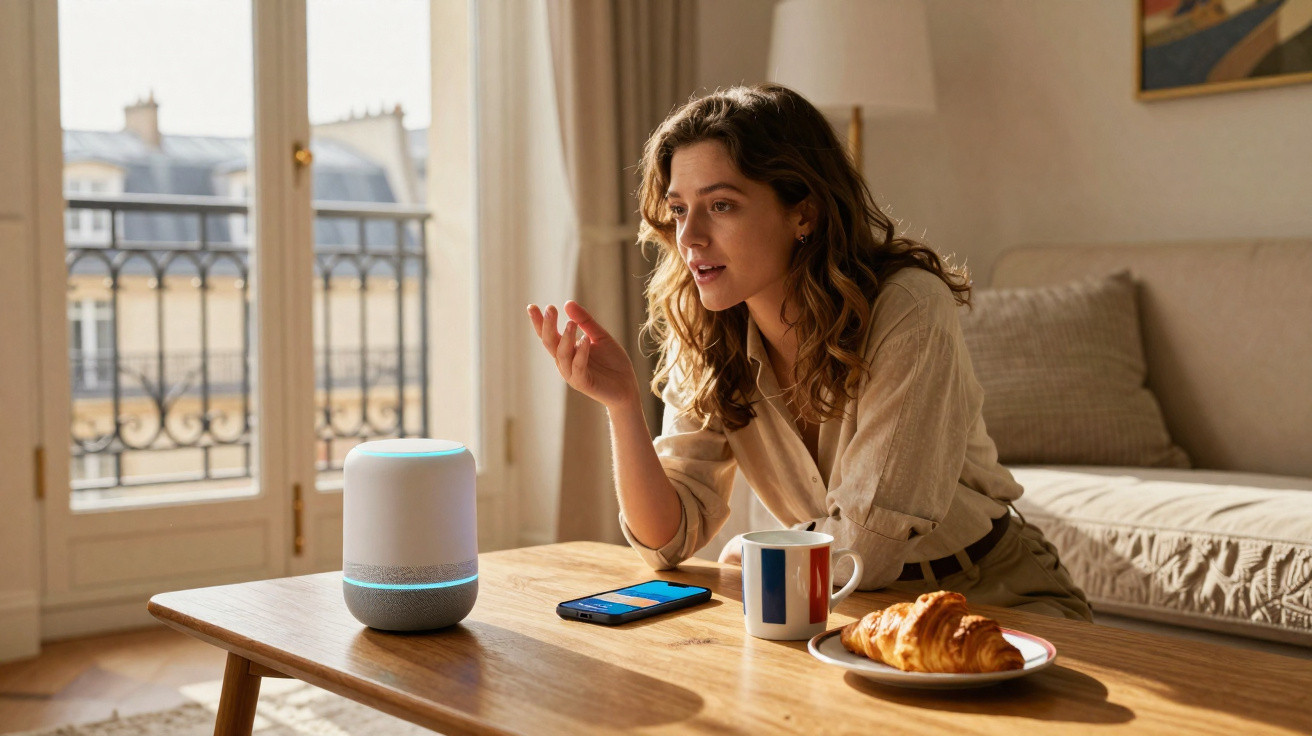
Amazon is launching Alexa+ in France today through early access. Supported by Mistral AI, the US giant is promising a new chapter for France’s most widely used voice assistant. We were given an early look at it.
Who has never got frustrated with their voice assistant? Like other players in the market, the previous Alexa worked on a deterministic model: you had to say precisely the right words in the right sequence to get an acceptable result. In practice, the model’s limitations resulted in millions of interactions ending with a highly irritating “sorry, I didn’t understand”. Even so, French users embraced Amazon’s assistant, with the company claiming 17 billion interactions in France over three years.
Despite this strong performance, the American giant needed to rethink its assistant. Last February, it unveiled Alexa+, a new version that can understand context, follow the thread of a conversation, and handle unfinished sentences or changes of subject during an exchange.
Above all, Alexa+ can take action on the user’s behalf. It can book a restaurant through TheFork, control smart-home equipment (Legrand-Netatmo, Somfy), send emails, manage your calendar and Amazon orders, and track parcel deliveries via Ring doorbells. Everything can be controlled by voice, without opening a single app.
Better still, Alexa+ can be accessed through any web browser. When it launched in the United States, Alexa+ understandably found its audience.
Subscribe to Presse-citron
Mistral AI at the centre of the French Alexa+ experience
To meet the expectations of French users, Amazon needed a partner with strong expertise in understanding languages and cultures. The US company has therefore enlisted Mistral AI. Alexa+ is built on an architecture unlike AI systems such as ChatGPT or Gemini. Alexa+ runs on Amazon Bedrock and draws on more than 70 different language models - a figure that changes every week as new models are released. The assistant selects the fastest and most effective model for each task.
For instance, it may choose a compact model optimised to switch on lights by voice, while using a more substantial model to plan a fortnight’s holiday on the other side of the world. Amazon also says that 76% of Alexa+ use cases across the Atlantic cannot be replicated through a chatbot.
Among these models, Mistral AI’s play a key role for non-English languages. Large language models are trained primarily on US data, meaning they remain shaped by an American way of thinking. Amazon says it has addressed this bias through supervised fine-tuning, reinforcement learning and a localised prompting system. Mistral is used extensively to assess the linguistic and cultural accuracy of responses. The remaining traffic is handled by Amazon’s in-house Nova models.
In practical terms, Alexa+ understands the pain au chocolat versus chocolatine debate - naturally, it is “pain au chocolat” - knows that ice cubes in wine are heresy, except rosé in summer, and can make Roland Garros jokes as though it had grown up in France. Another welcome touch: Alexa+ now uses the informal form of address to foster a closer relationship with the user.
Alexa+ included with Prime
Pricing could have been an obstacle. At €22.99 per month once the early-access period ends, Alexa+ is clearly not cheap. Amazon has therefore played its trump card: the Prime subscription. For every Prime member, Alexa+ is included at no extra cost. Prime, meanwhile, costs €6.99 per month.
During early access, it is free for everyone: either buy a new eligible Echo device for immediate access, or sign up at amazon.fr/nouvellealexa to join the waiting list. Amazon plans to invite hundreds of thousands of users over the coming weeks.
On the hardware side, four new devices have been designed specifically for Alexa+: the Echo Show 8, Echo Show 11, Echo Dot Max and Echo Studio, all offering greater computing power and next-generation sensors. Nearly all Echo speakers sold in France in recent years are also compatible. This summer, access is expected to expand to web browsers on PC and Mac, enabling context to carry across devices - so you can start a conversation on an Echo and continue it on your computer.
Our view on Alexa+
Alexa+ arrives with a different positioning from the most common AI tools. Far more than a chatbot, Alexa+ is an assistant that can make a tangible difference to users’ daily lives. Its inclusion with Prime is likely to be its strongest commercial argument in driving adoption.
Several reservations remain, however. First, Alexa+’s US launch highlighted hallucinations and genuine usability friction. During the demonstrations we were offered with the French version, we noticed some latency between asking questions and receiving Alexa+’s replies. On the other hand, the assistant completed every requested task without any mistakes.
It is, of course, still too soon to reach a definitive verdict on Alexa+. We will return soon with a full review.















Comments
No comments yet. Be the first to comment!
Leave a Comment