The knot in my cable beat the bus to it. While the display at the stop was still promising five minutes, I was bent over my bag, tugging at a tangled pair of earphones as though I were solving a puzzle from another dimension. The people beside me glanced over with that sympathetic raised-eyebrow look that says, “Yes, I know the feeling.” Smartphone in one hand, half a tangle of cable in the other - and somewhere in between, that sinking sense that precious seconds were once again being lost to a bit of plastic and rubber. Let’s be honest: nobody diligently winds up their cables every single time as if they were following a YouTube tutorial. Just as I was about to shove the whole frustrating mess into my coat pocket, I came across a paper clip. Tiny, unremarkable and really only intended to keep sheets of paper together. Yet suddenly, it looked like the small, understated hero that might save this chaos.
Why a paper clip can save our patience
Some things are so simple that they are easy to overlook. A paper clip unquestionably belongs in that category. It sits in a pen pot, drops out of an old notepad or lurks in a drawer between elastic bands and forgotten receipts. That is precisely why assigning it the role of cable saviour seems almost ridiculous. But that is where it becomes interesting. This small piece of bent metal has exactly what headphone cables need: stability, a defined shape, and a clear beginning and end. We all know the moment of rummaging through a bag when everything feels like a bird’s nest - the paper clip offers a quiet yet unmistakable “Stop” to it.
The first time I used this trick, it was not planned; it was simply an emergency measure. On a rainy Monday morning, standing on an overcrowded train, I needed some way to get my headphone cable under control. There was no organiser, cable case or anything else to hand. Just a crumpled ticket and a medium-sized paper clip. On impulse, I loosely coiled the cable, slipped the clip around it and assumed it might survive until I got to work. A few days later, I noticed that the cable was still tidy: no knot, no fraying. According to a survey by the Bitkom association, people spend an average of several minutes each week untangling cables - which may not sound like much, but over the months it adds up to entire hours. A piece of wire in exchange for a few saved hours of life is a rather good return.
There is more to the reason headphone cables tangle so readily than mere “bad luck”. Physicists refer to “spontaneous knotting”, the tendency of flexible cords to entwine themselves in enclosed spaces such as bags. The longer the cable and the tighter the space, the more likely a knot becomes. A loose cable in a handbag or rucksack is therefore practically a mathematical promise of frustration. A paper clip gives this disorder some structure. By keeping the cable in a defined form, it limits how freely the cord can move and removes some of the freedom physics needs to do its work. It is a minimal intervention that makes a noticeable difference to everyday life.
How the paper clip trick works, step by step
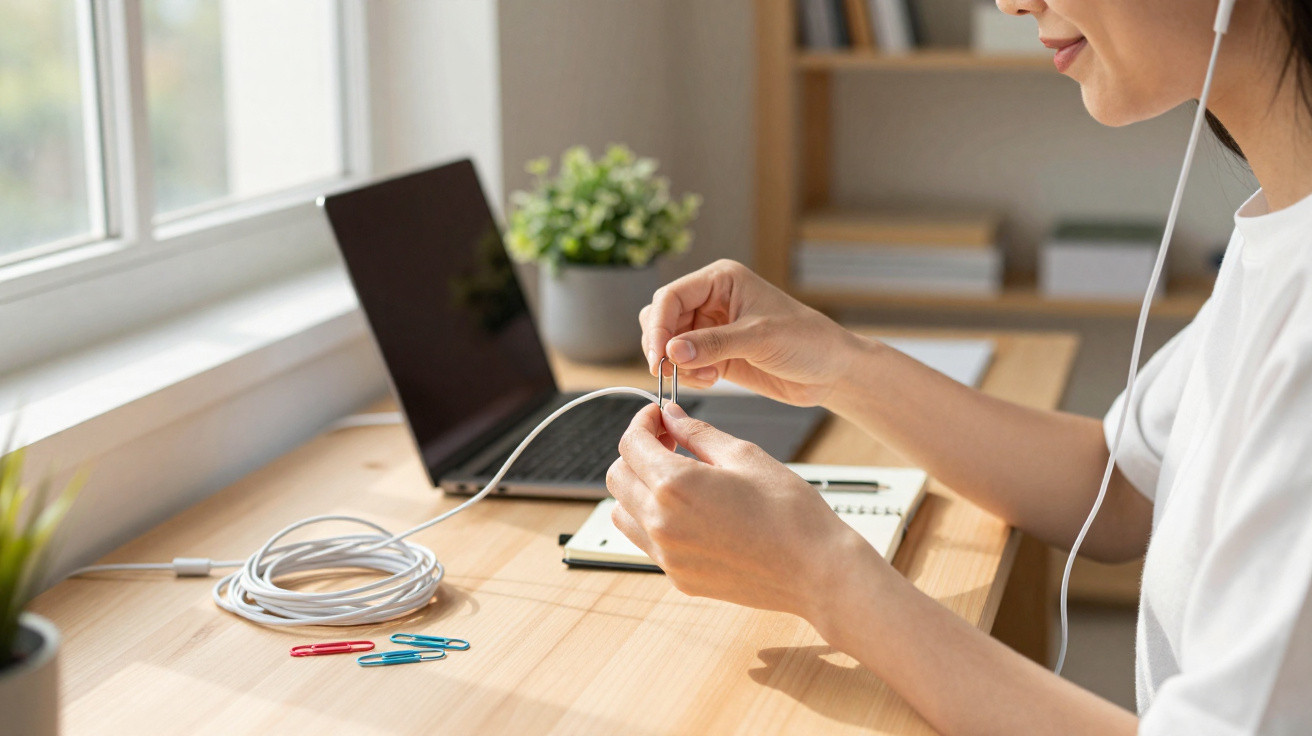
The method itself is so straightforward that it is almost funny. Take your headphone cable and arrange it in loose loops across your palm, much like the way a skipping rope used to be folded away. Do not create tight coils and do not aim for perfection; just make a few even arcs. Next, take a paper clip - a medium-sized metal one is ideal, rather than an especially tiny clip - and slide its open side over the bundle of cable, roughly through the middle of the loops. This applies light pressure to the cable without crushing it. If you want, you can also thread the plug end or jack plug through the clip once to create a kind of anchor. What was an irritating bundle of cord is suddenly a compact, easy-to-handle package.
At first, many people make the same mistake: they pull the cable too tightly, wind it up like a clock spring and then wonder why it breaks or cuts out in one ear. Headphones are delicate, particularly where the cable meets the plugs. The paper clip is meant to hold the cable, not strangle it. Think of a loose ponytail rather than a cable tie from a DIY shop. If you are pushing against resistance as you wind it or the cable begins to feel taut, you have already gone too far. Another common issue is plastic-coated or painted paper clips, which can become sticky over time or discolour the cable. Plain, uncoated metal is less flashy but more dependable. If you dislike the look of metal, you can still wrap a small piece of washi tape around it to make a colourful mini cover.
Over time, you develop a method of your own. Some people arrange the cable in a figure of eight, while others loop it around three fingers before placing the paper clip across it. One friend of mine swears by an especially simple version: she puts only the headphone split - the point where the cable separates towards the two earbuds - directly into the paper clip and lets the rest hang loosely from it. Her comment has stayed with me:
“At some point, I realised I don’t need fancy gadgets, just a reason not to shove the cable into my bag like a maniac.”
Small habits that happen almost automatically, without much thought, are useful here:
- Briefly wind up the cable and slide it into the paper clip after every phone call.
- Keep a paper clip permanently on your keyring, in your wallet or in your laptop bag.
- Use a separate colour-coded paper clip for every device with a cable, such as headphones, charging cables and adapters.
- Store all your “paper-clip cables” in one designated place instead of spreading them between different bags.
- Do a two-minute cable check once a week - no more is needed.
What this tiny solution has to do with a clearer mind
Anyone who starts with something as small as a paper clip soon realises that it is not just about the cable. It is about feeling in control of your own everyday bits and pieces. Pulling your phone out of your bag and plugging in your headphones immediately, without fiddling around, changes your mood. No eye-rolling, no “Oh no, not again”, no pulling at thin wires while the podcast has already begun. A neatly bundled cable quietly suggests that someone took two extra seconds. You can feel that when you stumble into the day half asleep and, at least when it comes to your soundtrack, do not have to battle with anything.
It is also interesting how readily such an inconspicuous trick spreads. You take out your neatly bundled headphones at work or on the train, someone glances over, spots the paper clip and asks, “How long have you been doing that?” A minor everyday aid becomes a conversation, and the conversation becomes a tip that travels onwards. That is how quiet micro-trends emerge: they have never had an advertising campaign, but they are rooted in genuine needs. Nobody longs for expensive cable organisers when a 2p paper clip does the same job. Let’s be honest: no one does this perfectly every day, but the barrier to saying “I’ll give that a try” is exceptionally low.
The eventual realisation is often almost unspectacular: small solutions can have a surprisingly big impact when they genuinely fit into daily life. A paper clip is light, sturdy, widely available and completely unremarkable. That is exactly why it suits most people’s lives far better than the next “must-have gadget”. Perhaps that is its appeal: no major purchase, no app, no battery, just a piece of bent metal quietly bringing order. Those who start taming their headphone cables this way often become bolder and apply the principle to other details: charging cables, a laptop power supply, bicycle keys. At some point, they realise that this tiny piece of everyday poetry is not in the paper clip itself - it lies in the fact that chaos is not compulsory.
| Key point | Detail | Benefit for the reader |
|---|---|---|
| Simple to use | Loosely wind the headphone cable and secure it with a metal paper clip | An immediately usable solution requiring no extra accessories or expense |
| Protects the cable | Avoid winding too tightly and prevent bends where cables meet plugs | Longer-lasting headphones, fewer cable breaks and less frustration |
| Everyday routine | Use brief steps after each use and create set “parking places” for cables | More order in your bag and mind, with less time spent searching and untangling |












Comments
No comments yet. Be the first to comment!
Leave a Comment