USMC UH-1Y Venom and AH-1Z Viper integration with FPV drones
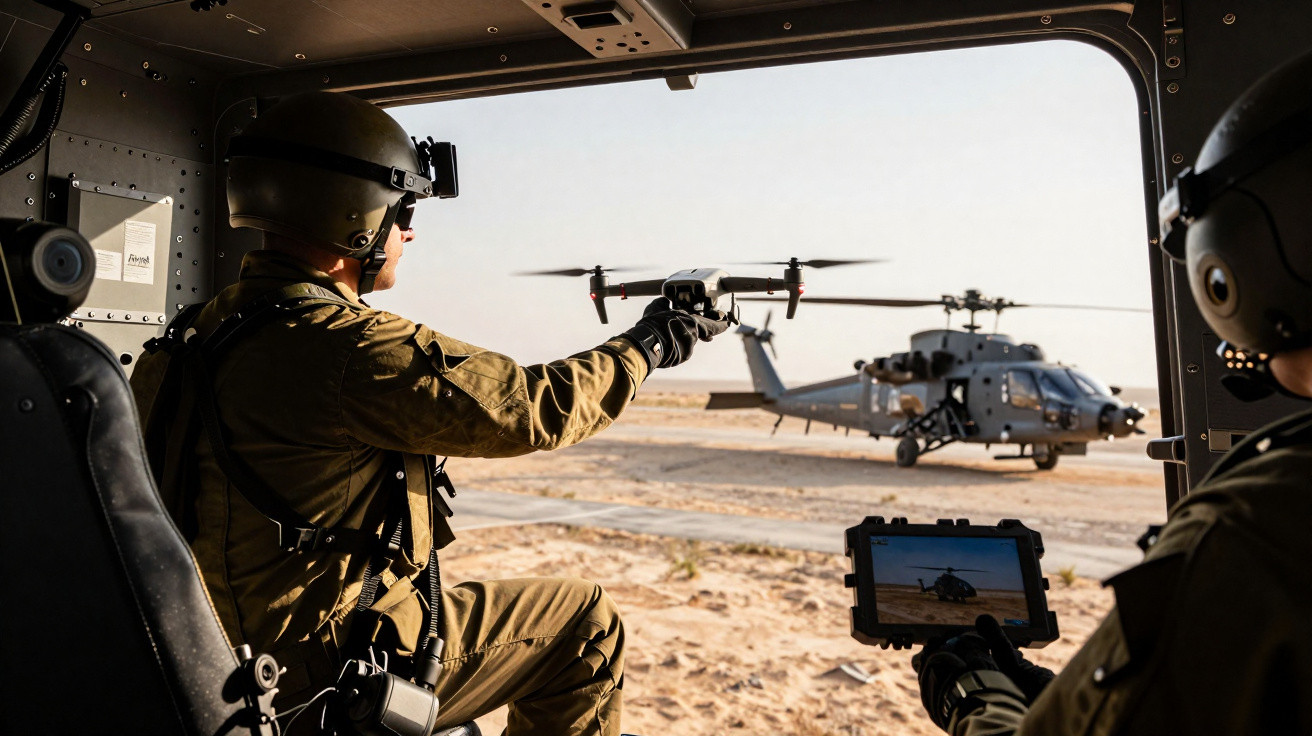
The United States Marine Corps (USMC) has carried out a fresh operational-capability demonstration integrating its UH-1Y Venom and AH-1Z Viper helicopters with low-cost first-person-view (FPV) drones. The aircraft were used as airborne “motherships” to extend battlefield range and strike capabilities. Personnel from the 169th Light Attack Helicopter Squadron (HMLA-169), part of Marine Aircraft Group 39 (MAG-39), 3rd Marine Aircraft Wing (3rd MAW), and the 3rd Light Armored Reconnaissance Battalion, 1st Marine Division, took part in the exercise.
During the event, Marines assessed whether FPV drones could be launched from helicopters in flight and remotely operated from inside UH-1Y Venoms. According to Captain Quinton Thornbury, a UH-1Y Venom pilot with HMLA-169, “the primary objective was to test the feasibility of non-kinetically launching an FPV drone from a moving helicopter, which we were able to do today”. He added that they then sought to “validate whether we can control the drone’s manoeuvres from the rear of the aircraft”.
Airborne command and extended strike range
The test used a tactical scenario in which ground forces from the 3rd Light Armored Reconnaissance Battalion launched a Neros Archer FPV drone. Once airborne, control of the unmanned aircraft was handed over to a specialist team aboard a UH-1Y Venom operating several kilometres away. From that position, the helicopter served as an airborne command post, using its greater altitude and mobility to direct the drone towards its assigned target.
The USMC is pursuing these capabilities in response to the growing threat posed by modern air-defence systems, which force helicopters to operate at greater stand-off distances in order to reduce risk. Pairing the H-1’s hovering and observation capabilities with expendable, low-cost FPV drones provides increased offensive reach without directly exposing aircrew.
Speaking about the new tactic, Sergeant Matthew Pocklington, a UH-1Y crew chief with HMLA-169, stated: “This allows us to keep our crews safe while extending the battlefield’s lethal reach right out to where the enemy is”. He added: “We continue to provide close air support and support to ground forces, but in a way that allows drones to get close and destroy the enemy instead of putting our Marines at risk”.
Neros Archer FPV drone and H-1 helicopter capabilities
The Neros Archer drone, currently one of the FPV systems most widely used by USMC infantry, was chosen for the demonstration because of its operational performance and the supply chain already in place across the force. This enables this type of capability to be integrated more rapidly into air and ground units, while also providing a lower-cost alternative to conventional guided weapons in certain tactical situations.
The demonstration also confirmed the feasibility of using FPV drones as a remote extension of the H-1 helicopters’ sensors and weapons. According to the Marines, the accuracy and compact size of these unmanned aircraft also help to reduce collateral damage in complex environments. Through this integration, helicopter formations will be able to detect, identify and engage ground and maritime targets at greater distances, strengthening the operational relevance of the UH-1Y Venom and AH-1Z Viper platforms in future combat scenarios.














Comments
No comments yet. Be the first to comment!
Leave a Comment