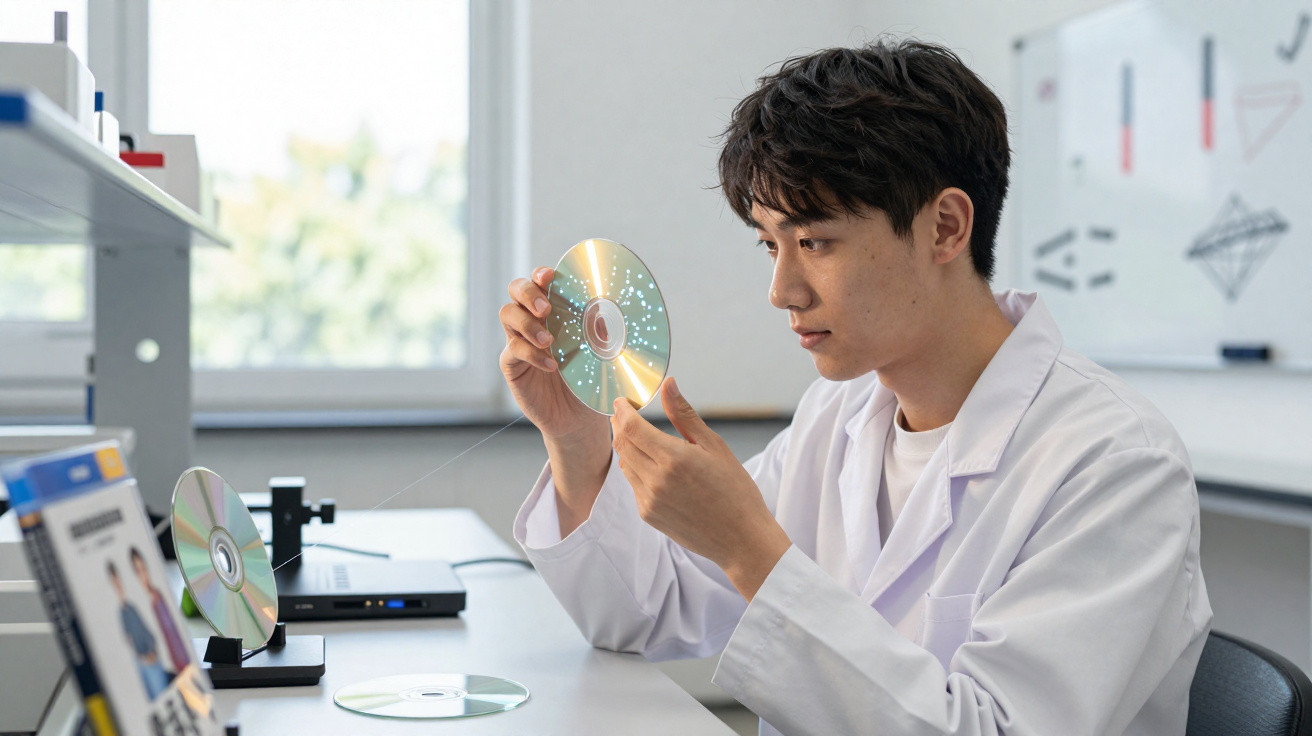
A research group at the University of Chicago is developing a storage technology that could make conventional CDs and DVDs look like relics from the Stone Age. Rather than pushing today’s lasers to their limits, the approach uses specialised crystals and quantum-mechanical effects to pack data exceptionally densely onto optical storage media.
How an old CD could become a high-tech storage medium
Optical media such as CDs, DVDs and Blu-ray discs face a physical limitation: a laser’s wavelength determines how small the data points on a disc can be. Shorter wavelengths enable denser data storage, but progress in this area has largely stalled for years.
The Chicago team is tackling that limit from a different direction. Instead of relying solely on increasingly powerful or more “colourful” lasers, the researchers introduce new materials: magnesium oxide crystals (MgO) paired with narrowband emitters. These are highly precise light sources fixed to very specific wavelengths.
Made from rare elements, these emitters produce photons that are substantially “smaller” than the light particles used in standard optical lasers. This makes it possible to position data points far closer together.
By combining specialised crystals with narrowband emitters, storage density on optical media could become up to a thousand times greater than it is today.
Defects that become useful: the science behind quantum defects
At the heart of the concept are what are known as “quantum defects” in the crystal structure. Although such irregularities would normally be considered flaws in a material, here they become the technology’s central feature.
The defects contain unbound electrons that can absorb and retain light energy. Narrowband emitters provide precisely the type of light these defects can capture, creating a form of microscopic optical memory within the crystal lattice.
Using complex models, the researchers tracked how energy moves between emitters and defects at the nanoscale. This points to a design in which information is no longer held solely on the surface of a storage medium: the material’s volume itself can be addressed in a controlled way.
How small are these light particles?
For comparison:
- Standard visible-light optical lasers: around 500 nanometres
- Infrared systems: up to 1 micrometre
- Narrowband emitters in the new concept: considerably shorter wavelengths, and therefore correspondingly finer data points
The theoretical result is that a medium occupying the same area as a current Blu-ray disc could hold up to 1,000 times more information.
From theory to practice: obstacles still to overcome
This is still fundamental research rather than an almost finished consumer technology. The key issues are the stability, readability and lifespan of stored information.
How long does light remain “trapped” in a defect?
Storage duration is a crucial concern. Quantum defects store energy as excited electrons, but it remains unclear how long this state can reliably persist. For a day-to-day storage medium, information would need to last for many years, ideally decades, without requiring a specialised laboratory.
The energy must also be retrieved in a controlled manner. In other words, a robust method is needed to read the stored states selectively without immediately destroying them or disturbing them too greatly.
Only when it is clear how stable the defects are and how precisely their states can be read will the vision of quantum storage become an everyday product.
The temperature challenge: quantum technology without a freezer?
Nearly every serious quantum application faces the same difficulty: it generally operates reliably only at extremely low temperatures. Superconducting qubits in quantum computers require cooling systems that come close to absolute zero.
The new storage principle is intended to work at room temperature wherever possible. Only then would it be suitable for data centres, archives or even home electronics. This is one of the greatest challenges, as thermal disruption must not cause the defects to continually lose their stored information.
- Objective: operation at normal ambient temperature
- Risk: stored states being lost because of thermal disturbance
- Research focus: selecting materials, doping and crystal structures that keep the defects robust
What such a storage medium could achieve
Imagine that this technology becomes market-ready in a few years or decades. An optical disc the size of a DVD could then be in an entirely different league from the silver discs on a shelf.
Examples of potential capacities, purely as a broad indication:
| Medium | Typical capacity today | Potential capacity with quantum storage (theoretical) |
|---|---|---|
| DVD | 4.7 GB | up to 4.7 TB |
| Blu-ray | 25–100 GB | up to 25–100 TB |
A single disc could consequently hold, for example:
- Thousands of films in 4K resolution
- Entire decades of corporate archives
- Vast training datasets for AI models
Such storage media would be particularly attractive to data centres seeking to archive large data volumes for the long term at comparatively low cost, including streaming services, research institutions and cloud providers.
Why the concept is based on the CD
In everyday life, optical media are now widely viewed as obsolete. Streaming, SSDs and cloud services have displaced shiny discs. Even so, CDs and DVDs retain several characteristics that make them appealing for long-term archiving:
- No moving parts within the medium itself
- Strong resistance to magnetic fields
- Easy to stack and store
- Clear physical separation between individual storage media
In a more advanced form, optical media could therefore serve as a kind of future “cold storage”: not for daily access, but as a huge data library operating in the background.
Quantum mechanics as a toolkit for next-generation storage
The work presented illustrates how powerfully quantum mechanics is now driving new storage concepts. Defects once regarded as undesirable are being understood as deliberately usable storage locations. Light is no longer treated merely as a reading beam, but as an active storage interface.
For readers unfamiliar with the term “defect centre”, it refers to a tiny “imperfection” in a crystal, such as a missing atom or a foreign atom in the wrong position. This imperfection creates new energy states that act like small drawers, where energy can be deposited for a limited period.
There are plenty of risks: interference from environmental influences, material ageing, and the complicated, costly manufacture of crystals. There is also the question of whether sufficiently fast writing and reading speeds can be achieved to compete with hard drives and SSDs.
On the other hand, the advantage is clear: storing data at enormous density on a physical medium could drastically reduce the energy use and space required in data centres. Instead of hundreds of hard-drive racks, a few cabinets of optical quantum storage could accommodate the same mass of data.
Integration with established systems is also an obvious possibility. One option would be a tiered storage model: fast SSDs and RAM for live operation, conventional hard drives for medium-term data, and high-density quantum CDs as deep archive storage that is accessed only rarely but safeguards huge quantities of data over the long term.
















Comments
No comments yet. Be the first to comment!
Leave a Comment