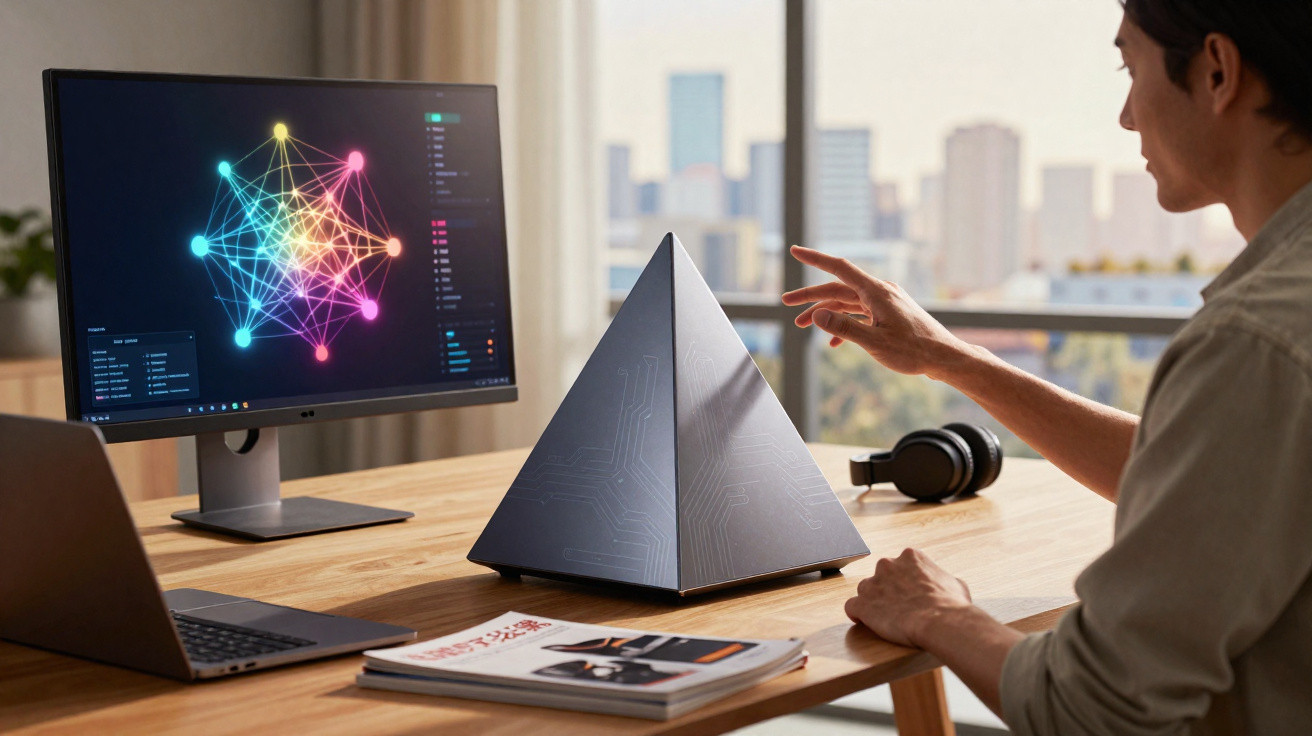
At first sight, this unusual pyramid-shaped computer is reshaping ideas about PCs, artificial intelligence and the true location of our data.
It initially resembles a piece of minimalist desk art rather than a device built for demanding tasks. However, this new Chinese desktop – formed as a sharply angled pyramid and designed to operate powerful artificial intelligence models completely offline – suggests a future in which a PC functions more like a private miniature data centre than a conventional computer.
A desktop more like a sculpture than hardware
Chinese hardware makers are competing to distinguish themselves in an overcrowded PC market. While some favour transparent enclosures and others rely on RGB illumination, this manufacturer has chosen geometry: a small pyramid case placed on a modest base, with ventilation openings concealed around its edges.
Its pyramid shape serves more than an aesthetic purpose. Locating the motherboard and heat-producing parts nearer the middle and bottom produces a chimney effect, allowing warm air to rise through vents at the top. As a result, it requires less noisy fan cooling and can remain comparatively quiet during intensive AI workloads.
This pyramid PC is meant to sit visibly on a desk, like a smart speaker or designer lamp, rather than hide under it.
The panels are expected to combine matt metal surfaces with restrained lighting that indicates conditions including AI processing, low-power operation and notifications. At a time when many people work from crowded house shares or kitchen tables, manufacturers recognise that a machine’s appearance can matter as much as its outright specifications.
Built from the ground up for local AI
The more significant change is inside the pyramid. Rather than focusing on gaming benchmark results, its components are configured to run large language models and image generators locally, without repeatedly relying on distant cloud servers.
Making this possible within a compact enclosure depends on three key components:
- A high-core-count CPU tuned for parallel workloads
- A powerful GPU or dedicated AI accelerator with ample VRAM
- A large, high-speed SSD for storing AI models and datasets that occupy multiple gigabytes
The manufacturer’s goal is straightforward: enable owners to operate chatbots, coding assistants, transcription software and image-generation tools directly on the machine. This cuts latency, avoids many connectivity restrictions in Chinese cities, and provides a different privacy profile from cloud services that may be blocked, restricted or monitored under local rules.
Local AI means your files, prompts and outputs do not need to leave your home or office router unless you choose.
Why local AI matters right now
Most AI tools currently used by consumers are reached in a browser. Each prompt travels to a remote data centre, where it is processed. This approach creates several points of friction: it requires a reliable internet connection, commonly comes with subscription costs, and makes it more difficult to keep sensitive information entirely on-site.
Local AI alters that equation. Users can fine-tune models using personal emails, company PDFs or photograph archives without passing those files to an outside provider. The pyramid PC is presented as a “personal AI station”, allowing small companies, developers and privacy-minded users to retain control while continuing to use modern models.
Technical choices behind the pyramid PC
The device is expected to use domestic or region-compatible chips, reflecting geopolitical limitations as well as China’s drive to create a self-sufficient AI ecosystem. This includes CPU, GPU and NPU (neural processing unit) options designed for transformer models, speech recognition and computer-vision work.
| Design aspect | AI impact |
|---|---|
| Pyramid cooling layout | Helps sustain long AI training or inference without thermal throttling |
| High VRAM accelerator | Allows running larger language models fully on-device |
| Fast NVMe storage | Reduces loading time for large model files and datasets |
| On-device encryption | Protects local AI projects and training data from casual access |
Cooling and power delivery remain two persistent challenges for AI-centred desktops. A large gaming tower can accommodate substantial fans and radiators, whereas a small pyramid cannot. Engineers seem to be relying on a mix of low-profile liquid cooling and precisely channelled airflow to control temperatures without making the PC resemble a desk fan.
Uses beyond a striking case
The pyramid PC is plainly intended for more than gaming. The company promotes it to several groups requiring AI capacity but unwilling to hire cloud infrastructure:
- Freelance developers using local code assistants and testing environments
- Designers treating image generation as a sketching aid
- Small studios producing transcriptions and translations for videos or podcasts
- Start-ups developing AI products without exposing ideas to external providers
For many Chinese startups, a one-off hardware purchase can be easier to justify than steady monthly cloud fees.
For example, a marketing agency could fine-tune a language model with its earlier campaigns, tone-of-voice documents and client feedback. That assistant would run exclusively from the pyramid PC, producing draft copy and social-media captions without sending client information to third parties.
How it fits into China’s AI strategy
China is moving quickly to build its own AI stack, including domestic chips, frameworks and foundation models. Although a pyramid-shaped PC might appear to be an eccentric design exercise, it forms part of a wider industrial and political narrative.
Operating AI locally lowers reliance on overseas cloud platforms while giving regulators closer control over models used within the country. It also showcases Chinese capabilities in chips and software, making AI more concrete for everyday users rather than an abstract service hosted far away.
What “running an AI model locally” really means
The term may seem imprecise, so it is useful to separate its elements. An AI model is a trained mathematical structure that converts inputs into outputs, whether text into text, images into images, speech into text or similar tasks.
When a model operates locally, its three principal stages take place on your own computer:
- The model file is kept on your local drive.
- Your CPU/GPU/NPU performs processing without outside servers.
- Both intermediate information and final results remain in local memory and storage.
This arrangement does not inherently provide flawless privacy or security. Malware, incorrectly configured backups and physical theft can still expose data. Nevertheless, local AI changes the pattern of risk: rather than placing trust in a remote provider’s security and compliance, you take responsibility for your own.
Benefits and trade-offs for everyday users
For anyone considering an AI-focused desktop such as this pyramid, the advantages are clear, though there are also practical compromises.
Local AI brings control and speed, but asks more from users in terms of updates, hardware care and electricity.
Possible advantages include:
- Quicker AI-tool responses because there is no network latency.
- Costs that are more predictable than ongoing cloud charges.
- The ability to explore a range of open-source models.
- Reduced dependence on particular accounts, regions and app stores.
Conversely, owners must monitor storage consumption, understand basic model management, and consider heat and noise. A computer routinely processing gigabytes of data while running its GPU under heavy load has a different footprint from a quiet office laptop.
What this could mean for future PCs
Should the pyramid PC attract buyers, it could encourage other manufacturers to treat AI as a core workload instead of an afterthought. This may lead to dedicated AI bays in desktop machines, additional NPUs in consumer processors, and operating systems built around local models as system-level services.
One credible possibility is that, within a few years, a typical home PC will arrive with two or three local models already installed. One could provide text assistance, another could manage voice commands, and a third could organise photographs. Hardware would be sized to support them, while the industrial design – pyramid-shaped or otherwise – would openly indicate that it is a “thinking machine”, rather than simply a spreadsheet box.
For the moment, the pyramid-shaped Chinese computer is a talking point. It represents a simple proposition: AI need not reside in remote data centres. It can occupy your desk, illuminate part of the room, process your prompts quietly – and keep them at home.













Comments
No comments yet. Be the first to comment!
Leave a Comment