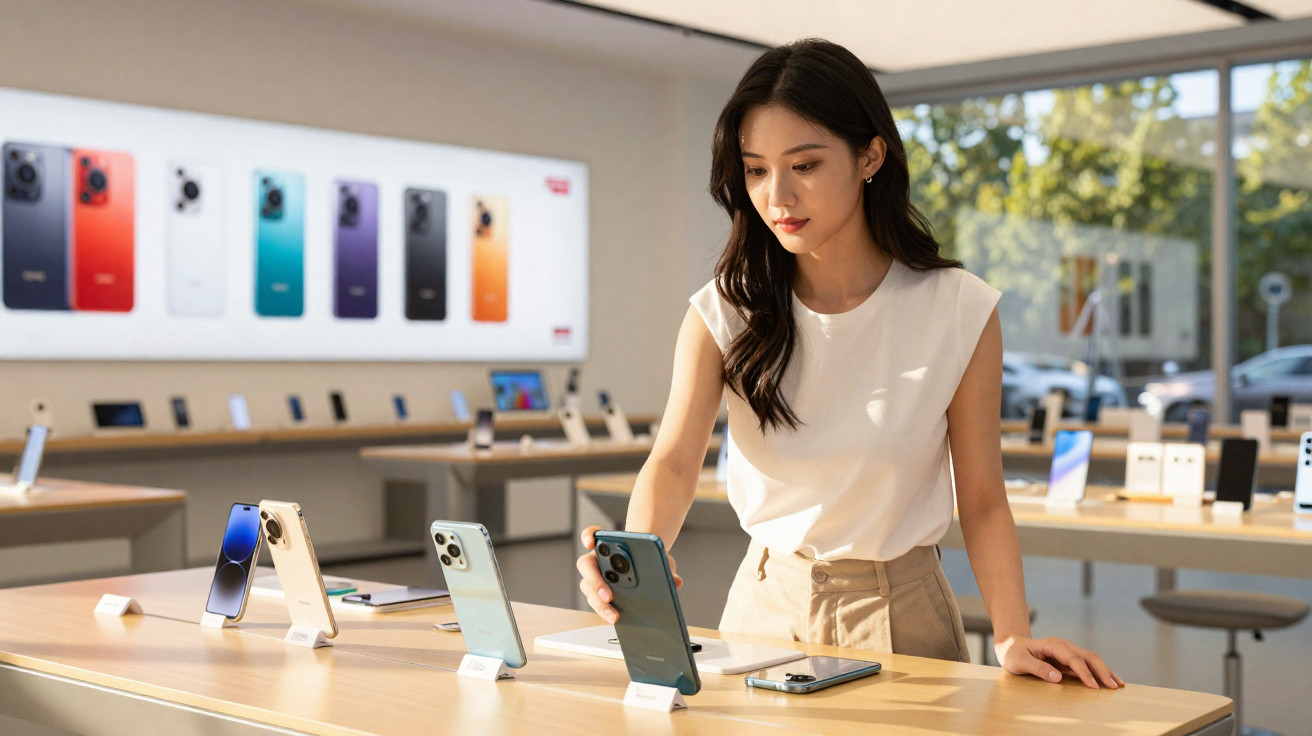
In a Shanghai shopping centre awash with neon and the muted whirr of escalators, the Apple Store continues to gleam like a glass cathedral. Children crowd against its windows, staring at the newest iPhone. Only a few paces away, however, another group gathers around a smaller, noisier space: the Huawei stand, packed with foldables and camera-focused flagship phones, marked by red price labels and “patriotic tech” messaging.
Shoppers are no longer weighing specifications alone. They are measuring competing narratives, loyalties and, since the latest round of US tariffs, the understated pressure on their budgets.
The familiar question used to be “iPhone or Android?”
For millions of Chinese consumers, the real question has now shifted in a more uncomfortable direction.
Tariffs shook the market, and Chinese buyers changed position
Visit a major electronics market in Beijing or Shenzhen and the altered atmosphere is unmistakable. Apple still projects a polished, aspirational and Instagrammable image. Yet customer traffic is gradually moving elsewhere, little by little, as tariffs and geopolitical tension redefine what counts as a “smart choice”.
Speak to a young professional replacing their handset and a cautious phrase often emerges: “I like Apple, but…” The calculation follows. Sometimes it is nationalism; sometimes it is straightforward curiosity about the advances local brands have made. The appeal of the bitten apple remains, but it is no longer beyond challenge.
Consider Li Wei, a 29-year-old project manager from Guangzhou. For years, every iPhone launch was a small holiday for him: he would queue outside the shop and share unboxing photos before sunrise.
When the latest US–China trade tensions drove prices upwards and intensified online arguments, he hesitated.
He compared an iPhone directly with a Huawei Mate and a Xiaomi flagship. The apps were the same, the cameras broadly comparable, 5G was everywhere, chargers came in the box, and repair shops were on nearly every street corner. He said the iPhone still felt smoother, but the price difference began to seem less like “premium” and more like “penalty”. One quiet night, he listed his iPhone for sale in a WeChat group before heading into a Huawei shop instead.
Decisions of this sort are seldom driven by tariffs alone. Tariffs are more like a forceful knock at the door, prompting people to reconsider purchasing habits they had maintained for years. Once the overall cost of ownership increases - including the handset, repairs and accessories affected by supply-chain disruption - buyers take a wider view.
Chinese manufacturers recognised the opportunity quickly. They increased R&D spending, refined their camera campaigns, emphasised home-grown chip stories and surrounded it all with a gentle message to “support local innovation”. The outcome was that tariffs hastened an existing movement: Apple shifted from being the automatic choice to being one contender among many, particularly in China’s intensely competitive premium market.
In China, Apple buyers ask: why not Huawei, Xiaomi or Honor?
At shop-floor level, this change feels largely practical and ordinary. People do not enter shops chanting about geopolitics; they arrive with cracked displays, ageing batteries and a fixed budget. Sales staff at Chinese-brand counters have mastered a simple approach: place rival devices together and allow the price labels to make the case.
They open the camera applications, zoom into a dark corner of the shopping centre, demonstrate telephoto lenses, AI filters and, where available, satellite messaging. Then comes the quiet addition: “This is a Chinese chip. This is our own ecosystem.” The question “Should I still buy Apple?” becomes “What exactly am I paying extra for?”
For many city-based customers, family provides the tipping point. One student in Chengdu said she changed her own handset first, then gradually encouraged her parents to do the same. Her mother had previously found iOS updates and English-heavy guides difficult. With a Vivo handset, she felt the device was designed around her daily needs: payments, health codes and local apps were integrated as standard.
Another frequently repeated experience is the group-chat effect. When several friends switch to Huawei or Xiaomi, the lone iPhone owner can suddenly seem out of place. Cross-device sharing, tablet-to-phone connectivity and smart-home controls now work more seamlessly inside Chinese ecosystems than between an iPhone and other products. The pull changes gradually, driven more by everyday ease than by political slogans.
Beneath these routine choices is a more fundamental issue of trust and control. US export restrictions, Chinese countermeasures and fractured supply chains have made technology appear vulnerable, even to people who previously paid no attention to policy news. Tariffs became an emblem of that vulnerability.
For certain Chinese consumers, Apple still represents status and a top-tier user experience. For an expanding group, though, Chinese brands signify resilience: “They won’t get cut off from their own market,” as one Shenzhen engineer told me. Realistically, no one studies every policy document before purchasing a phone. They see headlines, notice the price effect and take in the mood of their social feeds. Over time, that can be enough to steer a country’s buyers towards domestic brands.
How Apple is responding as Chinese brands improve
Apple has not merely stood by. In China, it has used promotions more assertively, aligning reductions with shopping festivals and relying on trade-in offers. In some cities, staff in Apple Stores gently guide visitors towards instalment plans intended to reduce the shock of the upfront price.
Its marketing language has also been subtly adjusted. There is less overt focus on “American design” and more emphasis on lifestyle, privacy and ecosystem dependability. Apple’s current formula is clear: maintain its premium position, while yielding enough on pricing and payment options to stop aspirational shoppers from leaving the store and walking across to Huawei.
Chinese brands, meanwhile, have worked on their former shortcomings. A few years ago, critics mocked awkward interfaces and bloatware. Those criticisms have not disappeared entirely, but they are far quieter than before.
Today, Android interfaces are more refined, updates arrive faster, and camera performance receives almost obsessive attention - from low-light photography and portrait modes to AI beautification tailored to local preferences. Foreign observers often make the mistake of assuming Chinese buyers care only about price. Speak with enough consumers and a more nuanced picture emerges: they seek balance between performance, pride, ecosystem and, naturally, a sensible price in a world unsettled by tariffs.
“Tariffs didn’t kill Apple in China,” a Shenzhen retailer told me. “They just gave people a reason to try what was already getting better every year.”
Foldables as a status upgrade
For some young professionals, replacing an iPhone with a folding Huawei or Oppo does not feel like “downgrading” at all. Instead, it feels like moving to the next form factor, particularly when the snap of a closing hinge attracts attention in a café.Battery life over brand logo
In Tier-2 and Tier-3 cities, concerns about battery life outweigh loyalty to a logo. When a Chinese handset lasts a day and a half while an iPhone runs out at dinner, the decision begins to appear less emotional and more about survival.Silent ecosystem lock-in
Once someone owns a Chinese smartwatch, earphones and perhaps a smart television, their phone becomes one part of a domestic-device puzzle. Returning to Apple would interrupt that flow - and few people want to make that change twice.Retail theatre versus street presence
Apple still dominates the iconic flagship-store experience. Chinese brands dominate much of the rest: underground adverts, livestreamed sales and pop-up events in medium-sized towns where Apple has barely any presence.Patriotism as background noise
Most shoppers will not claim to have selected a Chinese brand “for the country.” Even so, patriotic messaging runs quietly through advertising and media, influencing decisions at the margins when prices and specifications are already similar.
What the Apple China shift reveals about power, pride and premium phones
Step away from the bright shopping-centre lights and this appears to be about more than market-share figures. Tariffs may have supplied the spark, but the fuel was already in place: increasingly mature Chinese technology, greater confidence and mounting reluctance to pay a geopolitical surcharge for a foreign logo.
We have all experienced the moment when a product once regarded as untouchable suddenly seems… negotiable. Once that psychological change happens, reversing it is difficult.
Apple still has millions of committed users in China, along with a brand appeal that most businesses would envy. Its monopoly on desire, however, has disappeared. The question is no longer “Will Chinese buyers abandon Apple?” but “How many of them will hedge with a Chinese brand this upgrade cycle?”
For readers outside China, this is not only a story about phones. It offers a preview of what happens when tariffs turn consumer technology into a proxy battleground. Premium no longer automatically means “imported by default.” It means “justified under pressure.”
For Chinese brands, the opportunity is both exciting and risky. As they move into Apple’s former place at the top of the market, they also take on the same scrutiny around privacy, quality and long-term support. Apple, meanwhile - the company that once showed the world how to merge gadgetry with identity - must answer a harder question in China:
When competitors match its specifications, charge less, replicate its ecosystem techniques and speak the local language of pride and resilience, what precisely makes an iPhone worth buying?
| Key point | Detail | Value for the reader |
|---|---|---|
| Tariffs as an accelerator | Trade tensions increased prices and awareness, encouraging Chinese consumers to reconsider iPhone upgrades that had once been automatic. | Helps readers understand how policy-level action can quietly influence everyday purchasing decisions. |
| Rise of Chinese ecosystems | Huawei, Xiaomi, Oppo and others provide closely integrated devices, competitive cameras and localised services. | Shows why “just buy Apple” is no longer a straightforward default in China. |
| Emotional and symbolic layers | Patriotism, narratives of resilience and influence from social circles all shape choices when specifications are similar. | Offers a deeper perspective on the merging of identity and technology in modern China. |
FAQ:
- Question 1 Are tariffs the main reason Chinese consumers are buying fewer iPhones?
Answer 1
Tariffs are better understood as a catalyst than the underlying cause. They increased prices at the margins and made people consider value more carefully, while Chinese brands were already narrowing the quality and feature gap.
- Question 2 Is Apple losing China completely?
Answer 2
No. Apple retains a strong and loyal customer base, as well as a powerful brand, particularly in top-tier cities. The change is that it is no longer the automatic premium option for every buyer.
- Question 3 What are Chinese buyers getting from local brands that Apple doesn’t offer?
Answer 3
They frequently receive stronger price-to-performance value, localised apps and services, deeper links with other Chinese devices and a subtle feeling that they are supporting domestic innovation.
- Question 4 Are Chinese phones really on par with the iPhone now?
Answer 4
In many respects - cameras, battery life, charging speed and display quality - yes, they are highly competitive. Apple continues to lead in some areas, including long-term software support and ecosystem polish, but the gap has narrowed considerably.
- Question 5 What does this trend mean for consumers outside China?
Answer 5
It points to a more multipolar technology world. As Chinese brands become stronger domestically, they are likely to compete more forcefully overseas, providing global consumers with more high-end alternatives across different price points.










Comments
No comments yet. Be the first to comment!
Leave a Comment