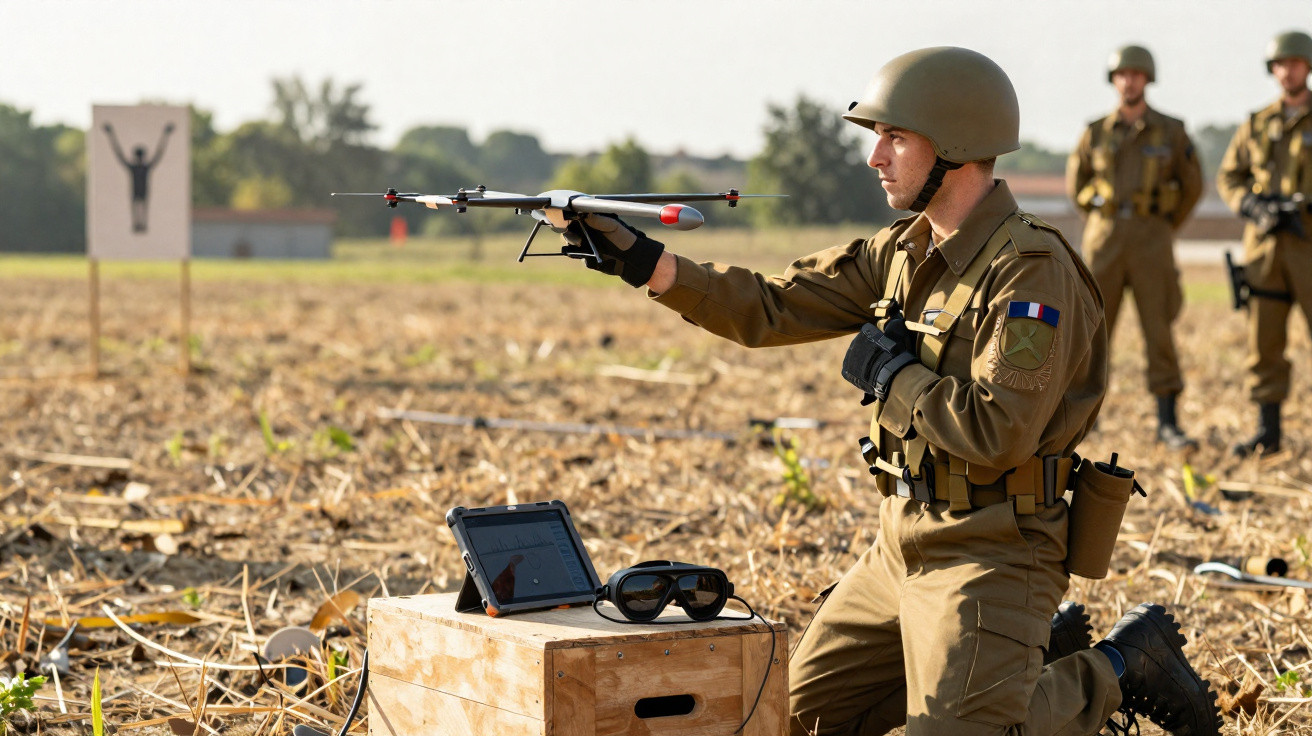
Fronde 2.0 is more than an airborne camera. Developed by frontline soldiers and further shaped alongside engineers, it is a guided weapon now moving closer to operational service.
A French-built response to low-cost killer drones
The concept behind Fronde 2.0 predates the point at which loitering munitions became a routine sight in footage from Ukraine. In about 2022, two soldiers from the French Army’s 1st Parachute Hussars Regiment (1er RHP) posed a straightforward question: could a rapid first-person-view (FPV) racing drone bridge the capability gap between a single-use anti-tank rocket and a conventional guided missile?
They wanted a system that troops could carry themselves, that remained affordable, and that could accurately engage hardened objectives including armoured vehicles, bunkers and fortified positions, without the expense or logistical burden associated with a heavy missile.
Fronde 2.0 aims to give French ground troops a disposable, steerable weapon that sits between a shoulder‑launched rocket and a medium-range guided missile.
One of the participating non-commissioned officers was already an FPV racing-drone enthusiast. Building on this knowledge, the two soldiers established an initial specification: an immersively piloted drone able to carry a converted explosive charge, alter its flight path almost until the moment of impact, and attack targets at distances of approximately 50 to 2,000 metres during flights lasting up to 30 minutes.
Turning legacy grenades into precision weapons
Rather than develop an entirely new warhead, the team examined existing stocks. The project considered the reuse of older rifle grenades still held in French stores:
- AC58 – an anti-tank grenade able to penetrate about 35 cm of steel in a direct strike
- APAV40 – a dual-purpose grenade assessed as capable of piercing around 20 cm of steel while also retaining fragmentation effects
Installing these established munitions on a drone airframe is intended to pair known ballistic effects with modern guidance and battlefield awareness. A live video feed sent to the operator’s goggles or display makes last-moment directional adjustments possible, unlike a conventional rifle grenade.
Support for the programme soon extended beyond the regiment. Engineers from the National Engineering School of Tarbes, together with the FabLab at the local business incubator, assisted with the design of attachment arrangements, the integration of electronics and safety processes.
Replacing Chinese racing drones with a European platform
Initial demonstrators used commercially available FPV racing drones manufactured in China. Although this approach suited rapid trials, it did not meet French requirements for electronic sovereignty, protected communications and night operations.
To meet national security and interoperability demands, the team shifted from hobby airframes to a European‑built tactical drone base.
France’s Future Combat Command (Commandement du combat futur, CCF) consequently called for an alternative platform. The regiment joined with French manufacturer Hexadrone and selected its Gekko 2.1 XL-EU drone as the basis of the weaponised system.
This change provided several benefits:
| Requirement | Benefit from Gekko 2.1 XL-EU |
|---|---|
| Electronic sovereignty | Components made in Europe lessen dependence on overseas suppliers and reduce security concerns. |
| Compatibility with soldier equipment | Integration with current radios, command systems and power standards is simpler. |
| Night operations | Compatibility with low-light or thermal sensors allows round-the-clock operation. |
The 17th Parachute Engineer Regiment (17e RGP) subsequently helped improve the firing chain. Its work concentrated on streamlining arming and detonation processes so that the system would remain dependable under pressure and could be operated by ordinary troops rather than specialists alone.
Fronde 2.0 passes a significant test stage
Following early live-fire tests at the French defence procurement agency’s land test centre in Bourges, the project advanced further towards the end of 2025. A fresh and larger-scale trial campaign took place at the Captieux range.
According to the 1er RHP, which drew attention to the event in a LinkedIn post dated 17 January, the trials used 14 drone “vectors” and six separate munition types. The regiment described the outcome as successful, indicating that integration and target-engagement performance had achieved expectations.
The 1st Parachute Hussars announced that Fronde 2.0 is expected to reach full maturity during 2026.
A central issue for the programme is reconciling disruptive technology with a low-cost approach while addressing the untidy realities of combat. This requires resilience against jamming, straightforward maintenance, intuitive controls and very limited operator training time.
Why loitering munitions are important to modern armies
Loitering munitions, also sometimes termed “kamikaze drones”, have become emblematic of recent wars. They can remain over the battlefield before descending on a target once it has been located. For forces such as the French Army, they represent a flexible option between artillery, man-portable anti-tank weapons and combat aircraft.
Launched from the shoulder or by a small catapult, such systems may track armoured formations, air-defence radars or command posts without putting aircrew at risk. They are substantially cheaper than a guided missile launched from a jet while still offering the precision needed against an individual vehicle or bunker.
Until only a few years ago, France did not have a domestic offering in this field. That situation shifted in 2022, when the Defence Innovation Agency (AID) opened two project calls, Larinae and Colibri. Major French firms including KDNS France, Thales and MBDA have since introduced complete loitering-munition ranges for varying distances and payloads.
Fronde 2.0 stands out as a bottom‑up initiative, born in a regiment and then reinforced by industry and research partners.
A ground-up weapon for soldiers
Fronde 2.0 is especially notable for its starting point: it did not originate in a corporate research and development centre, but in a combat regiment seeking usable equipment. That beginning is likely to influence its design priorities.
For the 1er RHP, the drone needs to be readily carried during foot patrols, prepared rapidly while under fire, and flown by personnel who may have completed only a small number of training sessions. Dependability and ease of use take precedence over maximum range or speed.
In practice, that calls for robust frames capable of withstanding rough treatment, uncomplicated user interfaces and parts that can be replaced in the field. Cost is equally important. A weapon intended to be expended against one target must be inexpensive enough for commanders to deploy it regularly.
How Fronde 2.0 may be used on future battlefields
In a hypothetical operation, a French patrol carrying several Fronde 2.0 systems might spot an enemy armoured vehicle positioned hull-down behind cover. A shoulder-fired rocket could find it difficult to reach the target or strike it accurately, whereas a drone operator could guide a loitering munition around obstructions and amend its route in real time using FPV goggles.
The drone might arrive from an unforeseen direction and aim for thinner armour on the vehicle’s roof or rear. It could instead neutralise a machine-gun position within a building, guiding the warhead through a window or towards a rooftop firing point.
For higher command, limited quantities of Fronde 2.0 could provide a rapid “gap filler” when artillery cannot be used or when collateral damage needs particularly tight control. The option to abort or divert the drone during flight may also lower unintended casualties in comparison with unguided munitions.
Key concepts: loitering munition, FPV and low-cost design
A number of terms recur in discussions of Fronde 2.0 and comparable systems:
- Loitering munition: A weapon that remains airborne for a period before conducting an attack, unlike a standard missile that travels directly to its target after launch.
- FPV (first-person view): The drone operator views imagery from a forward-facing camera as though positioned inside the aircraft, generally through goggles, enabling accurate low-level control.
- Low-cost approach: The system seeks relatively low per-unit costs by repurposing available explosives, using commercial-style components where feasible and avoiding unnecessary complexity.
This combination presents advantages as well as risks. Loitering munitions can allow smaller units to achieve effects beyond their weight and lessen exposure, but their comparatively low cost and portability also appeal to non-state actors as well as regular armed forces.
For countries such as France, national programmes including Fronde 2.0 offer a means of keeping up with this changing environment while maintaining control of supply chains and policies governing use. As testing proceeds throughout 2026, the main issue will be the speed at which systems of this kind progress from experimental sites such as Captieux to standard equipment lists for frontline formations.














Comments
No comments yet. Be the first to comment!
Leave a Comment