
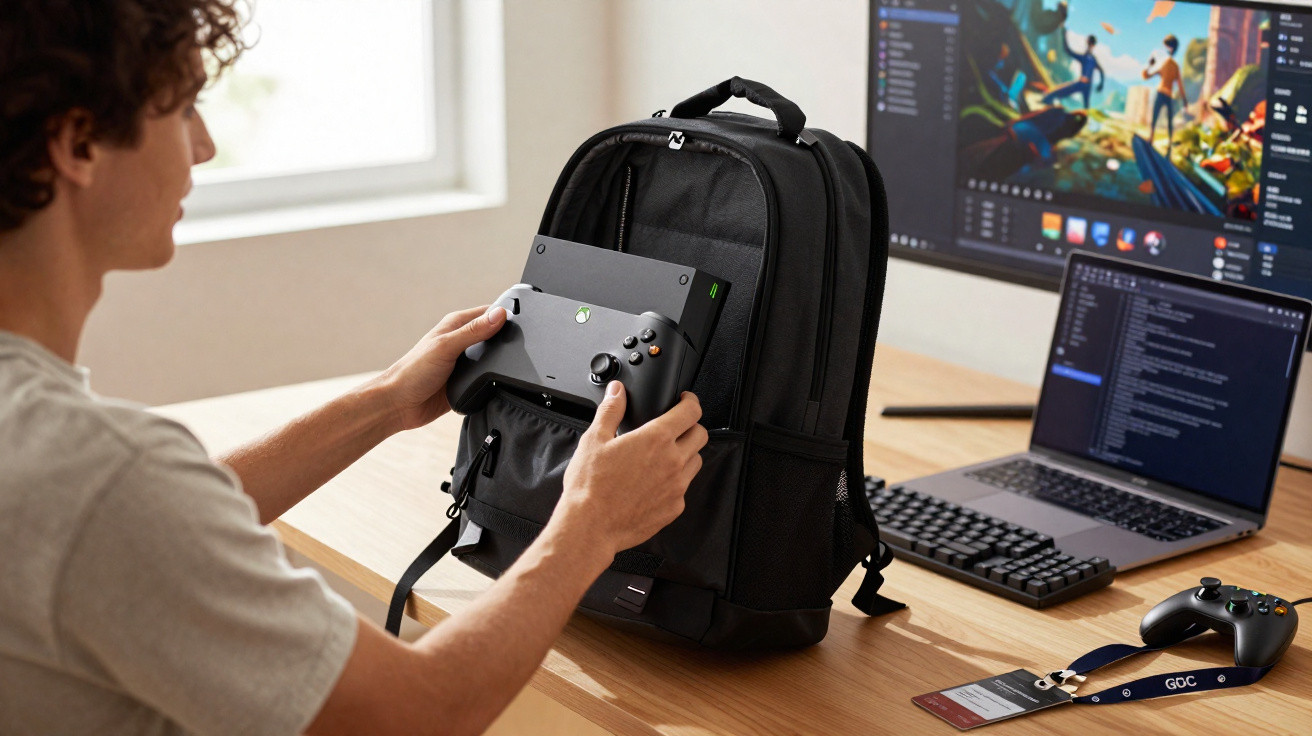
No-one is officially talking about a new console, yet the signals are hard to ignore: since the Game Developers Conference, a mysterious piece of hardware bearing an Xbox logo, developer markings and the codename Project Helix has been fuelling speculation. Much remains unclear, but the trajectory is already visible: Microsoft appears to be preparing a generation that blends console and PC more tightly than before.
What Microsoft actually showed at GDC
The speculation was sparked by several photos posted via the official Microsoft Game Dev account. In the images: a black-and-white box clearly labelled as Xbox hardware, featuring the marking XDK - the term Microsoft uses for its official development kits.
"An XDK isn’t a fan gadget; it’s a working tool for studios preparing games for upcoming Xbox hardware."
Hardware like this typically surfaces months - sometimes even years - ahead of any public console announcement. Its purpose is to let teams test engines, tools and early game builds on real target hardware, long before consumers have any idea what the final retail console will look like.
Old casing, new tech?
The most intriguing detail is the prototype’s exterior. The shell strongly resembles earlier developer kits, particularly the casing used for the Scorpio development hardware that later became the Xbox One X.
That immediately raises several questions:
- Are Microsoft’s engineers simply reusing an old casing to conceal new internals?
- Is the next Xbox generation’s architecture already inside?
- Or is this a stopgap platform intended to trial new, PC-adjacent features?
Microsoft has not commented on any of this. Even so, the timing is telling: publishing these images during the Game Developers Conference is unlikely to be accidental.
Project Helix: Xbox meets PC
The name Project Helix has been circulating in the rumour mill for a while and was mentioned, among others, by Asha Sharma, Microsoft’s new head of gaming. The suggestion is that this is more than just another console cycle with slightly prettier graphics.
"Project Helix is meant to become a hybrid platform that brings Xbox and PC together almost seamlessly, both technically and on the software side."
Based on what’s currently known, the available information points to three core aims:
- Stronger PC compatibility: Games built for Windows should be easier to move to the new Xbox - and the other way around.
- More PC-like architecture: The CPU, GPU and memory layout will likely mirror modern PC hardware even more closely.
- Deeper Game Pass integration: Whether on console, PC or via cloud, the subscription service is expected to sit at the centre.
Microsoft is already pursuing a dual-track strategy: exclusives often launch in parallel on Xbox and Windows, while progress and save files travel between platforms via Xbox Live. Project Helix could push that approach much further - supported by hardware that behaves more like a specialised gaming PC than a traditional living-room console.
What a hybrid console could mean in practice
A hybrid direction can sound vague, but it would have very tangible consequences. Plausible scenarios include:
| Possible feature | What it could mean for players |
|---|---|
| Unified builds for PC and Xbox | Faster ports, fewer technical differences, updates arriving closer together |
| Flexible graphics and performance profiles | More choice like on PC: prioritise FPS or visuals depending on preference |
| Shared mod and tool support | Part of the modding scene could operate directly on console |
| Tight integration with cloud gaming | Installed console games could blend smoothly with cloud streams |
Whether all of this will happen remains uncertain. Still, it matches the direction Microsoft has been moving in for years.
Why the timing is no coincidence
The Game Developers Conference isn’t known for big consumer-facing reveals; it’s built around technical sessions and B2B connections. The audience is packed with the people who build engines, write tooling and ship new games.
That is exactly the group Microsoft needs to reach right now. By sending an early, unambiguous signal that a new platform is on the way, Microsoft gains an advantage: studios can adjust roadmaps, plan for new features and prepare their teams for the next console generation well in advance.
"The images feel like a deliberately placed teaser: not enough for an official reveal, but sufficient to jolt developers and fans into paying attention."
This kind of breadcrumb trail has appeared in earlier Xbox cycles, too: devkits showing up in forums, technical terminology leaking out, long before any marketing slogan hits the main stage.
Xbox in transition - and what Project Helix has to deliver
Project Helix is taking shape at an awkward moment for Microsoft’s gaming division. The Xbox brand is under pressure: intense competition, expensive studio acquisitions, and strategies that swing between exclusivity and multiplatform releases. On top of that, there have been key personnel changes.
For that reason, the next hardware generation needs to do more than look better - it has to answer fundamental questions:
- Why should someone choose Xbox if many games also launch on PC and rival consoles?
- How can Game Pass continue to grow without undermining console sales?
- Which technical differentiator clearly sets Xbox apart from PlayStation and Nintendo?
A hybrid console–PC concept could be the missing piece. For anyone already moving between desk and sofa, a platform that links both worlds more tightly could be genuinely compelling.
Opportunities and risks of the Helix approach
As exciting as a hybrid Xbox sounds, it comes with real challenges:
- Complexity: The closer the console gets to a PC, the broader the range of configurations, profiles and options becomes. That can be technically appealing, but confusing for casual players.
- The price question: Hardware that leans towards high-end PC design is costly. Microsoft will have to balance performance against a price point that works for the mass market.
- A clear brand identity: If Xbox starts to feel too much like a PC, the obvious question is why a dedicated console is needed at all.
On the other hand, the upside is substantial: developers can stay closer to PC standards, ports become cheaper to produce, and Game Pass can be positioned as the core product regardless of the device.
What players can already take from this
There are still no official specifications, pricing details or a release window. Even so, a few trends can be inferred from what’s surfaced so far:
- The next Xbox generation isn’t just a concept - it already exists as physical hardware in developer offices.
- Microsoft is sticking to its plan of tightening the link between Xbox and Windows rather than relying solely on the classic exclusive-console model.
- Studios are getting early access to devkits, a sign that the coming years could be technically eventful.
For anyone who doesn’t hear the term devkit every day: it refers to special console variants that include extra ports, debugging capabilities and often more memory. They give developers insight into the platform’s eventual performance long before consumer hardware enters production.
For players, the key takeaway is simple: the next-generation foundations are being laid right now. Which features ultimately make it into Project Helix will also depend on how developers respond to today’s prototypes - and what they ask Microsoft to prioritise.
Before any official unveiling, there will likely be more leaks, teases and technical hints. But the first images already make one thing clear: behind the scenes, Microsoft is working hard to rethink Xbox - as a platform that feels even more like part of its PC ecosystem, without giving up the ease of a traditional console.




Comments
No comments yet. Be the first to comment!
Leave a Comment