
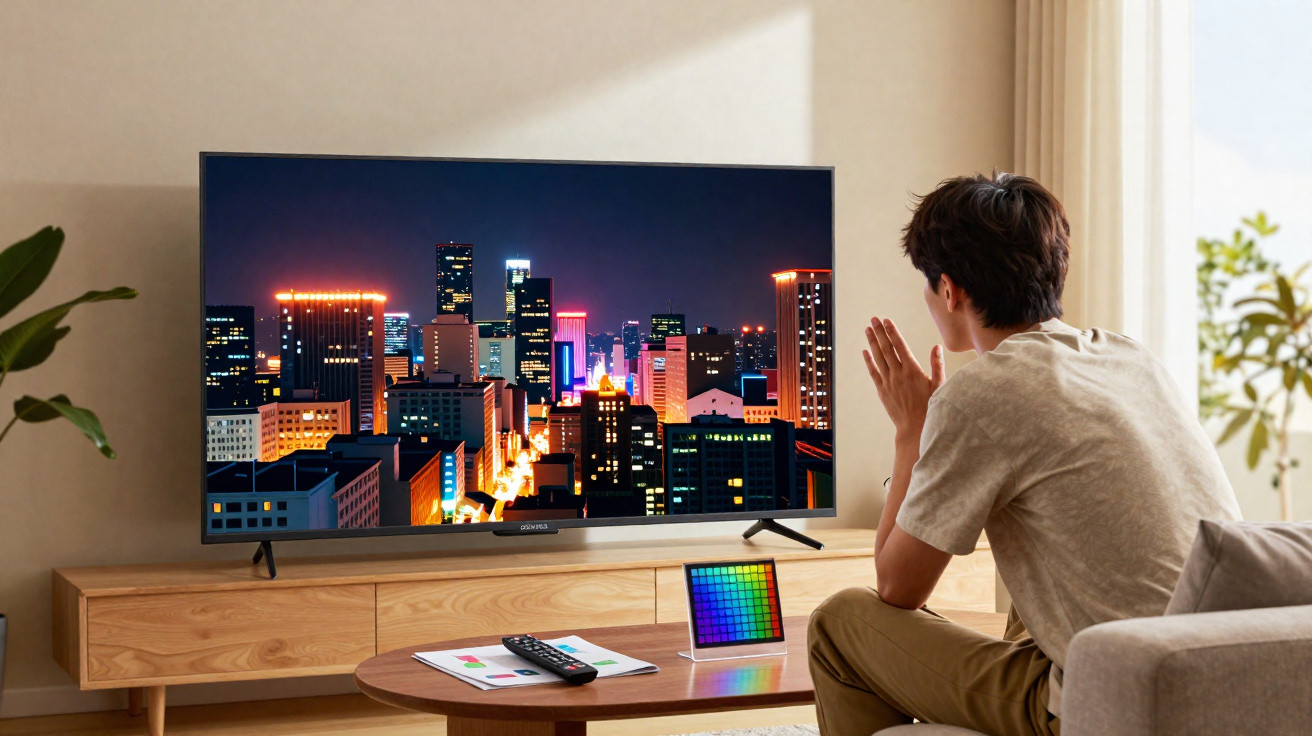
Whether it’s your television, smartphone, tablet or computer, you’re very likely to spend several hours a day looking at a screen. Behind that pane of glass that holds your attention sit a number of display technologies-but do you actually know what sets them apart? Let’s break down the jargon-heavy acronyms you see on spec sheets.
When it comes to displays, there are two big families: OLED and LCD. You may also have come across terms such as QLED, IPS, VA, Mini-LED or micro-LED. In most cases these are variations on LCD, but let’s take it step by step and start at the beginning.
What is LCD?
You’ve almost certainly heard its full name: Liquid Crystal Display (LCD). For decades it was the dominant way to build flat-panel screens, and a genuine (literally) slimline leap from the bulky cathode-ray tube televisions of earlier years. From the 1970s through to the 2000s, this technology appeared in computers, TVs, watches, mobile phones and plenty more besides.
How does LCD work?
Conceptually, an LCD is like a sandwich. Two glass plates hold a stack of layers: one layer of liquid crystals that shape the picture according to the electrical current, plus various filters-on modern screens this includes a colour filter, along with two polarising filters that control how light passes through. Because you need light to see anything at all, the illumination comes from behind this whole “salad-tomato-onion” stack: the backlight.
Light from the backlight travels through the different layers, which in turn block part of it (the polarising filters), shape it (the liquid crystals) and apply further adjustments (colour, contrast, and so on) until an image appears. Repeat that process many times per second and you have a functioning display.
IPS, VA, TN… still LCD, just built differently
LCD is a broad umbrella that includes several panel types. You’ll see IPS, VA or TN depending on how the layers in that “sandwich” are arranged.
Without diving deep into the engineering, each approach comes with its own pros and cons. Gamers often gravitate towards TN monitors because their strong motion clarity helps reduce blur, but they need to be viewed straight-on because their viewing angles are limited. For film and TV, VA is typically preferred, as it delivers higher contrast that can evoke the look of older plasma screens.
In practice, IPS has become the most widespread over time. Although its contrast can be underwhelming (to varying degrees depending on ambient light), its wide viewing angles have helped it dominate both living-room TVs and the screens in our pockets on smartphones.
Different kinds of backlighting
Beyond the panel itself, the backlight has a major impact on image quality. Broadly speaking, there are two lighting approaches: “LED Edge” and “Direct LED” (sometimes also called “Full LED”).
With “LED Edge”, the LEDs are positioned around the edges of the screen. Reflectors then spread that light across the whole panel, with accuracy that can vary significantly from one model to another. As a result, some displays show uneven illumination (“clouding”) and a “blooming” effect where bright areas bleed into darker neighbouring zones. A common example is a visible halo around white subtitles on a black background.
With Direct LED, a grid/panel of LEDs sits behind the display, shining through from the rear. This typically enables higher brightness and more precise lighting control, but it also makes the screen thicker.
Then OLED arrived
In the late 1990s, OLED appeared-short for Organic Light-Emitting Diode (OLED). As the name suggests, it uses organic materials that emit light when a voltage is applied. In effect, the polarising filters in our “sandwich” are replaced with an anode and a cathode; by controlling where and when current flows, you once again create an image.
Because these diodes generate their own light, there’s no need to place a backlight behind the panel. That has made it possible to produce much thinner screens. Another direct benefit of removing the backlight is that, since organic diodes can switch off completely, blacks become far deeper and contrast becomes more pronounced.
Variant: QD-OLED
More recently, you may have seen QD-OLED screens (for Quantum Dots OLED), a Samsung technology positioned against LG’s W-OLED. Rather than using white light that passes through filters to split out the required colours, QD-OLED produces blue light and sends it through nano-crystals that convert part of it into red or green light. The result is improved brightness and a wider available colour range.
LCD vs OLED: strengths and weaknesses
LCD and OLED are fundamentally different because they don’t create light in the same way. Each has its own advantages and drawbacks, although the gap between them has narrowed.
For years, brightness was one of OLED’s weak points. The diodes are delicate and, to reduce the risk of image retention (sometimes permanent), manufacturers have tended to limit light output. However, technological progress has largely smoothed over this difference, and recent OLED panels can be brighter than LCD. That also helps OLED close the gap on colour reproduction, by covering a broader spectrum even at higher brightness levels.
On the other hand, OLED generally uses less power and delivers much stronger contrast, a better refresh rate, and wider viewing angles than LCD.
Mini-LED, LCD’s comeback
On paper, OLED is now better across the board (except for cost-OLED remains more expensive), which is why it has increasingly become the default on many devices. Even so, LCD is far from finished.
Because LCD’s main limitation comes from its backlight, Mini-LED was developed to improve it. As the name implies, the LEDs are made smaller so manufacturers can fit thousands of them, allowing much finer control of the backlight.
This has given LCD a second wind: deeper contrast (still not quite OLED-level), a clear reduction in blooming and clouding depending on panel quality, and all while maintaining excellent brightness.
The QLED case
It’s only a single letter different, yet OLED and QLED are very different approaches, since QLED is built on an LCD panel. Similar to QD-OLED, traditional colour filters are replaced here by quantum dots-nano-crystals that produce a specific colour.
This LCD panel can be lit either by standard LEDs or by Mini-LEDs (Neo QLED) to improve contrast and precision. The quantum-dot layer also helps cover a wider colour gamut, particularly in very bright tones.
The future: micro-LED
Each year at CES, one “next big thing” you can often spot is micro-LED. In this design, the LEDs are so small (on the nanometre scale) that they effectively act as the display themselves, emitting light without needing any other lighting system or filter. One clear benefit is that the display can be made significantly thinner.
While today’s screens (OLED or LCD) struggle to reach peak brightness much beyond 3000 nits, micro-LED can hit peaks above 100 000 nits. It also brings other advantages, such as contrast performance, response time and energy efficiency.
At the time of writing, micro-LED manufacturing remains extremely expensive. Expect to pay more than 1000 euros per inch of diagonal. So for the most commonly sold TV size today, that comes out at roughly 65 000 euros for a television-clearly not within everyone’s budget.
What to take away
All of that sounds great-but what should you actually choose? Here’s a quick recap.
Broadly, there are two main technology families. On one side you have LCD, which-despite its age-has evolved over the years by changing its filters and improving its backlighting. On the other side, OLED produces its own light.
Today, OLED has taken the lead and is found almost everywhere thanks to its image quality (better contrast, more vivid colours, excellent viewing angles). Over time, the key criticisms levelled at it (price, lifespan and lower brightness) have been addressed, making it a mature, accessible and effective technology. Even so, LCD is still competitive, and the rise of QLED helps it hold its ground at certain sizes (especially TVs).
Lurking in the wings is micro-LED: a brand-new technology that could, if it delivers on its promises, replace both OLED and LCD in the coming years. You can count on us to cover it as soon as that happens.


Comments
No comments yet. Be the first to comment!
Leave a Comment