
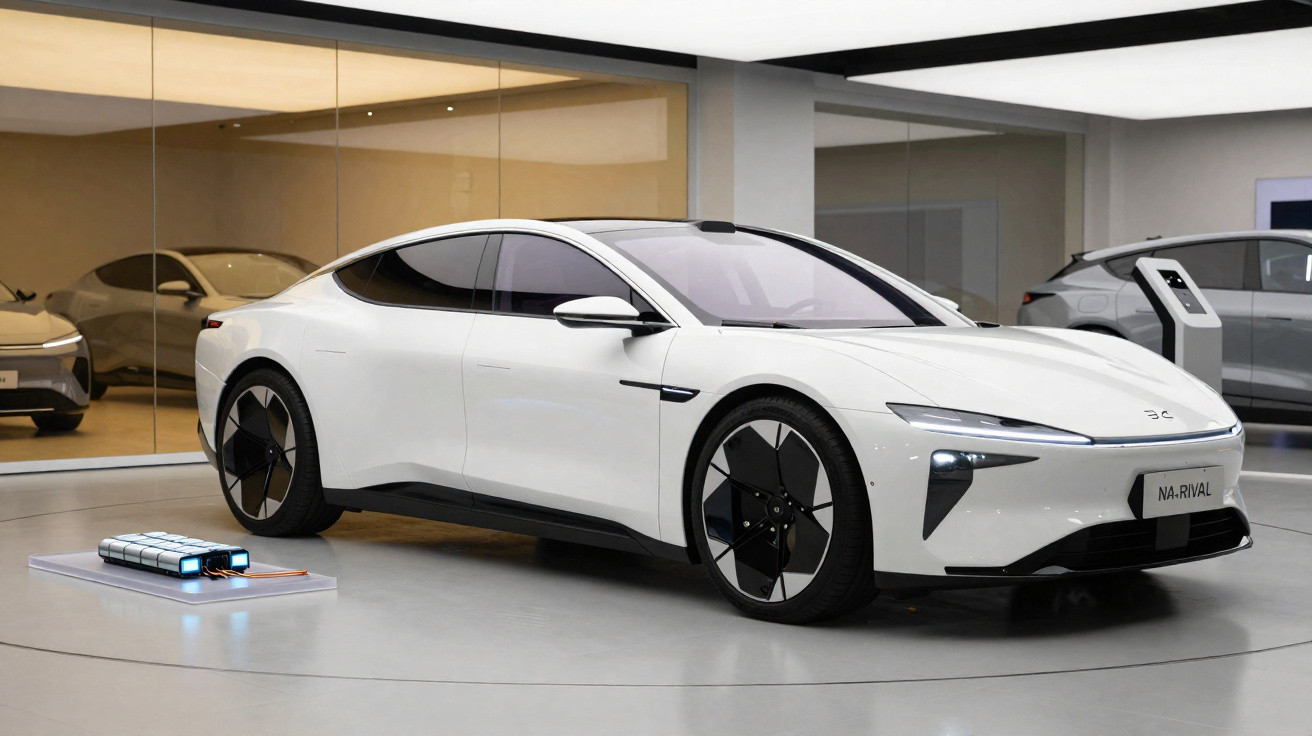
Electric cars depend on a resource that is difficult to mine, patchily distributed worldwide and rising in price quarter after quarter. Lithium sits at the centre of almost every battery driving the move away from petrol, and the sector has mostly operated on the assumption that nothing else is truly ready to take its place.
One Chinese battery maker took a different view. Hina Battery developed a sodium-based cell, brought it into commercial manufacture, and started supplying it for vehicles and grid-scale energy storage.
A group of researchers in Germany then dismantled one of these cells to judge it against Tesla’s batteries. Their analysis pointed to a sodium battery rival that outperformed what many specialists had anticipated.
Inside the tear-down
The cell examined was produced by Hina Battery, and the company’s batteries are already used in cars and large energy storage installations across China. Rather than lithium, the chemistry is built around sodium – the same element present in table salt.
Moritz Schütte, a battery researcher at RWTH Aachen University in Germany, led a team aiming to understand how this off-the-shelf sodium product compared with Tesla’s lithium-ion cells. Given Tesla’s reputation as an industry yardstick, the match-up was a meaningful one.
The researchers began by scanning 120 cells non-destructively to measure how consistent they were from one unit to the next. After that, they cycled the batteries under practical operating conditions, adjusting the electrical current and testing across a broad range of temperatures.
They used X-ray techniques to chart the internal layout, and only then opened the cells to examine the materials first-hand.
Sodium battery rival found
Their first unexpected result was the similarity between the units. Across all 120 cells, electrical resistance varied by only a little over 5% – a narrow spread that points to controlled, repeatable manufacturing rather than an immature, early-stage product.
That level of uniformity surprised the team. In both performance and build quality, the cells came out comparable with state-of-the-art lithium-ion batteries – a threshold sodium technology was not widely expected to reach so quickly.
Internally, the construction also mirrored Tesla’s thinking. The design used a tabless configuration, with aluminium employed on both sides of the internal current pathway – an arrangement intended to reduce resistance and distribute heat more evenly through the cell.
Reaching a similar architecture independently suggested the engineering had already reached a notably mature stage. The headline, in other words, was manufacturing quality as much as chemistry.
A copper puzzle
Next came the genuinely puzzling observation. When the researchers analysed the positive electrode – the component that stores and releases charge during operation – they detected copper appearing in uneven, unexpectedly high concentrations in certain areas.
Before this work, that specific pattern had not been reported in a commercial sodium cell. The copper was not evenly blended through the electrode material.
Within individual particles, the copper separated from the other metals in the formulation. Rather than forming a uniform distribution, it occupied its own distinct region – a spatial isolation the team did not expect.
What purpose this copper serves is still unclear. The scans showed the separation plainly, but whether it improves performance, shortens service life, or produces a mixture of effects has yet to be determined.
Schütte described it as a result that raises substantive questions about how the metal influences performance and ageing in these cells.
Where it falls short
Despite the strong showing, the battery also revealed obvious drawbacks. Its energy density – the amount of charge packed into a given size and mass – remains below the best lithium-ion cells, implying extra weight or volume for the same driving range.
Low temperatures exposed a more pronounced limitation. When discharged at -20°C (-4°F), the battery still delivered over 80% of its usable energy.
Charging under the same cold conditions proved far more difficult. The proportion dropped to just over half.
That difference highlights the area most in need of improvement. A cell that can be discharged in the cold but is hard to recharge there may suit certain applications while causing real frustration in others.
Schütte noted that repeated charging at low temperatures would require careful thermal control or more sophisticated operating strategies to mitigate the issue.
Why sodium appeals
Sodium’s attraction is largely about availability. Lithium resources are unevenly spread, becoming more expensive, and are projected by industry analysts to struggle to keep pace with demand as electric vehicles and grid storage continue to expand.
Sodium avoids many of those constraints. It is plentiful, straightforward to obtain and significantly cheaper to extract – attributes that could reduce raw-material costs for manufacturers and relieve the supply-chain pressure hanging over the lithium market.
A report examining battery supply chains illustrates how tight the lithium outlook is becoming.
These sodium cells also cope reasonably well with high demands in cold conditions. That capability strengthens the argument for this sodium battery rival in stationary storage and for vehicles operating in colder climates.
Schütte sees the most convincing near-term fit in grid services, backup storage, and shorter-range or commercial vehicles, where lowering costs matters more than extracting every last kilometre of range.
Road ahead for sodium
The conclusion is tangible: a commercially produced sodium battery – made at scale and sold today – can now stand alongside premium lithium-ion cells in consistency, power delivery and cold-weather discharge performance.
Many in the field expected progress in this direction, but it had not been demonstrated so clearly in a product already being shipped. For an element that is both inexpensive and widespread, that represents a meaningful milestone.
The copper finding gives researchers a new line of investigation. Future sodium chemistries may try to remove both nickel and copper while increasing energy density, and understanding why copper segregated in this way could inform those next formulations.
Schütte expects the largest improvements to come from advances in electrode materials and electrolytes.
For motorists and grid operators, the real-world benefits are still some way off. If the cold-charging weakness can be addressed and the energy-density gap narrowed, sodium will no longer look like a budget alternative.
At that point, sodium battery technology becomes a genuine rival – a cheaper route to storing energy and powering cars without depending on lithium supplies that are both strained and costly.




Comments
No comments yet. Be the first to comment!
Leave a Comment