
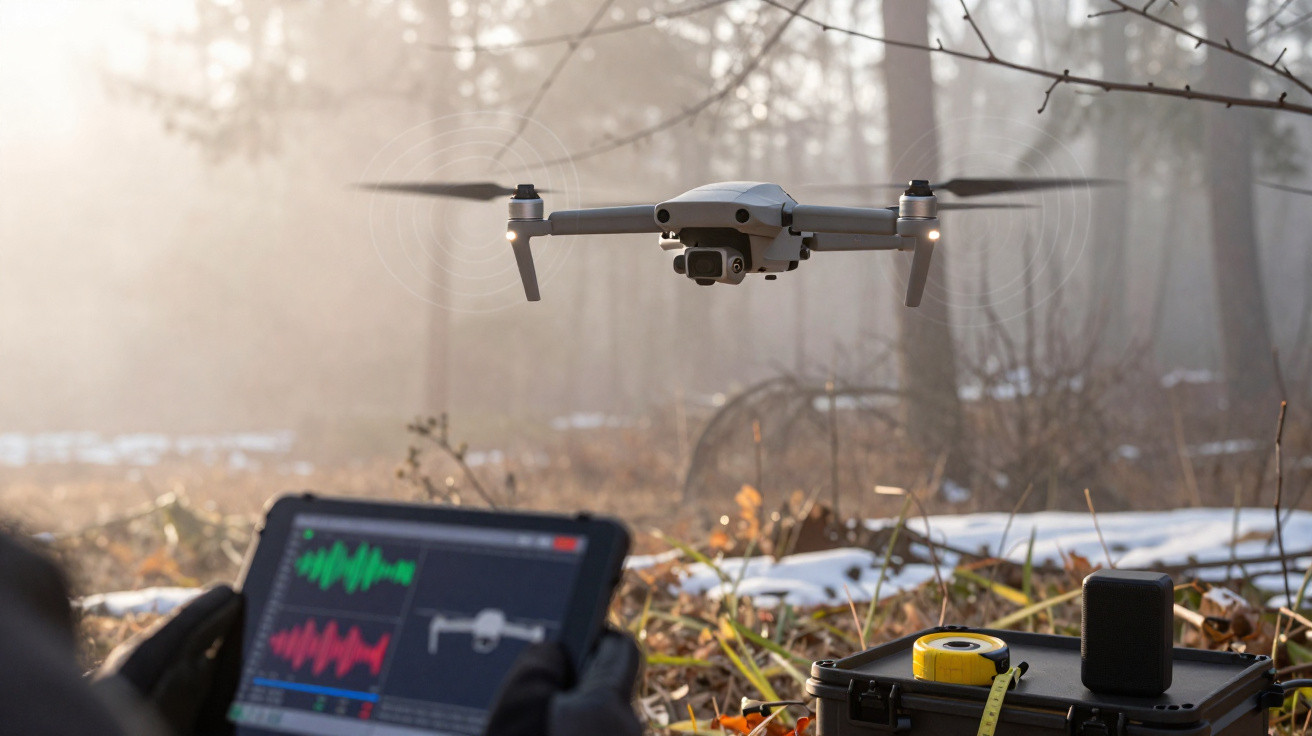
Researchers have shown that a palm-sized drone can steer through fog, darkness and falling snow using just two sound sensors and onboard computing.
The finding suggests a search-and-rescue machine that could continue operating when smoke, shade and visually cluttered scenes overwhelm conventional navigation.
Drone navigates using sound
In both indoor obstacle courses and among trees on outdoor routes, the miniature aircraft repeatedly located openings that camera-based systems would be likely to overlook.
At Worcester Polytechnic Institute (WPI), Nitin J. Sanket demonstrated that flight can be guided by echoes alone in situations where cameras typically struggle.
In trials, the same drone negotiated plastic film, boxes, poles and trees, although the slimmest obstacles still exposed the limits of the approach.
That mixed result underlines the key issue: what makes sound effective in conditions where sight-led systems break down.
Cameras fail in poor visibility
Cameras and laser rangefinders used on many drones have long been vulnerable to fog, smoke, glass and heavy shadow.
Because these tools depend on reflected light, systems such as LiDAR become less precise when airborne particles scatter the beam.
Radar can cut through some of this interference, but the equipment typically demands more space and power than a tiny aircraft can afford.
With that in mind, the researchers looked for a sensing method that stays useful when vision fails and energy budgets are tight.
Drone filters its own noise
The toughest hurdle was the noise of the spinning propellers: the drone needed to pick out faint echoes while producing loud sound itself.
To reduce that contamination, the team used ultrasound-inaudible to people-and fitted a small barrier between the sensors and the propellers.
By dampening part of the propeller noise, the shield stopped reflections from trees, plastic film and boxes being swamped.
Even with this measure, thin poles and narrow branches still produced weak reflections, giving the drone less time to avoid them cleanly.
Learning from sound echoes
Manually cleaning up the echoes did not solve the problem on its own, so the researchers adopted deep learning, a pattern-recognition approach within artificial intelligence.
They trained a system called Saranga on simulated echo data combined with real propeller noise, so it could learn which parts of the signal were meaningful.
The full sensing stack consumed about 1.2 milliwatts, and the compiled model was only 0.5 megabytes.
This mattered because small robots have strict payload limits-the maximum weight they can carry.
Drone performs well in tests
Over 180 runs, the drone completed difficult courses with success rates between 72 percent and 100 percent.
It managed indoor routes in darkness, fog, snow and low light, and then navigated wooded outdoor tracks.
The robot was roughly 15 cm (6 inches) across, weighed about 0.45 kg (1 lb), and stayed airborne for around 5 minutes.
These figures do not yet add up to a finished rescue device, but they do demonstrate that the underlying concept works.
The challenge of thin obstacles
Problems emerged when the craft encountered objects that returned very little sound-most notably thin metal poles and slender branches.
In some instances, the faint return reduced the warning distance to under about 41 cm (16 inches), leaving minimal time to respond.
Greater speed amplified the issue: success dropped from perfect at about 3.5 km/h (2.2 miles per hour) to 72.73 percent at roughly 7.2 km/h (near 4.5 miles per hour).
Engineers’ next aim is to extend sensing range without adding the bulk that would remove the system’s main advantage.
Saving power with sound sensing
Energy constraints influenced every decision, because on a tiny aircraft each sensor competes with the motors for precious seconds in the air.
From the outset, the project treated endurance as a survival factor rather than a mere engineering bonus.
“In a real search-and-rescue mission, a few more seconds of flight time could mean the difference between life and death for a survivor,” said Sanket.
That argument carries weight because common sensing hardware can draw tens of watts, whereas the new sound-based system used only a tiny fraction of that.
The advantage of ultrasound
In bench testing, the sound system continued detecting obstacles in fog, darkness, glass and thin plastic-cases where other sensors struggled.
Across those difficult materials and conditions, it achieved an overall average accuracy of 89.3 percent in bench trials.
During testing, standard options such as cameras and radar each failed in at least one important scenario.
This does not mean ultrasound is always the best choice, but it does indicate unusual reliability when conditions become hostile.
Improvements for future drones
Later versions will probably rely on smaller processors and lighter airframes, as the current prototype still consumed more than 100 watts while hovering.
That imbalance means the low-power sensing benefit will matter most once the rest of the platform is also made more efficient.
Sanket’s team intends to add more capable navigation so the drone can remember nearby hazards rather than responding to a single echo at a time.
If that succeeds, the same concept could fly faster and slip through tighter gaps without sacrificing its minimalist design.
Overall, the work points towards a possible design rule for tiny flying robots: prioritise hearing, keep computation light, and carry less.
Whether this moves from a promising demonstration to a practical field tool will depend on longer endurance, smaller supporting hardware and more reliable detection of thin branches.



Comments
No comments yet. Be the first to comment!
Leave a Comment