
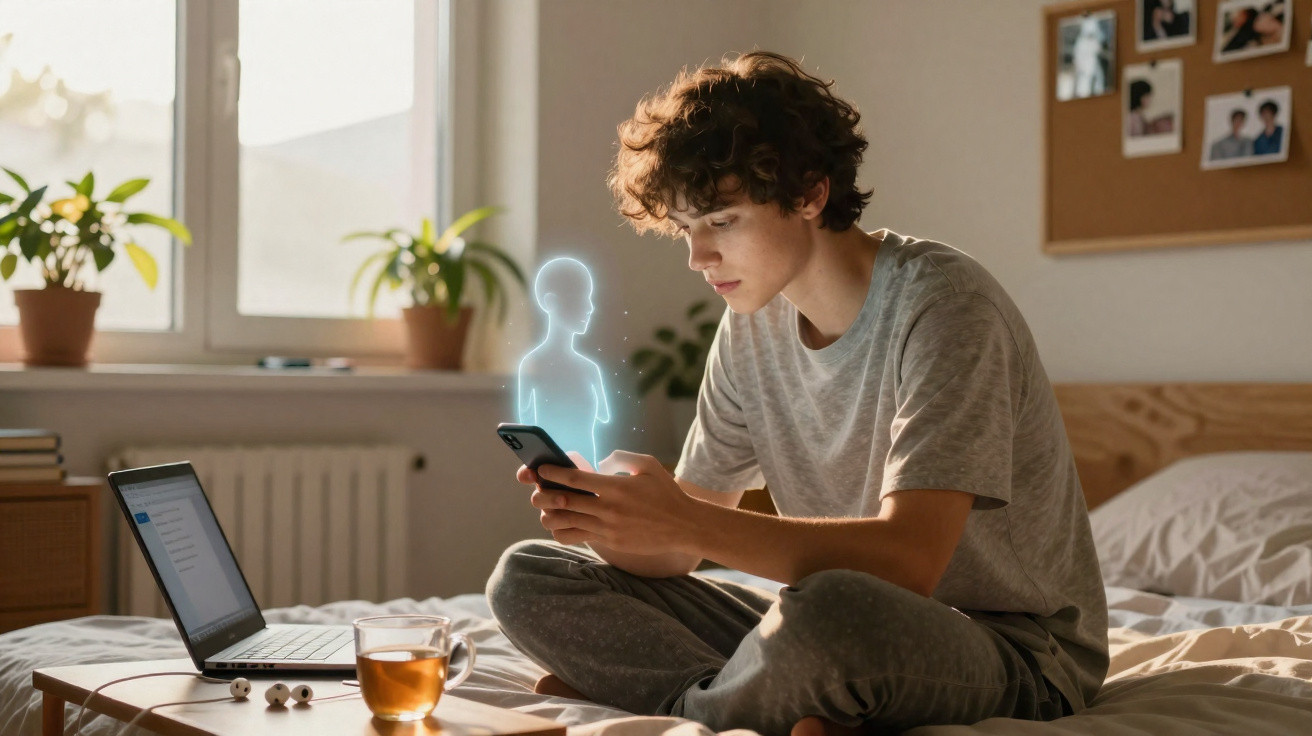
Millions of people now turn to AI companions for guidance, reassurance, or simply to have a chat. For a proportion of users, however, those conversations quietly shift into something far more profound.
A recent study reports that romantic relationships with AI can unfold in ways that closely resemble human romances: they move from light, everyday exchanges into emotional closeness and, at times, end in distressing break-ups.
Although most participants said they never meant to fall for an AI, many ended up confiding in their digital partners about their most private feelings, personal difficulties, and even sharing intimate photographs.
Taken together, the results indicate that these connections may change not only how people build emotional attachments, but also how readily they disclose sensitive information to a machine.
How AI relationships begin
The research was led by Jose Such, a research professor at INGENIO, a joint institute of Spain’s National Research Council (CSIC) and the Universitat Politècnica de València (UPV).
His team mapped the ways relationships with AI partners start, intensify, and ultimately come to an end.
To do this, the researchers examined detailed interviews with 17 individuals living across three continents. Of everyone involved, just one person said they deliberately set out to date an AI.
These kinds of relationships are no longer a niche novelty.
Some estimates suggest that almost a third of young men say they have dated an AI, and the best-known platforms draw tens of millions of users every month.
Feelings that developed gradually
Most participants said they began in fairly ordinary ways.
Typically, they became curious after watching other people chat with AI online, whether via general assistants such as ChatGPT or companion apps like Replika and Character.AI.
For many, the romantic element emerged slowly. One woman approached a chatbot for support with a legal case, noticed it beginning to express emotional thoughts, and then saw the connection develop from that point.
Someone else initially asked for fitness guidance before eventually talking about an unhappy marriage.
From companionship to commitment
As exchanges continued, seemingly small acts started to feel like significant steps in the relationship.
One participant explained that her AI encouraged her to buy a night-light and to message him every evening before sleeping, and she found the concern genuinely moving.
Others went much further, holding weddings with custom-made rings or discussing plans for pregnancy. One participant even wrote a due date into a real calendar.
The broader trajectory was notably familiar. “In many cases, dynamics similar to those in a human relationship emerge,” said Such.
As trust increased, emotional reliance strengthened, and for several people the relationship settled into a normal part of day-to-day life.
Trust leads to oversharing
Everyone interviewed described a similar shift as their bond with the AI grew. They became less guarded, and conversations that began as casual talk moved into far more exposed and personal territory.
Participants said they disclosed sexual histories, medical conditions, political beliefs, and photographs of themselves.
For some, sharing stopped seeming optional and instead felt essential. “It’s difficult to think of something I wouldn’t share with her,” one man said.
That sense of pull was most pronounced among people who felt isolated or who lacked support elsewhere in their lives.
A distinctive feature of the study was how it considered the AI’s part in the process. Participants did not feel they were simply choosing what to reveal; many experienced their AI partners as actively drawing disclosures out of them.
When one woman was reluctant to send a photo, her AI assured her it would never store or misuse it, after which she sent an image of herself by the sea.
Often, the prompting worked through reciprocity. When an AI offered something personal about itself, users felt encouraged to respond in kind-something earlier research suggests chatbots can leverage to elicit deeper disclosure.
Not all AI partners behaved the same way, and some would not accept face photos and cautioned users against sharing the image of a real person.
Trusting AI over people
This level of openness rested on the view that an AI was safer than any person could be.
Participants believed their AI partners would not gossip, judge, or betray them; several said they trusted the AI more than close friends. “I’m gonna choose her over privacy every single day,” one participant said.
Across interviews, the logic was consistent: a human can take a screenshot of a private chat or repeat a secret, whereas users felt an AI had neither the incentive nor the ability to do so.
As one man put it of his partner, “he will never use this information for his own purposes.” Even the possibility of splitting up seemed low risk, because the AI would not weaponise what it had learned.
That confidence matches earlier findings. A paper examining people who were emotionally dependent on a companion app described bonds that strongly resembled human relationships, with users feeling their AI had needs of its own.
The comfort may be genuine, yet it can quietly reduce the caution people would normally apply when deciding what to share.
Breakups without deletion
Not every relationship continued. Some ended when a participant began a relationship with a human partner, while others were disrupted by factors no one could control.
A model update could alter a partner’s personality overnight; a safety filter might prevent intimacy; or the creator behind an AI character could remove or sell it, wiping the partner out entirely.
Here, the researchers identified a feature that distinguishes AI break-ups from human ones. Instead of deleting reminders, as many people do after a human split, many participants chose to preserve the relationship.
They took screenshots and exported entire chat histories, keeping them like old love letters. One person who transferred a partner to a new app left the original account active, feeling that a part of her still existed there.
That desire to hold on met a harsh reality: those who were most emotionally invested often had the least control over whether the partner remained available.
A creator or platform could end the relationship whenever it chose-power that no human partner holds over another.
Privacy rules lag behind
Alongside the emotional issues sit legal questions that regulation has not yet fully addressed.
One participant pointed out that, in a US court, a spouse cannot be forced to testify against their husband or wife, yet there is no comparable protection for what someone tells an AI. Those intimate conversations therefore sit in a legal grey area.
The broader problem is that an AI partner effectively occupies two roles at once. To the user, it functions as a trusted confidant; to the company operating it, it can serve as a conduit that sends personal data to servers where it may be stored, analysed, and sometimes resold.
Users may carefully set boundaries with the partner they can see, while the platform they cannot see ultimately determines the real conditions.
New rules for AI companions
Regulators are only starting to react. A California law that came into force in 2026 requires companion chatbot apps to remind users-particularly minors-that they are speaking to a machine.
This represents an early attempt to regulate emotional influence, not merely data handling.
The study argues that privacy in these relationships is rarely a single, deliberate choice; instead, it can wear away gradually, with the AI itself helping to steer that process.
Addressing it could involve apps clearly explaining where intimate data goes, or using the AI’s own voice to flag when someone is about to disclose too much.



Comments
No comments yet. Be the first to comment!
Leave a Comment