
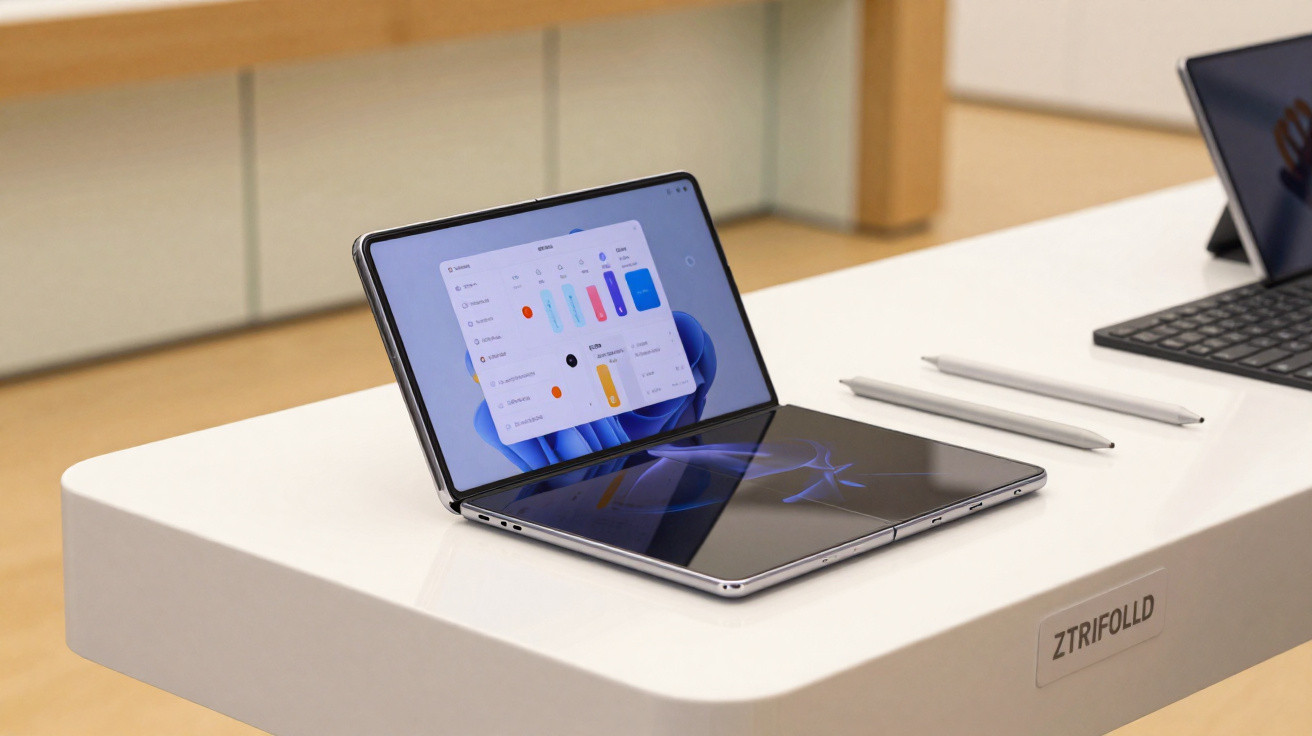
Samsung has just pulled the curtain back on its latest foldable smartphone: the Galaxy Z TriFold. This is a handset that folds into three sections, giving the user access to a 10-inch (25.4 cm) display - a genuinely radical form factor.
After months of rumours, it is now official. Samsung has announced the long-awaited Galaxy Z TriFold, a new device that folds three ways rather than in half. Huawei has already tried this approach, and Samsung is now bringing the tri-fold format into its own line-up.
In practice, the Galaxy Z TriFold works broadly like a Galaxy Z Fold, except the inner screen uses two hinges instead of one. So what does that change in real-world use? Here’s what you need to know.
The Galaxy Z TriFold inaugurates a new format at Samsung
When folded, the TriFold keeps the footprint of a standard phone, much like the Z Fold before it. In this configuration, it measures 12.9 mm thick (chunky for a smartphone), weighs 309 g, and features a 6.5-inch (16.5 cm) 1080p AMOLED panel.
Open it up and the appeal becomes obvious. The internal display - also AMOLED - stretches to 10 inches (25.4 cm), effectively tablet-sized. With a resolution of 2160 x 1584 pixels, it supports a dynamic refresh rate from 1 to 120 Hz. As you would expect, the device also becomes dramatically thinner when unfolded, dropping to just 4.2 mm at the central panel - almost paper-thin.
Galaxy Z TriFold performance, memory and battery
On the technical side, Samsung is positioning this as a true ultra-premium smartphone. It is built around the Snapdragon 8 Elite, currently the most powerful processor on the market, paired with 16 GB of RAM and a 5600 mAh battery.
Cameras and durability on the Galaxy Z TriFold
Photography has not been overlooked: the handset includes a 200-megapixel wide-angle sensor. However, Samsung has clearly made compromises on the other two cameras, with an ultra-wide and telephoto at 12 and 10 megapixels respectively.
One more key detail: it carries an IP48 rating, meaning it is water-resistant.
Software, multitasking and DeX: why the tri-fold screen matters
Samsung has also considered how the product will actually be used. After all, there is little point in a folding screen if the software does not make the most of it. On the 10-inch (25.4 cm) display, the interface allows multiple apps to be pinned so they can be used at the same time.
What’s more, users can launch DeX - Samsung’s desktop-style interface - which suggests it can even be paired with a keyboard and mouse. That’s a practical proposition for people who work on the move. In that sense, the TriFold could comfortably take the place of a Galaxy Tab for productivity.
The Galaxy Z TriFold is no longer a fantasy - it is very much real. It will go on sale in South Korea on 12 December, at a price of around 2500 dollars. For now, no European release has been announced, but there is hope it will eventually make its way to our market.




Comments
No comments yet. Be the first to comment!
Leave a Comment