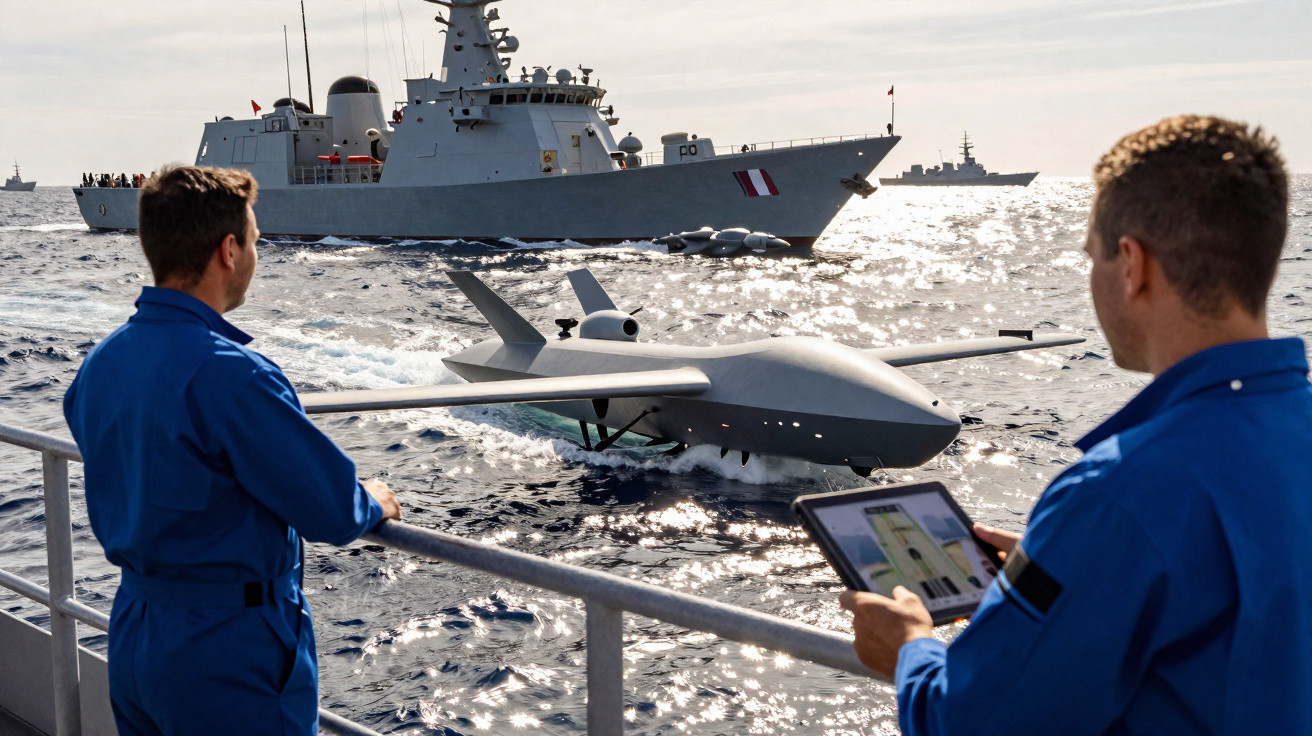
The French Navy is progressively reshaping its fleet. Alongside frigates, submarines and patrol vessels, armed uncrewed surface drones are soon expected to become routine. Behind the sober-sounding DANAE programme lies a fundamental shift: autonomous systems will increasingly take on combat duties at sea, moving people away from the first line of danger.
What the DANAE programme really involves
DANAE refers, in essence, to armed autonomous naval surface drones. Through it, France intends to become one of Europe’s first navies to integrate such systems routinely into its combat formations.
DANAE represents a turning point for the French Navy: the aim is a mixed fleet of crewed ships and networked drones operating together.
Its political basis is the French Military Programming Act 2024–2030. The plan allocates €413 billion to defence overall, with a substantial share directed towards autonomous systems in the air, on the surface and underwater. DANAE itself is initially expected to receive a budget in the tens of millions of euros over three years. The requirement is for an initial operational capability to be available as early as 2027/2028.
The reason is straightforward. Footage of attacks using remotely controlled explosive boats in the Black Sea, Red Sea and Persian Gulf has demonstrated how exposed major warships can be to fast, small targets. Even the most advanced frigates remain expensive, highly visible individual targets with limited crews; a single hit can put one out of action.
Three phases towards series production
Tough sea trials: Phase 1
Phase 1 began in January 2026, when seven different surface drones competed at the French procurement agency’s test site in Saint-Mandrier. Well-known defence companies including Naval Group, Thales and Exail took part, alongside smaller specialist firms.
The drones had to perform under realistic conditions:
- Operating in rough seas with heavy swell
- Navigating at night without continuous remote control
- Maintaining communications amid disrupted radio conditions
- Detecting and identifying uncertain targets on the water
The Navy is therefore assessing not only the technology, but also which industrial team can deliver rapidly and reliably. The pressure is considerable, as the fleet wants to move from experimental prototypes to practical platforms as quickly as possible.
Arming the drones without overloading them: Phase 2
During the second phase, scheduled for mid-2026, three designs are expected to be selected and upgraded. The Navy is taking a practical approach: the drone is not intended to become a “mini-frigate”, but a lightly armed and intelligent tool.
Planned onboard sensors include:
- Radar for surface surveillance
- Lightweight sonar for underwater contacts
- Optronic systems for day and night operations
- AI-supported analysis for threat classification
Potential armament includes:
- Light anti-ship missiles, such as the Akeron type
- Remotely operated 12.7 mm machine guns
- Charges or grenades to counter hostile drones
- Decoys and jammers for electronic countermeasures
Control arrangements remain clearly defined: people will operate the drones from a frigate, command ship or shore-based control centre. Autonomy is intended mainly for navigation and situational awareness, rather than independent weapons use.
Series production from 2027: Phase 3
From 2027, the Navy plans to enter the third phase: a single drone design manufactured industrially and subject to a clear cost ceiling. The unit price is to remain below €1 million. Initial batch sizes will range from 20 to 50 systems, with scope for further orders.
| Phase | Period | Objective |
|---|---|---|
| 1 | Early 2026 | Technical and resilience testing of several prototypes |
| 2 | Mid-2026 | Selection of three designs, armament and integration |
| 3 | From 2027 | Series readiness, one type, costs below €1 million per drone |
Studies are already under way in parallel for much larger uncrewed vessels: drone corvettes measuring 65 to 85 metres in length, with extensive range and long endurance at sea. Such platforms could eventually operate independently within blue-water naval formations.
Industry under intense pressure: seven companies, one objective
The competition at Saint-Mandrier illustrates France’s approach to the project: every relevant supplier must present its solution at the same location, at the same time and under identical conditions. This speeds up comparison and compels industry to move quickly.
The French government has made it clear: drones at sea are no longer a research project, but a capability gap that must be closed quickly.
The initiative forms part of a wider effort. At the same time, the Navy is working on:
- Drones launched into the air from ships and submarines
- Uncrewed underwater vehicles and gliders for extended reconnaissance missions
- Counter-drone systems and maritime laser weapons
In the longer term, Paris is also considering exports. The systems are intended to be NATO-compatible and particularly attractive to navies in the Mediterranean and Indo-Pacific regions, where France has traditionally maintained a military presence.
How far can autonomy go? France sets red lines
DANAE deliberately addresses the sensitive issue of “killer robots”. France’s position is that artificial intelligence may detect, classify and make recommendations, but the authority to fire remains with a human. Fully autonomous lethal systems are regarded as taboo.
Cybersecurity is a second critical concern. Networked drone formations are vulnerable to hacking and electronic warfare. If an entire drone swarm fell under hostile control, it could become a threat to its own side. Developers are therefore planning:
- Strongly encrypted, mesh communications networks
- Backup channels for disruption and blockage scenarios
- Robust safeguards against takeover attempts and false signals
These measures require money and time, but reduce the risk that a high-technology system becomes a weak point. France is thereby positioning itself as a country seeking to combine military innovation with ethical safeguards.
Rivalry and models: looking to the US, China and Europe
With DANAE, the French Navy is gaining an advantage over many European partners that remain at the project stage on surface drones. At the same time, France is looking to the United States, which is already further ahead with the uncrewed vessels Sea Hunter and Seahawk.
These US platforms, around 40 metres long, can operate for weeks without a crew, gather data, track submarines and work alongside crewed units. The US Navy plans to have more than 30 such units by 2030; in the long term, almost half of all surface ships could be uncrewed.
Beijing is advancing its own autonomous surface-vessel projects, often closely linked to civilian research ships and coastal surveillance. For Paris, the conclusion is clear: any country seeking to protect its sea lanes cannot simply watch this development from the sidelines.
What DANAE drones can do at sea
The Navy is considering DANAE for more than conventional combat missions, envisaging a broad range of uses. Typical scenarios could include:
- Forward reconnaissance ahead of a frigate in dangerous coastal waters
- Protecting ports and naval bases from explosive boats and other drones
- Escorting and safeguarding merchant vessels in high-risk areas
- Mine detection in mined waters without endangering crews
- Electronic jamming operations against hostile sensors and communications
One advantage lies in the cost structure. Losing a drone during an operation would be painful, but it would not be a strategic loss on the scale of a frigate carrying hundreds of sailors. This permits tactics that would be difficult to justify with crewed ships, such as deliberately sending a platform ahead into suspected danger zones.
Key concepts and risks explained
Anyone discussing DANAE often encounters terms such as “autonomy”, “swarm” or “hybrid fleet”. These refer to concrete technical concepts. An autonomous system makes certain decisions independently, for example to avoid collisions or select a route. A swarm is formed when several drones communicate with one another and coordinate themselves, such as to monitor an area without gaps.
However, this also increases dependencies: more software means a larger attack surface. If the satellite network fails or GPS signals are jammed, the drones must still navigate safely. Manufacturers are therefore relying on inertial sensors, alternative positioning methods and partially autonomous mission profiles, allowing a drone to continue operating even when contact with its control station is briefly lost.
For other European navies, DANAE will become a benchmark. If France succeeds in deploying a reliable operational fleet of ships and drones by the end of the decade, pressure will grow to develop similar capabilities, whether through NATO or bilateral projects. Smaller states in particular could be interested in French systems, as these could reinforce their limited ship inventories without immediately requiring the purchase of new large warships.
















Comments
No comments yet. Be the first to comment!
Leave a Comment