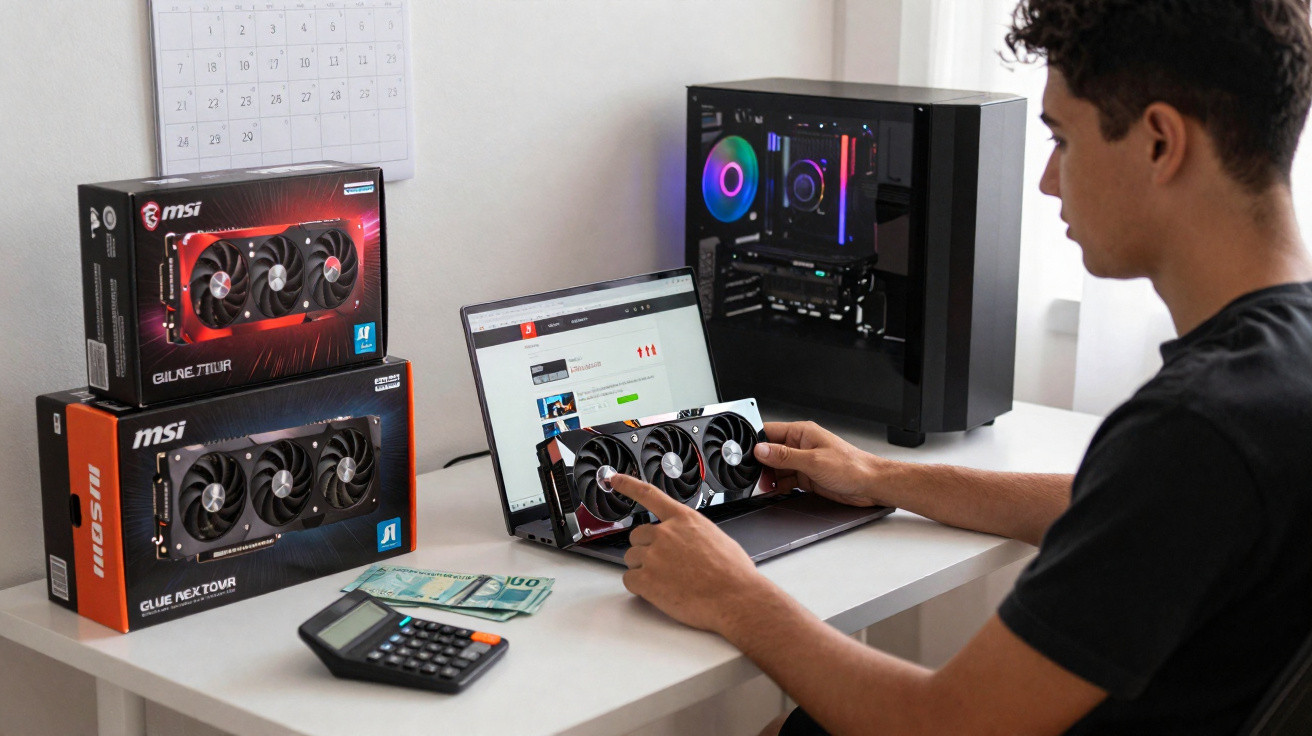
Behind the scenes, chip companies and suppliers have been negotiating for months, and the outcome is now clear: the cost of key graphics card components is rising sharply. NVIDIA has formally alerted its partners, while manufacturers from ASUS to MSI are already responding with higher retail prices, particularly for models with large amounts of video memory.
What NVIDIA has told partners internally
The current wave was triggered by an internal NVIDIA notice to its so-called AIC partners – manufacturers including ASUS, MSI and Gigabyte. Its message was essentially that prices for graphics memory, specifically GDDR6 and GDDR7, are climbing substantially.
The graphics processors themselves are retaining their recommended retail price, but the memory chips fitted to every modern graphics card are becoming more expensive to source.
At first glance, that may appear harmless, as the GPU – the graphics card’s actual core component – is officially holding steady in price. In reality, however, the entire board matters, and it consists of far more than the chip alone:
- GPU (graphics processing unit)
- VRAM (GDDR6 or GDDR7 memory chips)
- Voltage regulation, circuit board, cooling, fans and shroud
- Logistics, marketing, and the margins of partners and retailers
As memory costs rise, manufacturers’ calculations are thrown off balance. On cards with 12, 16 or even more gigabytes, memory represents a significant share of the bill of materials. Until now, many partners could absorb increased purchase prices internally or soften them through volume discounts. That buffer now appears to have been exhausted.
Why now? The impact of expiring contracts
The timing is no coincidence. Many memory supply agreements ended around the turn of the year. New contracts reflect the higher manufacturing costs faced by memory producers. Anyone buying fresh batches of GDDR6 or GDDR7 now is paying noticeably more than they did last year.
Demand for fast memory chips is also rising beyond gaming. Data centres for AI applications, large language models and cloud services consume enormous volumes of high-speed memory. This pushes up the price of the same, or comparable, modules used on gaming graphics cards.
Put simply: gaming graphics cards are competing directly with AI servers for the same memory resources – and the AI boom generally wins the budget battle.
MSI moves first as ASUS and Gigabyte follow
The development is already becoming very tangible in Asia. According to reports from industry sources, MSI was the first manufacturer to raise prices for its new RTX 50 models in December. Other partners are preparing to take the same step.
A similar picture is emerging in the UK and European market. Retailers are already reporting higher wholesale costs, which they are passing on to customers. Models with substantial VRAM capacities, such as 16 GB or more, are particularly affected.
Current price increases at a glance
| Product category | Typical VRAM configuration | Observed price increase |
|---|---|---|
| NVIDIA RTX 50 Series (upper mid-range / high end) | 16 GB and more | around 15–20% |
| AMD Radeon RX 9000 Series | mostly 16 GB | approximately 10–18% |
| Entry-level and mid-range cards | often 8 GB | modest, and in some cases still stable |
The price ranges differ by country, retailer and availability, but the direction is clear: anyone considering a high-memory model must expect significantly higher prices.
Different approaches: NVIDIA reduces memory, AMD favours capacity
It is notable how differently NVIDIA and AMD are responding. Among NVIDIA’s partners, a clear trend is taking shape: production of 8 GB VRAM models is receiving greater emphasis.
This could affect products such as a potential RTX 5060 or 8 GB versions of the 5060 Ti. Less memory means lower material costs, leaving more room to prevent final retail prices from escalating completely.
More memory sounds like a gamer’s dream, but new purchase prices turn it into a cost driver – and that is precisely where manufacturers are now making cuts.
According to industry reports, AMD is pursuing a different course. Its “red” graphics cards remain firmly committed to 16 GB across many XT models. The aim is to position itself as the memory leader for future-proofing and resolution, including 1440p or 4K gaming.
It is a bold strategy. Offering more memory makes for an attractive specification sheet, but it also means carrying the increased costs. As a result, the price advantage of many AMD models over comparable NVIDIA cards could shrink at least partly.
What this means for PC gamers in the UK
For gamers in the UK, the question is now whether to buy, wait or rethink their plans. There is no universal answer, but several clear trends can be identified.
For buyers looking to purchase now
Anyone already planning a near-term upgrade should look more closely:
- Models with 8 GB of VRAM are usually still the cheapest and are rising more slowly in price.
- Cards with 16 GB or more are becoming noticeably more expensive, especially in the high-end segment.
- Remaining stock supplied under older contracts may briefly stay on shelves at “old” prices, making price comparisons worthwhile.
For 1080p gaming in particular, many current 8 GB cards still deliver solid performance, provided every setting is not pushed to maximum. Those mainly playing esports titles such as Counter-Strike, League of Legends or Valorant will often benefit more from a powerful CPU and a fast monitor than from excessive graphics memory.
For those who would rather wait
Anyone without time pressure can wait to see how the market settles. After an initial price spike, retailers often respond with promotions, bundle deals or discounts once demand eases somewhat. The next GPU generation is always waiting in the wings as well, which generally makes older models cheaper over time – although high memory prices could limit that effect on this occasion.
Why memory has such a strong effect on final prices
Graphics memory has long ceased to be a cheap by-product. Fast GDDR6 and GDDR7 modules in particular require complex manufacturing processes and are produced in comparatively limited volumes. Every capacity expansion at a factory costs billions.
When demand from AI, gaming, professional workstations and console production rises simultaneously, factories approach their capacity limits. At that point, even minor disruption – such as political tensions, shortages of chemicals or outages at individual facilities – can cause major swings in purchase prices.
For customers, the cost ultimately follows a simple formula: more gigabytes combined with a faster standard, such as GDDR7 instead of GDDR6, means considerably higher material costs per card. Manufacturers can only sacrifice so much margin before a model simply stops being worthwhile.
Practical tips for buying a graphics card
Anyone building a gaming PC now can use a few rules of thumb to avoid spending unnecessarily:
- For 1080p gaming: 8 GB of VRAM is sufficient in many cases if you are prepared to lower detail settings slightly.
- For 1440p: 12 to 16 GB is more comfortable over the long term, particularly in current AAA titles.
- For 4K and ray tracing: this is premium territory, where price increases will be especially noticeable.
- Anyone who uses extensive mods or high-resolution texture packs benefits noticeably from additional VRAM.
A balanced system often delivers more than an oversized graphics card: fast SSDs, sufficient system memory and a decent power supply prevent bottlenecks that would otherwise hold back a powerful GPU.
What could happen next in the hardware market
The current round of price rises does not have to become permanent. If conditions in the memory segment improve – through new production capacity or weakening AI demand, for example – purchase prices could decline again in the medium term. Hardware has repeatedly gone through cycles in which periods of high prices have been followed by substantial corrections.
Until then, it is worth making purchasing decisions more carefully: read technical specifications closely, assess your own usage realistically and monitor price trends. The shock of higher prices on the graphics card shelf may be unpleasant, but it does not necessarily have to make gaming an unaffordable hobby.














Comments
No comments yet. Be the first to comment!
Leave a Comment