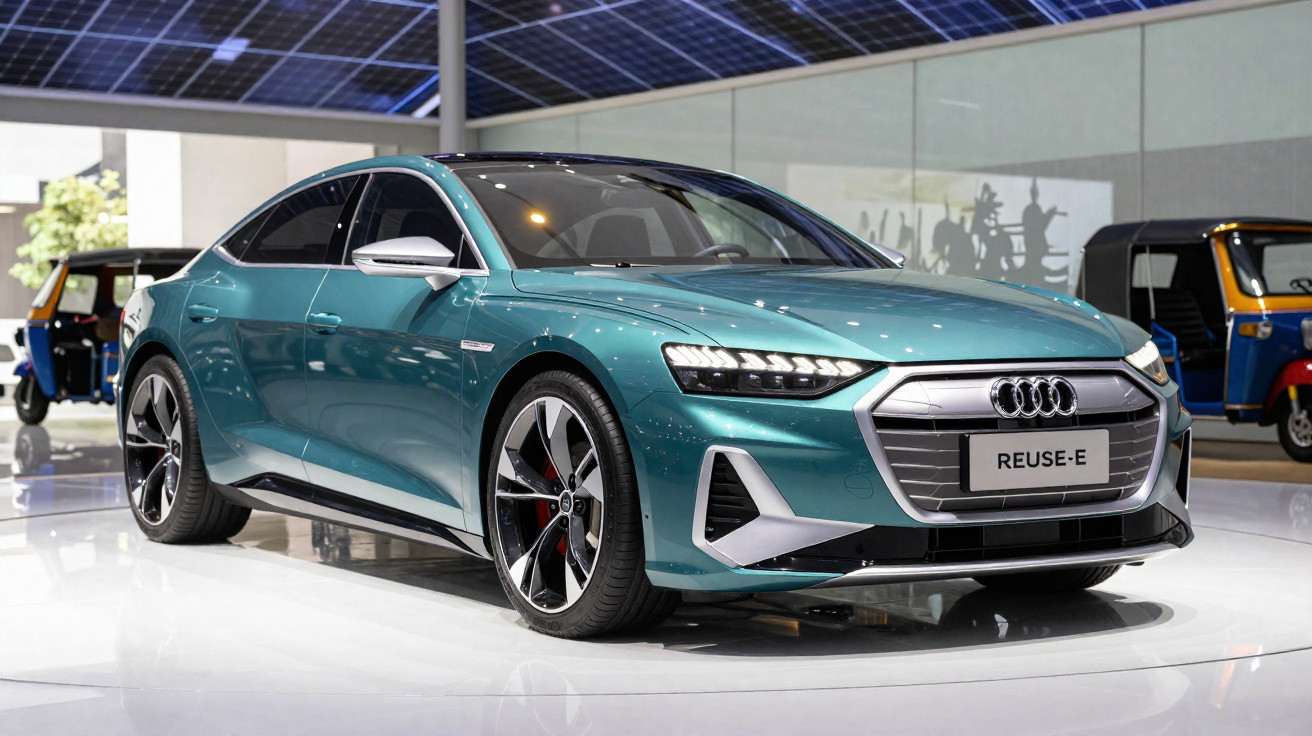
End-of-life batteries from electric cars present an environmental challenge, but Audi believes it has found a use for some of the batteries formerly fitted to the e-tron, its first electric car: powering small rickshaw vehicles, better known to us as tuk-tuks.
The Audi Environmental Foundation, working with Nunam, a German-Indian start-up based in Berlin, Germany, and Bengaluru, India, whose mission is to give used batteries a new purpose, will put a fleet of tuk-tuks on Indian roads using battery modules previously installed in e-trons from Audi’s test-vehicle fleet.
So far, Nunam has built only three prototypes alongside a training team from Audi’s Neckarsulm site in Germany. However, indications suggest that further vehicles will be available in 2023 and supplied to a non-profit organisation.
Reusing Audi e-tron batteries is the priority
As Nunam co-founder Prodip Chatterjee explains, “Car batteries are designed to last for the entire life of the car. But even after their initial use in a vehicle, they still have a lot of power.”
“For vehicles with limited range and power requirements, as well as low overall weight, these batteries are extremely promising,” Chatterjee added, before stressing: “Old batteries are still very powerful”.
For these reasons, the small urban vehicles are ideal candidates for the used battery modules, allowing them to be put back into service.
Thanks to the battery’s high energy density and the vehicle’s low weight, the electric motor does not need to be especially powerful. This is particularly relevant in India’s urban centres, which experience some of the densest traffic flows in the world, meaning journeys are almost always short and undertaken at low speeds.
The batteries will not be used solely in tuk-tuks. After a “first life” in the Audi e-tron and a “second life” in these electric tuk-tuks, they could have a “third life” in stationary installations, such as LED lighting systems. Only afterwards will they be recycled.
What changes for a conventional electric tuk-tuk?
It is worth noting that many electric tuk-tuks already exist. However, they nearly always use lead-acid batteries, which not only have a comparatively short service life but are also often disposed of improperly.
Another change that Nunam and Audi intend to introduce concerns charging. Existing electric tuk-tuks in India are charged using electricity from the public grid, much of which is generated by coal-fired power stations.
For these electric tuk-tuks, fitted with high-density lithium-ion batteries from the Audi e-tron, Nunam proposes solar charging stations, with solar panels installed on the roofs of the project’s local partners.
How do the solar charging stations work?
During the day, sunlight is used to charge an Audi e-tron battery, which in this case acts as an energy store. At night, the stored energy is used to charge the tuk-tuks, enabling them to operate all day without producing any emissions.
This highly promising charging station - India benefits from excellent levels of sunshine for virtually the entire year - was developed in-house by the partners involved in this pilot project.
Environmental and social responsibility
Alongside its environmental aims, the pilot project also carries social responsibilities, as these small electric vehicles will help provide work for women producing food goods, clothing and handicrafts.
With these vehicles, they will be able to sell and deliver their products more quickly, affordably and sustainably.

















Comments
No comments yet. Be the first to comment!
Leave a Comment