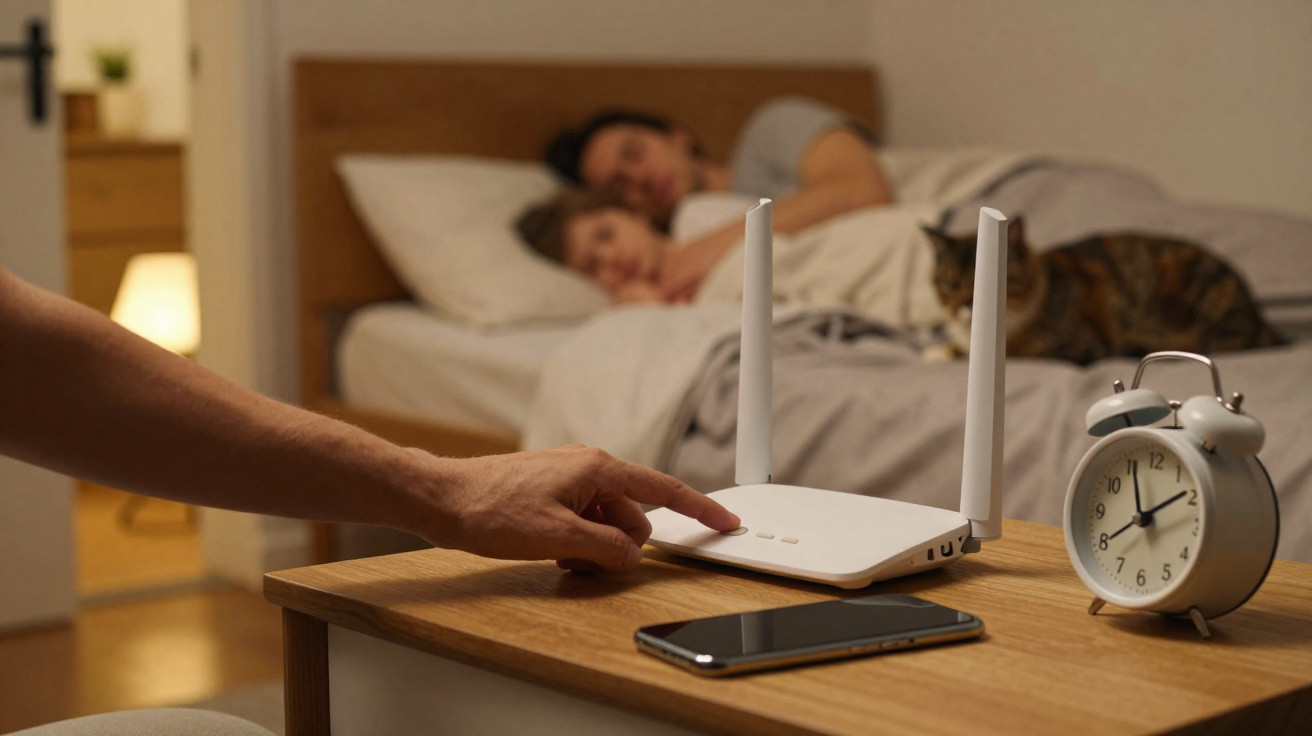
By the evening, when all you want to do is collapse onto the pillow, the router in the hallway is rarely on your mind. The wireless network simply keeps running, night after night. Yet a growing number of specialists are questioning this assumption. They advise deliberately switching off Wi-Fi overnight – for health reasons, calmer sleep and even a little extra money in your pocket.
Why Wi-Fi in the bedroom may be a problem
People are not designed to be digitally available 24 hours a day. Our bodies follow what is known as the circadian rhythm: an internal clock that regulates sleeping and waking. Light, sound and the technology around us can all affect this rhythm.
Wi-Fi routers transmit radio waves continuously. Although these signals are weak and far below legal exposure limits, sleep specialists and environmental medicine practitioners regularly urge greater caution. They point to indications that constant radio-frequency exposure may disrupt sleep, particularly when routers and connected devices sit directly beside the bed or headboard.
Switching off the wireless network at night creates a calmer environment for the brain and nervous system – at least offering a few hours of genuine offline time.
Research remains inconclusive in many respects. There is no definite figure for the level of radiation at which sleep is guaranteed to suffer. Even so, individual studies and personal reports suggest that people often sleep better when less technology is active in the room and Wi-Fi takes a break overnight.
How radio waves could affect the sleep cycle
Radio waves are suspected of altering subtle processes in the body. One topic under discussion is whether they can affect the release of melatonin, the “sleep hormone”. When the internal clock is disrupted, common consequences can include:
- taking longer to fall asleep
- waking repeatedly during the night
- light, insufficiently restorative sleep
- daytime tiredness and difficulty concentrating
The reality is that many people sleep in rooms crowded with routers, repeaters, Bluetooth speakers, smart TVs and several smartphones. All of them transmit signals at the same time. Consciously cutting back can reduce the strain on the body, even if the exact effect of each individual radio source is difficult to measure.
Save electricity with one click: what it really achieves
Health is one consideration; the electricity bill is another. A router running around the clock typically uses between 5 and 10 watts. That may sound insignificant, but it is still charged for 365 days a year.
Turning the device off for eight hours each night reduces its operating time by one third of the day. Depending on the model, a typical router can save roughly 2 to 3 kilowatt-hours each month. Over a year, that amounts to a single-digit or low double-digit sum in pounds – not a fortune, but certainly not nothing.
Turning off Wi-Fi overnight will not save a huge amount, but it fits perfectly into a lifestyle where electricity is used more consciously.
The household’s “silent” electricity users
The router represents a wider issue: so-called hidden or phantom electricity use. These are devices that appear to be off but continue consuming power:
- televisions and games consoles left on standby
- plug-in radios, smart speakers and set-top boxes
- chargers left plugged into the socket
- printers that are never fully switched off
In some homes, these always-on consumers account for a double-digit percentage of the annual bill. Switching off Wi-Fi at night often prompts people to consider other devices too – and the combined saving can be considerably greater than the router’s contribution alone.
Establishing a new evening routine in just a few days
Many people resist changing their habits because it seems complicated. With a router, however, all that is needed is a straightforward routine. After one or two weeks, it becomes almost automatic, much like brushing your teeth.
Practical ways to stop Wi-Fi every evening
There are several ways to introduce a night mode for your home internet connection:
- Use a switched socket: Plug the router into a basic socket with an on/off switch, turn it off briefly in the evening and back on in the morning.
- Fit a timer switch: An analogue or digital timer can automatically disconnect the router from the mains every evening.
- Set a router schedule: Many devices include time profiles in their settings, allowing Wi-Fi transmission to pause overnight as standard.
- Set a phone reminder: For the simplest approach, create a regular alarm reminder on your smartphone.
It can feel unfamiliar at first, especially if you normally stream programmes or browse social media just before bed. After a few days, media use usually shifts slightly earlier without much effort. For many users, switching off becomes a consciously recognised signal: the day is over.
Less radio-frequency exposure for children, babies and pets
This is particularly relevant in households with children. Parents often already use blue-light filters, limit phone use and keep tablets out of children’s bedrooms. Muting the router overnight is a useful addition to these protective measures.
Children’s bodies respond more sensitively to stimuli, while their nervous systems are still developing. Scientific studies are ongoing, but many doctors recommend the same principle for radio waves: as little as is reasonably possible. The same applies to babies, who often sleep in the same room for several hours at a time, and to pets that favour resting near extension leads or routers.
Anyone who disconnects Wi-Fi overnight reduces radio-frequency exposure for everyone living under the same roof – without much effort or loss of comfort.
What users should consider before switching off
The step should not be taken without thought. A few points need attention:
- Do smart smoke alarms or security systems use your home Wi-Fi? If so, a solution with mobile-network backup or a separate network is required.
- Some smart-home systems control heating or blinds overnight. Check their settings to establish whether the router truly needs to run continuously.
- Anyone working night shifts or on call should confirm that all essential devices can operate through the mobile network.
In many households, these questions can be dealt with quickly. Most devices often use mobile data anyway, or are not as closely dependent on Wi-Fi as people assume.
Digital detox: why offline time benefits mental wellbeing
Beyond radio waves and the electricity bill, switching off has another effect that is harder to quantify: psychological distance. When people know that no new messages, emails or push notifications can arrive through the home Wi-Fi overnight, they generally put their smartphone down sooner.
The brain then leaves its state of “constant readiness”. Sleep experts repeatedly report that this moment of switching off is particularly important for restful nights. Whether Wi-Fi is on or off, making a deliberate decision to draw a line under the evening sends a clear message to both body and mind.
How one small button press can change daily life
Creating an evening ritual around switching off the router can trigger more change than you might expect. Those who begin deliberately ending their internet connection often question other habits too: Does the phone really need to come to bed? Is a television needed in the bedroom? Would an e-reader in flight mode be enough?
Gradually, the evening can become a little more analogue – with a book, conversation, a board game or simply more peace and quiet. Electricity use falls, radio-frequency exposure in the home decreases, and sleep has a better chance of becoming genuinely restorative. The effort remains minimal: one movement, one button press or a small timer switch.

















Comments
No comments yet. Be the first to comment!
Leave a Comment