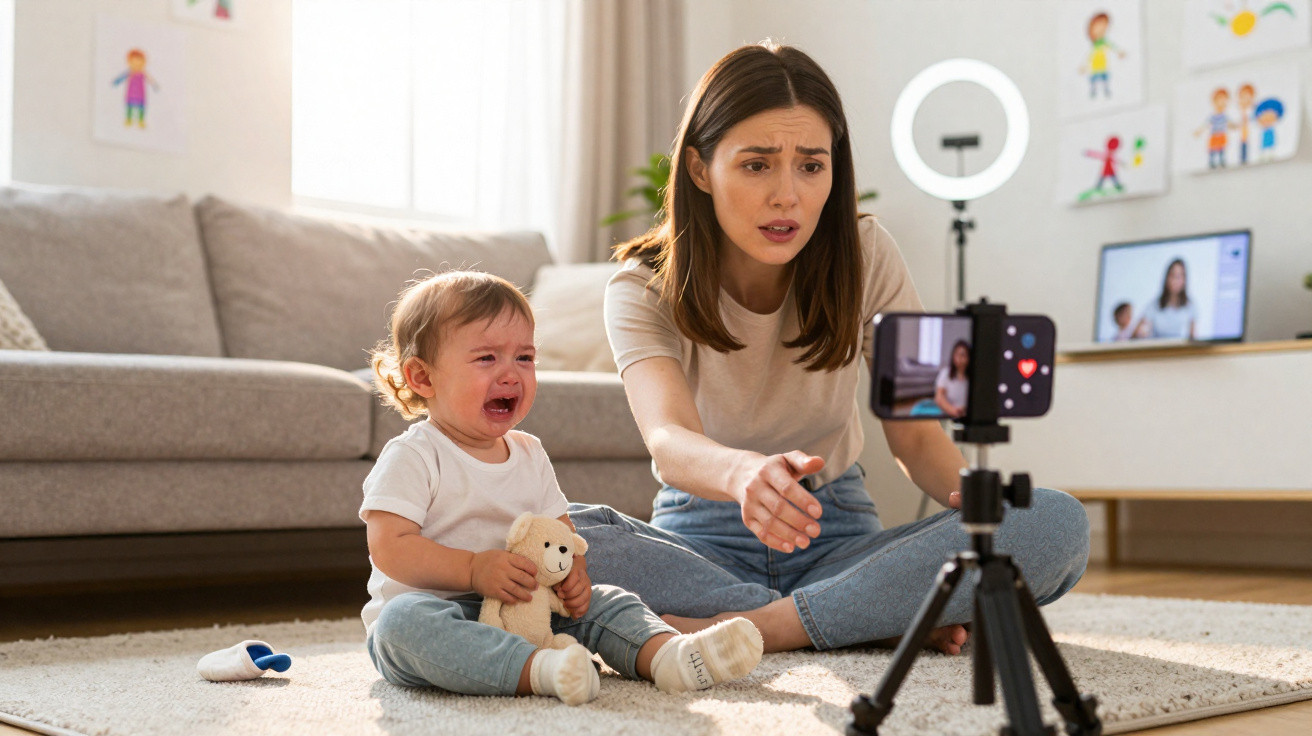
The footage opens halfway through a scream. A small boy, perhaps three years old, lies on the kitchen floor in Spider-Man pyjamas, his face flushed as he catches his breath between sobs. His mother raises her phone above the scene and narrates the turmoil. “This is tantrum number three today,” she sighs, sounding equally amused and worn out. The video is unpolished, unsteady and strangely personal. Within a few hours, it has drawn millions of views, waves of comments and several brand reposts. By nightfall, the boy’s distress has been stitched, turned into memes and remixed with comic sound effects.
The following morning, he wakes up in a world where strangers already know that yesterday was “his worst day.”
All he wanted was one more biscuit.
We describe it as honest parenting content.
Some would call it something much nearer to betrayal.
When your child’s worst moments become your best-performing content
Spend time scrolling parenting TikTok or Instagram Reels and a clear trend emerges: the most unvarnished clips get the strongest numbers. A toddler yelling from a car seat. A nursery-age child crying in a supermarket aisle. A child trembling with rage as their parent murmurs to the camera, “Stay-at-home mom life, you guys.” These videos seem authentic and unfiltered-the complete opposite of the polished, picture-perfect family scenes many of us saw in magazines growing up.
For an exhausted parent endlessly scrolling at 11 p.m., they can feel comforting and confronting in equal measure.
Consider an influencer mum-call her Jenna-whose audience grew rapidly when she started posting every meltdown involving her four-year-old daughter. In one viral reel, the child screams after being told she cannot have a second ice cream. Its caption says: “Gentle parenting is so fun!!!” followed by three crying-laughing emojis. Two million views. Twenty thousand comments. A brand partnership the following week.
Her audience applauds the openness. More quietly, others wonder whether the girl ever consented to becoming the face of “tantrum content.”
Algorithms thrive on extremes. Peaceful mornings, quiet play and children reading on the sofa tend to drift along unnoticed. Major surges come from disorder: doors being slammed, tear-and-snot-covered faces, children shouting “I hate you” into the camera. Viewed purely as digital strategy, the logic is harsh but straightforward: drama brings reach. Reach brings money. That calculation exists on one side of the screen.
On the other is a very small person who cannot yet spell “privacy”, never mind insist upon it.
Drawing the line when you live, and earn, online
For parents whose income depends on sharing their lives, the divide between “sharing” and “selling” may become unclear very quickly. A useful first step is a simple thought experiment: would I be comfortable if this exact video were shown on a screen in my child’s classroom five years from now? If the answer brings a deep, sick feeling, it should not be made public.
Another practical approach is to postpone posting. Film the incident if you feel you must, but then put your phone away. Look at the footage again once everybody is calm. Intense emotion can look very different in the clear light of the following day.
Many parents press record before thinking, then find themselves editing a reel while their child is still crying outside the frame. It is not necessarily cruelty; often, it is exhaustion and routine. Reaching for the phone becomes automatic. A small but meaningful change is to set personal limits: no faces during major meltdowns, no filming in bedrooms or bathrooms, and no posts about embarrassing accidents.
Honestly, no one manages this perfectly every day. Yet even one or two firm limits can do more to preserve a child’s dignity than any hashtag ever could.
Parenting psychologist Livia Rahman told me, “Kids don’t just remember that they cried. They remember who was holding them, and who was holding a phone.”
- Ask consent when possible
When children are able to understand, offer them a genuine choice about being filmed or posted online-and accept “no” without trying to persuade them. - Use delayed storytelling
Wait for weeks or months, alter identifying details and share what you learned without tying the story to a single recognisable, vulnerable incident. - Keep the worst off the internet
Night terrors, medical events, intense crying about divorce or death-these should remain private rather than appearing on a For You page. - Build “offline-only” memories
Protect certain places and occasions-bedtime, family meals and school events-where phones do not enter the picture. - Audit your feed regularly
Review your posts as though you were your future teenager rather than your current follower total, and quietly remove anything that now feels wrong.
The quiet cost we won’t see until these kids grow up
There is a reason so many people in their twenties speak of “digital footprints” as though they are a burden. They grew up putting their own awkward years online. Children of today’s influencers often had no such decision to make. Their most exposed outbursts, battles for control and breakdowns can become searchable material before they can read.
We still do not fully understand the impact of a generation arriving at secondary school with a catalogue of viral meltdowns already following them.
| Key point | Detail | Value for the reader |
|---|---|---|
| Emotional safety beats engagement | Deciding not to film or publish a child’s breakdown safeguards long-term trust | Helps parents put relationships before reach |
| Boundaries can be simple | Rules such as “no filming during tears” or “no posting from bedrooms” are straightforward to use | Provides clear, realistic guidance for everyday life |
| Future perspective matters | Picturing your child watching these videos as a teenager changes what seems appropriate to share | Supports considered, future-proof content decisions |
FAQ:
- Question 1 Is it always wrong to film my child’s tantrum?
- Answer 1 Not necessarily. Brief filming to show a partner, therapist or to consider your own response may be useful. The ethical boundary is often crossed when those clips leave the private circle and become entertainment for strangers.
- Question 2 What if sharing my struggles online genuinely helps my mental health?
- Answer 2 Being open about the difficulty of parenting can be a lifeline. The key is centering your feelings, not your child’s distress. Speak about your tiredness, frustration and learning curve, using images or moments that do not expose your child at their most vulnerable.
- Question 3 Can I ever monetize family life ethically?
- Answer 3 Yes. Some creators manage this with firm safeguards: limited time on screen for children, shared earnings for older children who appear regularly, and strict “no post” rules for sensitive matters such as school difficulties, health or discipline.
- Question 4 My past posts cross a line. What do I do now?
- Answer 4 Begin by quietly archiving or deleting anything that seems exploitative. If your child is old enough, you can later discuss it with them, explain that you have changed your approach and give them control over their future online presence.
- Question 5 Isn’t this just what modern parenting looks like?
- Answer 5 Online sharing is now part of life for many families, yes. But the blunt question beneath it is: are we documenting our children, or are we using them? Facing that tension honestly is part of parenting in the era of the front-facing camera.

















Comments
No comments yet. Be the first to comment!
Leave a Comment