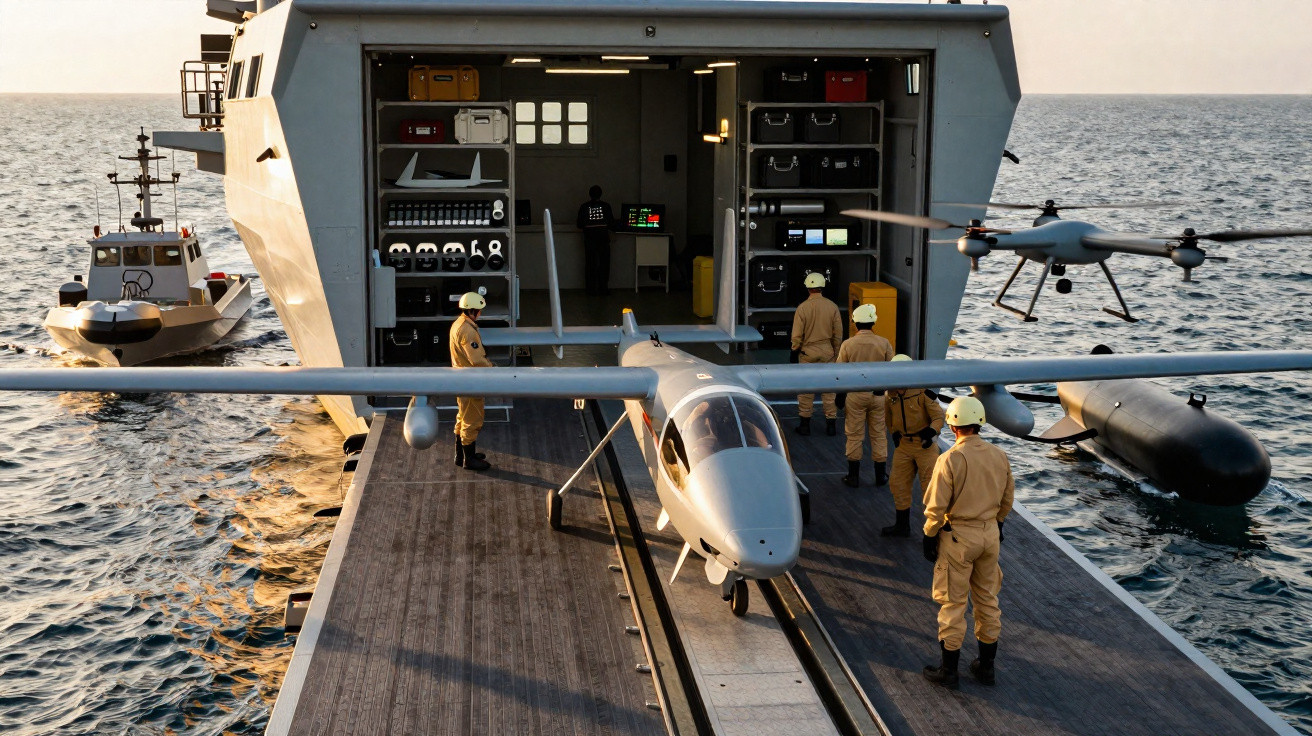
The NRPD João II is a compact carrier purpose-built for drones and is poised to represent a major shift for European naval forces. Constructed in Portugal by the Dutch shipbuilder Damen, it is expected to provide Portugal – and NATO – with a maritime test platform for unmanned operations that, until now, have largely remained on drawing boards and PowerPoint slides.
A compact carrier for drones rather than jets
Although much smaller than a traditional aircraft carrier, the João II has a layout unmistakably influenced by one. It will be about 108 metres long, while its 94-metre flight deck extends across almost the full length of the hull. Rather than operating fast jets, the deck has been planned for fixed-wing drones, rotary-wing drones and possibly vertical-take-off unmanned aircraft.
The João II trades catapults and arrestor wires for modular launch pads, data links, and hangars full of unmanned systems.
Beneath and aft of the extended deck is a hangar space where drones can be assembled, armed and serviced before returning to flight. A stern ramp leads straight into the sea, enabling personnel to deploy and retrieve surface drones and underwater vehicles even in comparatively rough seas.
Its purpose is straightforward: instead of serving as a floating airfield for crewed aircraft, it will function as a seaborne technology platform for sensors, algorithms and remote operators.
Why Portugal is investing in a drone carrier
Portugal oversees a huge area of the Atlantic, encompassing the Azores and Madeira archipelagos, as well as extensive coastlines requiring observation. This creates an ongoing demand for patrols, surveillance and search-and-rescue operations. However, Portugal has a limited defence budget, while large warships and crewed aircraft are costly to run.
A ship centred on drones presents another approach: maintaining a comparatively small complement at sea while deploying unmanned vehicles for hazardous, repetitive or long-duration tasks.
- Long-range maritime patrols without requiring crewed aircraft to remain airborne for hours
- Continuous tracking of smuggling craft or suspect vessels
- Environmental surveillance, including illegal fishing and pollution
- Support for NATO exercises and multinational task groups
For Portugal, operating Europe’s first fully dedicated drone carrier also sends a political message. It demonstrates that smaller navies can pioneer emerging concepts instead of merely purchasing reduced versions of vessels used by major powers.
Inside the unmanned systems warship
Aerial, surface and underwater drones from one deck
Early descriptions of the concept suggest that the João II will be able to operate several types of unmanned system simultaneously. Vertical-take-off drones on the flight deck could deliver surveillance, relay communications or even serve as decoys. Smaller quadcopters could undertake close-range inspections of vessels or coastal locations.
The stern ramp has been designed for unmanned surface vessels (USVs): small, high-speed boats able to carry cameras, radar, sonar or mine-hunting equipment. Unmanned underwater vehicles (UUVs) can also be launched alongside them to conduct discreet seabed surveys or inspect cables.
The stern ramp effectively turns the ship into a mother vessel for robotic boats and submarines, extending its reach far beyond the horizon and below the waves.
Every one of these machines requires control consoles, antennas and data-processing centres. Much of the João II’s real capability will therefore be housed in its operations spaces, rather than its weapons lockers.
Possible roles in peace and conflict
The Portuguese Navy has not publicly set out every intended mission, but several potential applications are broadly expected:
| Mission type | Role of drones |
|---|---|
| Maritime security | Follow suspicious shipping, assist boarding operations, observe chokepoints |
| Search and rescue | Rapidly search wide areas, deploy life rafts or guidance beacons |
| Environmental patrol | Identify oil spills, track fish stocks, survey protected zones |
| Mine countermeasures | Deploy USVs and UUVs to find and neutralise mines at a safe distance |
| Wartime operations | Supply targeting information, electronic warfare support and decoys |
Given its modest size, the vessel is likely to concentrate on sensing and support instead of major strike tasks. Nevertheless, information can be more valuable than firepower, particularly in congested waters.
Europe’s broader move towards unmanned navies
Portugal is not the only country examining unmanned ships and aircraft, but the João II takes the trend further. Rather than adding a small number of drones to a conventional frigate, its design begins with the premise that most off-board systems will be uncrewed.
Other European navies are conducting their own experiments. The UK has trialled drone mothership concepts, while France and Italy are deploying unmanned mine-hunting systems. The Baltic states make extensive use of small unmanned surveillance platforms. Even so, one named naval vessel identified as a “drone carrier” gives the concept a different level of prominence.
The João II acts as a floating laboratory where NATO partners can train, plug in their own drones, and test tactics that are difficult to trial from land.
This is significant when the war in Ukraine has demonstrated the effect of maritime drones, ranging from explosive surface craft in the Black Sea to inexpensive quadcopters locating artillery targets on land.
Risks, constraints and ethical questions
A vessel packed with drones creates fresh advantages, but it also introduces evident weaknesses. Unmanned systems rely heavily on GPS and data links. In a contested setting, these signals may be jammed, spoofed or hacked. The ship consequently needs strong electronic protection and alternative means of navigation.
Human considerations are important too. Operators will need to control several airborne and seaborne robots at the same time, each transmitting radar, video and telemetry information. Information overload is a genuine danger, and training standards will determine how safely and efficiently the vessel is operated.
Ethical concerns are also close at hand. Portugal has stressed surveillance and support missions, but the same framework could accommodate armed drones later on. That prompts questions of accountability where lethal decisions are increasingly shaped by algorithms and remote operators rather than sailors on the deck.
How a drone carrier transforms everyday naval operations
On a conventional patrol ship, time at sea commonly consists of lengthy transits followed by brief periods of action when radar detects something. A drone carrier changes that rhythm. Personnel could keep unmanned aircraft circling slowly around the vessel, extending their view for dozens of miles. Surface drones could spread across shipping lanes and transmit identification data back to the ship.
During a crisis, the drone carrier could remain beyond the horizon as unmanned boats close on an unidentified vessel, reducing the likelihood of a direct encounter. Where a ship is releasing oil, airborne drones could chart the spill as underwater vehicles examine the hull for damage.
This layered form of presence alters how often a navy must deploy several crewed ships to monitor the same area. It also enables mixed formations, with a conventional frigate supplying protection and heavy armament while the João II operates beside it as a sensor hub.
Key concepts to clarify
A number of technical terms underpin the João II project:
- Unmanned aerial vehicle (UAV): An aircraft with no pilot on board, operated remotely or following a pre-programmed route.
- Unmanned surface vessel (USV): A small craft that travels on the surface and generally carries cameras, radar or other sensors.
- Unmanned underwater vehicle (UUV): A robotic submarine capable of surveying the seabed, examining cables or looking for mines.
- Mother ship: A larger vessel that carries, launches, recovers and maintains smaller craft or drones.
In practical terms, the João II is a mother ship designed around these unmanned assets from the keel upwards, rather than being an adaptation of an existing hull. This design approach is what distinguishes it and makes it a point of reference for future naval planners in London, Washington and Brussels.
















Comments
No comments yet. Be the first to comment!
Leave a Comment