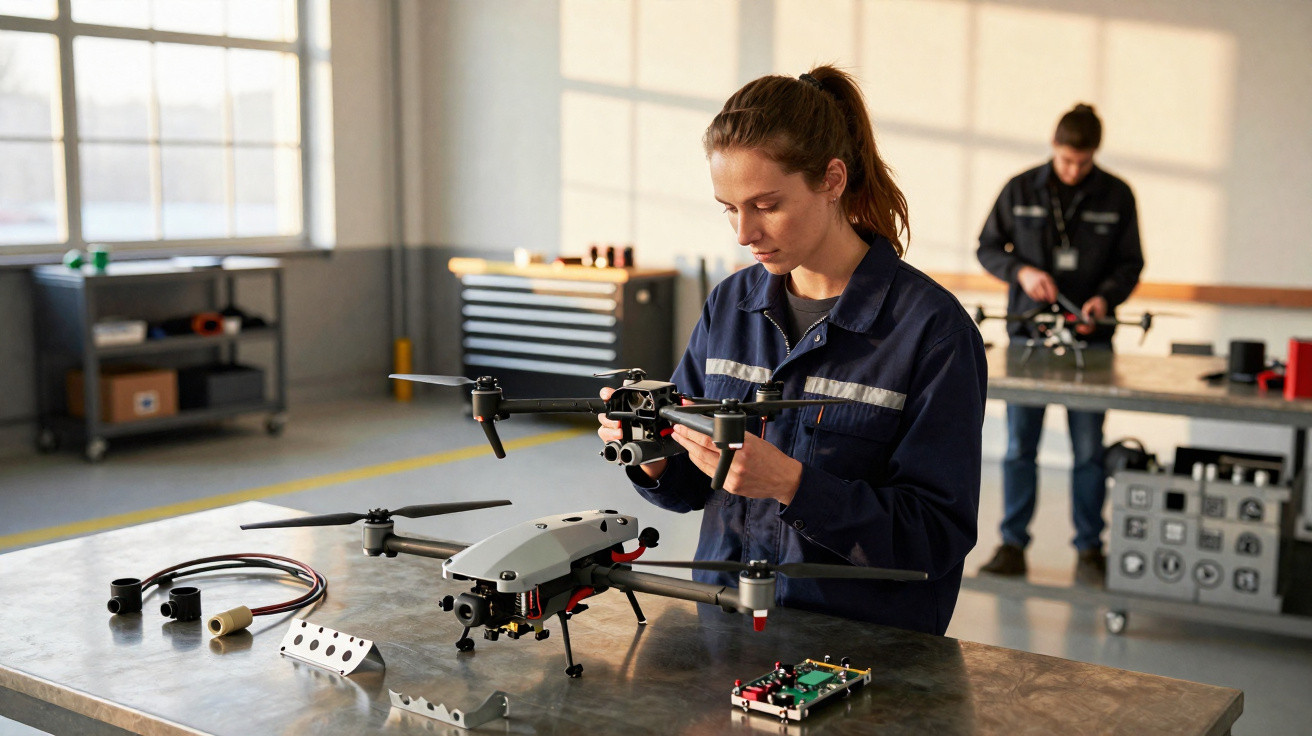
France is scrambling to create a genuine combat-drone sector as Ukraine consumes thousands of drones every month. To close the gap, it is taking inspiration from Silicon Valley as well as automotive production lines.
From laggard to late sprint: France’s drone awakening
For many years, France depended on a small number of costly surveillance drones alongside conventional fighter aircraft. Russia’s war against Ukraine has upended that approach.
Russian troops now deploy swarms of Iranian-designed Shahed drones, assembled in Russia and manufactured on an industrial scale. Their purpose is volume rather than sophistication: striking electricity networks, saturating air defences and wearing away Ukraine’s economy.
Cheap, expendable drones have turned into a strategic weapon, not just a gadget for special forces or intelligence units.
French officials have followed this change with increasing concern. If a medium-sized European armed force such as Ukraine requires tens of thousands of drones every month simply to maintain its positions, France would need comparable quantities in a future high-intensity conflict.
That conclusion is forcing Paris to look beyond specialist prototypes and regard drones as munitions to be manufactured in thousands rather than dozens.
What a military drone really is - and why it’s so easy to build
Despite the military terminology, a drone is fundamentally straightforward: an unmanned vehicle with motors, electronics and a control connection. Its real capability comes from the equipment attached to it.
As one French start-up chief puts it, a basic airframe can be produced in a day using a 3D printer and open-source designs. The difficult element is the “payload” - the functional equipment that transforms a flying toy into either a weapon or a sensor platform.
The payload: where the value sits
- Eyes: electro-optical and infrared cameras, compact radars and laser rangefinders.
- Ears: antennas that capture enemy communications or identify radar emissions.
- Brain: navigation and guidance software, plus AI for recognising targets or flying autonomously.
- Fist: explosives for one-way “kamikaze” attacks, or interceptors intended to collide with hostile drones.
- Jammer: electronic-warfare equipment that disrupts GPS or communications within a defined area.
Every configuration serves a distinct purpose, ranging from spotting for artillery to long-range strikes on fuel facilities hundreds of kilometres away.
The same plastic frame can be a flying camera one day and a precision loitering munition the next, depending on what you screw underneath.
Ukraine as a live-fire laboratory
Ukraine has become a proving ground for this emerging form of warfare. The Russian attacks that recently left more than a million Kyiv residents without power depended heavily on large numbers of Shahed drones, frequently launched in combination with ballistic missiles.
The objective of this combination is straightforward: to overwhelm Ukrainian defences. Advanced surface-to-air missiles can bring down a drone, but using a missile worth hundreds of thousands of pounds against a target that costs a few hundred is hard to justify.
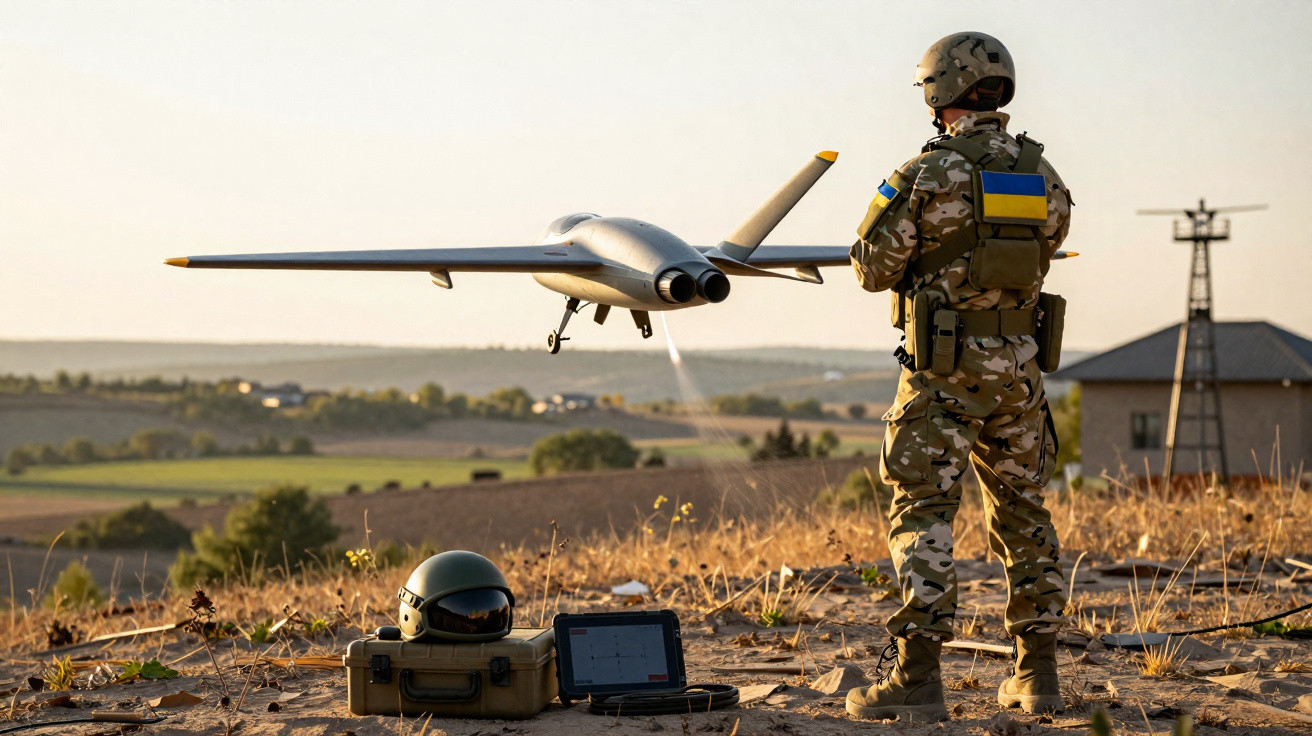
Kyiv’s response has been to deploy its own fleets of inexpensive interceptor drones. Rather than consume scarce missiles, Ukrainian forces are increasingly seeking to destroy incoming drones with drones of their own.
Start-ups with French connections are closely involved in this development. One business established in Ukraine but supported from France equips interceptor drones with software which, its executives say, raises the interception rate from about 30% to 65%, aiming for 85% - broadly comparable with high-end systems such as the US Patriot in ideal conditions.
The volume involved is extraordinary. Ukrainian officials and industry sources cite demand for around 20,000 drones each month across every category: reconnaissance, kamikaze, interceptor and specialist electronic-warfare platforms.
| Type of drone | Main role in Ukraine | Key feature |
|---|---|---|
| Shahed-type attack drone | Large-scale strikes on infrastructure | Low-cost, long-range and deployed in swarms |
| FPV kamikaze drone | Precision attacks at the front line | First-person view and operated like a video game |
| Interceptor drone | Destroying hostile drones | Fast and manoeuvrable, often directed by AI-assisted software |
| EW (electronic warfare) drone | Disrupting GPS and communications | Uses compact jammers rather than explosives |
For France, Ukraine has offered both a warning and valuable evidence: what fails, what succeeds, which software upgrades count, and how quickly units can adapt when new drones emerge every few weeks.
Paris–Kyiv axis: from symbolic support to joint production
The political message was delivered in late 2025, when Emmanuel Macron and Volodymyr Zelensky attended the first Franco-Ukrainian forum dedicated to joint drone manufacturing.
Before that point, French support had largely centred on artillery, air defence and training. The forum signalled a new direction: Paris wants French companies to do more than supply equipment, instead jointly developing and producing it with Ukrainian partners in Ukraine.
The goal is to help Ukraine move from improvisation to an industrial tempo - and bring those lessons back into French factories.
For start-ups including Alta Ares, and established defence firms such as Turgis & Gaillard - whose Aarok combat drone attracted notice at the Paris Air Show - Ukraine provides battlefield feedback as well as an unforgiving test of performance. If a design cannot survive there, it is unlikely to perform in a future European war.
Automotive know-how: the unlikely backbone of French drone mass-production
One striking feature of France’s drone drive is the source of much of its manufacturing expertise: the motor industry.
Car factories already understand how to manufacture complex, safety-critical goods in large quantities while exercising severe control over costs. Those capabilities are highly transferable to drone production.
What carmakers bring to the drone table
- Assembly-line discipline: modular manufacturing, standardised components and strict quality control.
- Supply-chain muscle: access to a worldwide network for electronics, batteries and composites.
- Cost engineering: reducing the cost of every unit to ensure mass deployment remains affordable.
- Battery and electric-motor expertise: vital for small and medium-sized tactical drones.
French defence officials are now actively seeking partnerships with carmakers and their suppliers, advocating blended production lines that combine military-grade drones with civilian components. The intention is to make drones a reproducible product rather than a hand-built prototype.
France’s new drone ecosystem: from start-ups to heavyweights
The outcome is a rapidly expanding but somewhat disordered ecosystem.
At one end, small companies are testing 3D-printed airframes, bespoke software and specialised functions such as counter-drone interception or GPS spoofing. At the other, established defence groups are developing larger and more capable systems, including MALE (medium-altitude, long-endurance) drones and heavy combat drones intended to operate alongside Rafale jets.
The strategic bet is that a mix of “high” platforms and “low” disposable systems will offer France both staying power and flexibility on future battlefields.
Important arguments are now taking place within the French defence ministry and parliament. How much funding should be allocated to sophisticated, durable drones, and how much to inexpensive expendable systems? How can France reduce reliance on foreign parts, particularly Chinese electronics, without sending costs soaring?
Risks, trade-offs and what this means for future wars
A major shift towards combat drones also creates a range of difficulties.
Technically, drones’ heavy dependence on GPS and radio connections leaves them exposed to jamming. Russia and Ukraine are both continually experimenting with methods of blinding or taking control of opposing systems. This is steering French engineers towards greater navigational autonomy, onboard computing and resilient communications - all of which increase expense and complexity.
Armed drones also pose ethical and legal issues concerning targeting, responsibility and escalation. France states that humans will remain firmly “in the loop” when lethal choices are made, yet the boundary between software assisting human judgement and replacing it will become less clear as such systems improve.
There is a proliferation danger too. Once factories are producing cheap, effective combat drones at scale, preventing the technology from reaching hostile actors becomes far more difficult than it is for a limited number of advanced fighter aircraft or missiles.
Key terms worth clarifying
Two ideas are now central to French drone thinking:
- Loitering munition: a one-way drone able to circle above an area before diving onto a target, combining characteristics of a missile and a UAV.
- Swarm: multiple drones working together, sometimes semi-autonomously, to overload defences or confuse radar systems. France has only recently begun serious experimentation in this field.
Analysts in Paris are increasingly considering crisis scenarios in which French troops have to protect overseas bases or European infrastructure from mass drone attacks resembling those seen above Kyiv. In these simulations, a state unable to deploy its own cheap interceptor and offensive drones could be outmanoeuvred despite possessing advanced jets and frigates.
The transformation now in progress - driven by Ukraine’s experience and fresh links with carmakers and start-ups - seeks to prevent that result. Whether France can expand production quickly enough, and at a cost acceptable to taxpayers, will influence not only its own security but also Europe’s capacity to manage the drone age.















Comments
No comments yet. Be the first to comment!
Leave a Comment