
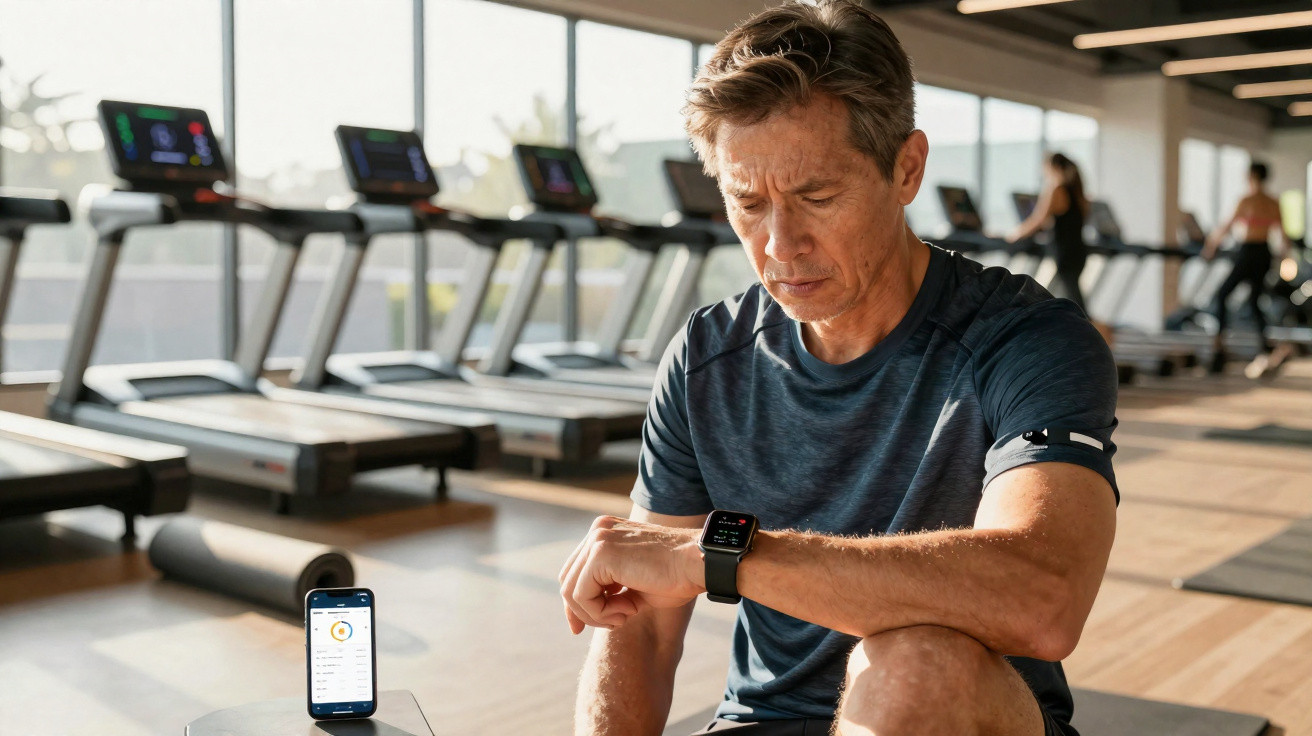
The person on the treadmill beside you keeps checking his watch. Heart rate, pace, calories burnt - another figure lights up every second. His breathing has the hushed sound of an engine close to cutting out, yet he increases the speed when his smartwatch vibrates. You ease off, though, not because a device instructed you to, but because your chest feels tight and your legs weigh more than they did yesterday.
On the way home, your phone serves up a report: steps, sleep score and productivity streak. The figures look “good”, but you feel oddly depleted. Alert yet exhausted. You flick through the graphs, looking for an explanation your body had already offered hours earlier.
Somewhere in the space between data and discomfort, a quiet question emerges.
When performance numbers drown out body whispers
Step into almost any gym today and there is an understated chorus of devices: beeps, buzzes and soft vibrations from wrists and chests. People look down halfway through a squat, a breath, or simply their day. They are not asking, “How do I feel?” but, “What does my watch say?” That subtle change affects everything. The body becomes something to optimise rather than a partner worth listening to.
Most of us know that moment: the tracker announces “Great job!” while your body is saying “Please stop.” Strangely, we often place more faith in the score than in the heaviness in our lungs or the knot in our stomach. Eventually, that disconnect can start to feel normal.
A runner I interviewed last year described it plainly. She progressed from weekend runs to preparing for her first marathon, encouraged by a stylish GPS watch and an app that praised her every day. Initially, she enjoyed it: her pace improved, her weekly mileage rose, and the bars and lines kept climbing. Then there were mornings when her knees hurt before she had even left the bed.
Because the app showed her in the green zone, she told herself she was “just being lazy”. She dismissed a sharp pain in her hip, ran “just five more kilometers”, and continued because that was what her training plan required. A fortnight later, she was on the sofa with a stress fracture, scrolling through old statistics as though they belonged to another person. The data had never been better. Her body had never been worse.
The process is both straightforward and deceptive. Numbers appear objective, tidy and almost moral, whereas feelings can seem untidy and untrustworthy. Gradually, we hand our decisions over to screens. If the watch gives us a sleep score of 92, we question the dense fog behind our eyes. If an app calls it a “high productivity” day, we suppress the quiet dread in our chest. But performance data can only recognise what it measures; your body knows everything beyond that.
Pain, tension, sudden tiredness and an unusual sense of resistance before a task are not system faults. They are feedback loops shaped by years of lived experience. When we silence them merely to meet a target or close a ring, we are not showing discipline. We are overriding our own survival software.
How to tune back into your body’s language
Begin more simply than you might expect. Before opening your fitness app or checking your diary, stop for 30 seconds. Truly, 30. Sit or stand, shut your eyes if possible, and scan your body from forehead to toes. Put three straightforward questions to yourself: Where does it hurt? Where does it feel tight? Where does it feel unexpectedly okay?
Do not attempt to solve anything at that point. Only notice. Repeating this brief check-in every day begins to restore a conversation you may have left behind years ago. In time, patterns become clearer: the dull ache in your shoulder during stressful weeks, or lighter legs after a genuine rest day. This is body literacy, and it quietly guards against the most damaging forms of self-sabotage.
A further practical step is to grant your body “veto power” over the plan. Perhaps you have a demanding workout or a major push at work scheduled. Before starting, score how you feel from 1 to 10 - not your mood, but your physical readiness. At 7 or above, proceed as planned. Between 4 and 6, reduce the intensity rather than abandoning the commitment. Below 4? Move into maintenance mode only: walk, stretch, do the minimum and rest.
To be honest, no one follows this approach every day without fail. Even so, applying it a few times each week can stop the quiet drift towards burnout. It shifts your thinking from “follow the plan at all costs” to “follow the plan in partnership with my body.”
“The body keeps the score,” wrote psychiatrist Bessel van der Kolk about trauma. You don’t need to have gone through something dramatic for that sentence to ring true. Every late night, skipped meal, rushed workout and swallowed emotion shows up somewhere - in your neck, your jaw, your gut. Listening is not some fluffy wellness trend. It’s basic maintenance of your only home.
- Micro-pauses during the day - take 3 breaths before opening emails, or notice your feet against the floor during a call.
- Replace “Can I push harder?” with “What would feel sustainable today?”
- Tracking signals, not just stats - note pain, tension, energy and digestion alongside your steps or sets.
- Allow a rest day to remain a rest day, even when your watch prompts you to “move more.”
- Accepting that some days your best is simply not making things worse.
Beyond metrics: choosing a different kind of progress
Sooner or later, most of us recognise that charts will never be content. Reach one goal and a new one appears: faster, leaner, more productive, more “optimized”. Yet the friends you privately admire - those who seem steady and unusually alive - often use an entirely different measure. They ask: Can I hear myself? Can I honour what my body is telling me, even when the world rewards me for ignoring it?
That change does not occur overnight. It is made up of small, nearly unremarkable choices: leaving a party when your social battery is empty instead of forcing three more drinks; ending a run partway through because your ankle twinges; taking a nap rather than making your exhaustion into an Instagram joke. On paper, it may appear less impressive. In real life, it is much kinder.
Listening to your body over your performance metrics is not about doing less; it’s about doing what actually sustains you. On some days, that involves giving more than you believed you could. On others, it means shutting the laptop at 3 p.m. and going outdoors. Both may count as wins. Both may be progress. Only one person, however, gets to experience the difference from within.
| Key point | Detail | Value for the reader |
|---|---|---|
| Body signals are real data | Pain, fatigue, tension and ease provide information rather than being annoyances | Helps avoid injury, burnout and emotional overload |
| Simple daily check-ins | 30-second scans, readiness ratings and micro-pauses during the day | Makes body awareness practical and achievable in busy lives |
| Redefining “progress” | Moving attention from perfect statistics to sustainable energy and well-being | Supports long-term health rather than brief periods of performance |













Comments
No comments yet. Be the first to comment!
Leave a Comment